

"This is a positive signal." Work has begun on transforming the area around the Oqsaroy residence in Tashkent into an open public park (photo)
Work has begun on transforming the area around the Oqsaroy residence in Tashkent into a public park: fences are being removed these days. Experts are calling this a 'positive signal' for increasing the number of open public spaces, but are also calling for more than just that. Newspaper report.
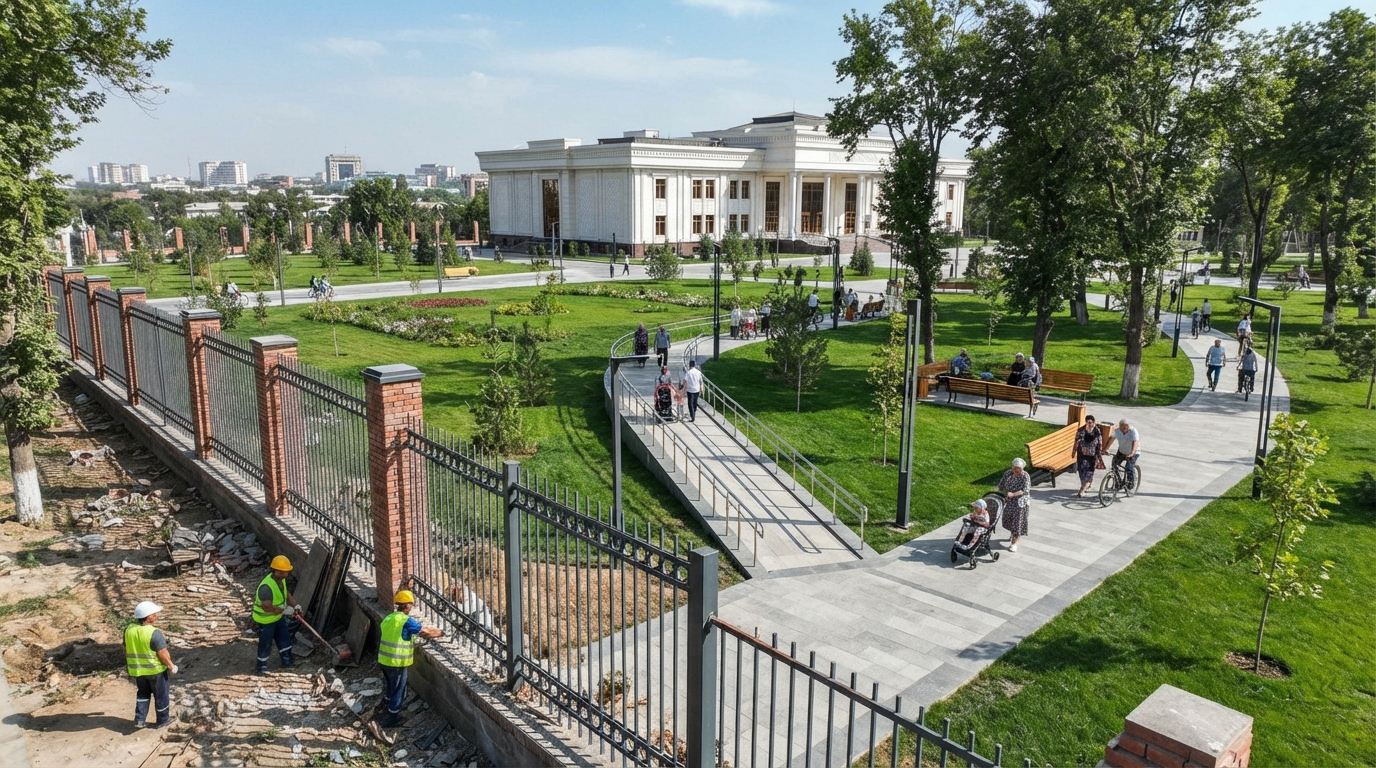
**"This is a positive signal." Work has begun on the construction of an open public park around the Oqsaroy residence in Tashkent (photo)**
Work has begun on the creation of an open public park on a 37-hectare area adjacent to the Oqsaroy residence, which was used as a permanent workplace by the first President of Uzbekistan Islam Karimov from 1999 to 2016. The newspaper correspondent covered this process and learned the opinions of experts.
At the end of July, the head of the presidential administration, Saida Mirziyoyeva, inspected several parks in the capital and got acquainted with projects aimed at improving them and making them more convenient for residents. At that time, she announced that the area around the Oqsaroy residence would be open to everyone. Ten days later, high fences were removed around the Scientific and Educational Memorial Complex named after Islam Karimov, and landscaping work began.
The press service of the Tashkent city administration informed Gazeta that the project involves comprehensive improvement of the territory, its adaptation to modern urban planning requirements and the needs of the population.
In particular, the barriers restricting access to the park will be dismantled, and convenient access paths and a network of interconnected pedestrian walkways will be built in their place. It is planned to create a barrier-free environment in the area for people with disabilities, the elderly, families with children, and visitors in strollers.
Attention will also be paid to preserving green areas, creating shaded walkways and quiet recreation areas. A modern lighting system, navigation and visitor safety devices will be installed in the park.
According to the administration, the project is part of a large-scale work aimed at improving the ecological situation in the capital, expanding green areas, and creating convenient public spaces on central streets and adjacent areas.
According to Azizkhon Shavkatov, Deputy Mayor of Tashkent for Tourism, Culture, Cultural Heritage and Mass Communications, work has begun to dismantle about 2 kilometers of barriers in the area. At the same time, a convenient infrastructure for visitors will be built.
According to him, 10 hectares of the park will be included in the "green route" of Tashkent, which will cover an area of about 700 hectares in the future. This route will connect Magic City, Anhor-Lokomotiv Park, Ecopark, Mirzo Ulugbek Central Park, Abdulla Qodiriy Park, the Center for Islamic Civilization and other public spaces.
"The "green route" refers to a single space where all parks in Tashkent are interconnected and people can freely move from one to another. "This is part of the five-year program for the development of the city," the deputy governor said.
He noted that no major construction work is planned in the area. The park will be built with walkways and recreation areas, benches will be installed, and sidewalks will be renovated based on existing sidewalks. "Not a single tree will be cut down," said Azizkhan Shavkatov.
Urbanist Iskandar Soliyev said that the removal of fences around the Oqsaroy residence and the opening of the area to the public is an important step towards the development of open public spaces in Tashkent.
"This is a very good sign. The opening of public spaces to the public and the removal of fences is a positive signal for residents. "A park should not only have attractions, but also areas where people can relax in peace," he says.
Soliyev notes that the city has very few parks and open spaces compared to the needs of the population, and their number has not increased. Therefore, people are forced to go out of town on weekends. "It is a very good practice to make the capital greener, connect green areas with each other, and organize long walking routes," says the urban planner.
According to Iskandar Soliyev, it is also of particular importance that these efforts began precisely in the Oqsaroy area. He emphasized that public places should be free of fences.
"Ecopark, Central Park or National Park - all of them should be open spaces that can be entered and exited from all sides. People use the park not only to relax, but also to move around the city. And fences hinder them. "Putting fences on the road or along the water is not the solution," says Iskandar Soliyev.
According to him, it is natural that the number of visitors to the Oksaroy Park will initially increase, but this will not exceed the level of an Ecopark or a Japanese garden. This situation shows that the city has a high need for such public areas.
"The history and context of Oksaroy should be better explained to people. You can show its two-century history, organize historical stands, plaques or a small museum. It is necessary to reveal information about the area through storytelling," he says.
According to Soliyev, changes should also be made to the management system so that such decisions do not become one-time initiatives.
"The first step is to reduce the verticality in the system. Now everyone is waiting for a signal from above. There should be horizontal management, people and experts should participate in the discussion of decisions. "If we don't change this system, it's difficult to achieve good results with such point changes," the urban planner says.
He notes that the future functions of the area should be determined through discussions between residents, experts, and the city government. At the same time, he notes that he is against the commercialization of such areas.
"Otherwise, shops, ice cream parlors, and other commercial facilities will come here. Public spaces are subsidized areas. Their preservation and development should be one of the main tasks of the city government," the urban planner says.
According to Soliyev, the area around Independence Square should also be fully opened in the future. "Shaded recreation areas can be organized there. "There are still enough such closed areas in Tashkent that could be opened to the public," says Iskandar Soliyev.
Architect Shukhrat Abdullayev noted that removing the fences around Oqsaroy could turn the area into a more open and public space. In his opinion, if the fences were preserved, the complex would have acquired a more serious and administrative character.
Shukhrat Abdullayev said that he accepted such a change in a positive sense, adding that if the landscape, parks and museums of the area were harmonized, Oqsaroy would become a public complex open to the public.
"If the area from which the fences were removed is turned into a large park, people can walk here, see a museum related to the first president's era, and remember the history of the area," says the architect.
Abdullayev believes that the value of Oqsaroy lies not only in its appearance or architecture, but also in its connection with a specific historical period and the people who worked there. stressed.
"Architecture is not just a form, it is also a monument to the people who lived there. It is considered a monument of the first era and the residence of the first president," says Shukhrat Abdullayev.
According to Vahob Kokchorov, head of the scientific research and educational center of the Islam Karimov Scientific and Educational Memorial Complex, the Oqsaroy complex covers an area of about 9.6 hectares. The project of the structure, built in 1997-1999, was prepared by architects Azamat Tokhtayev and Rustam Shokirov based on the instructions and recommendations of Islam Karimov.
According to Klara Vildanova, an agronomist, candidate of biological sciences, who worked in the Presidential Administration for 22 years, Islam Karimov loved nature and the world of plants. He was interested in it and asked various questions, seeking information on specific issues.
"For example, you cannot immediately answer the question, "Why do leaves turn yellow and fall to the ground?" It is also inconvenient to simply say, "Because it is autumn." All of these had to be answered from a scientific point of view. He would ask and be interested in everything, whether a particular tree was not blooming or why it was sick, and in general, about everything. Sometimes, if someone asked, "Why doesn't grass grow under a chestnut tree?", he would give a scientific explanation for why it wasn't growing," says Klara Vildanova.
The article notes that Islam Karimov organized a small pine grove in the Oqsaroy park in order to ensure environmental and air cleanliness. He personally planted several of the trees. The apple farmers also live there.
For your information, the Islam Karimov Scientific and Educational Memorial Complex was established in 2017 on the territory of the Oqsaroy residence. It includes a museum, a research and education center, a library, and a conference hall.