

Sudan's invisible children - born in war with no legal identity
Babies born as a result of rape are often unable to get a birth certificate, meaning a life-time of problems.
**Sudan's "Invisible Children": Born in Conflict, Lacking Legal Identity**
**Warning: This story contains details some may find distressing.**
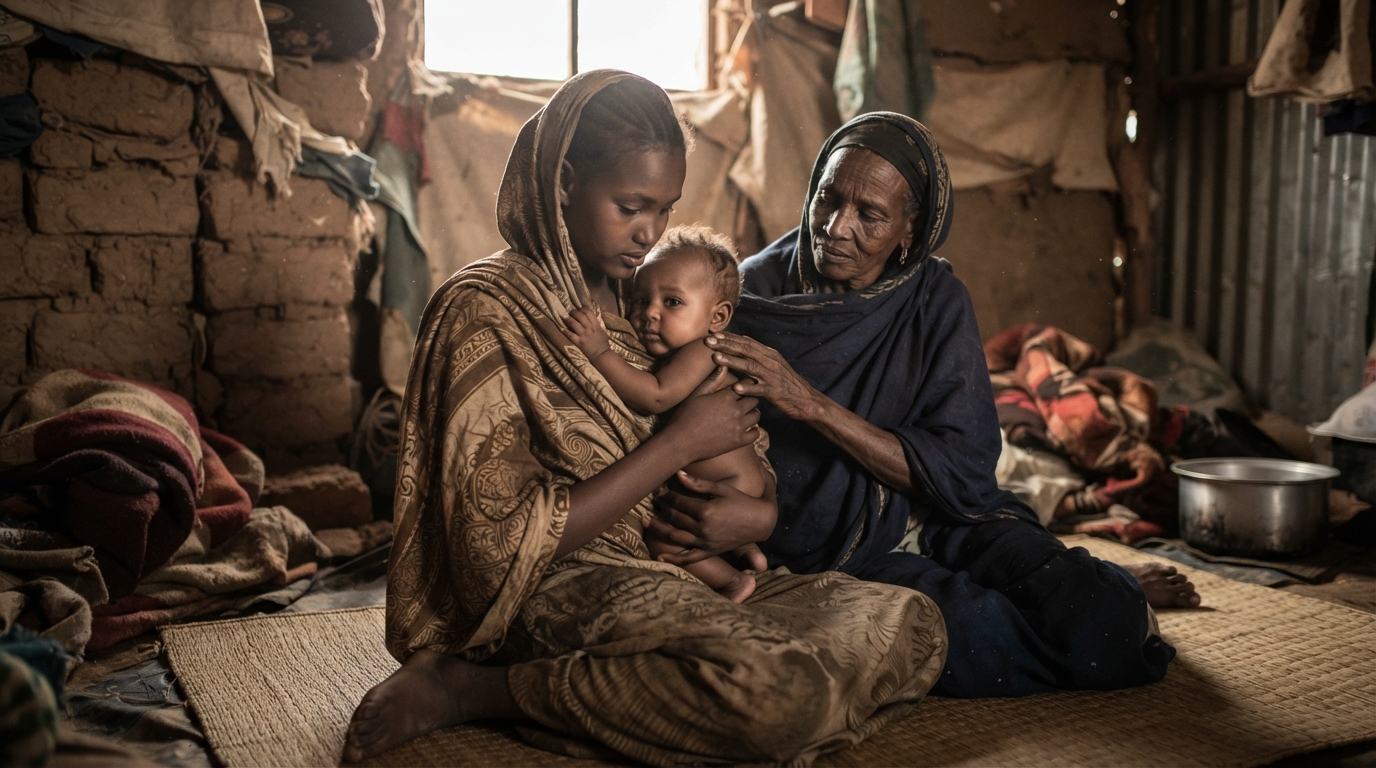
In Sudan, a 17-year-old girl, identified as Amira (name changed for protection), cradles her infant son with a composure that belies her youth and the profound anxieties she harbors for his future. "This son of mine has no father, no birth certificate, and no national number," Amira disclosed to the BBC. Her gaze fixed on the child, she spoke slowly, as if still processing the events that unfolded since the civil war erupted in Sudan.
Amira and her family once resided in the eastern neighborhoods of el-Fasher, a city that endured an 18-month siege by the paramilitary Rapid Support Forces (RSF), which has been locked in a brutal power struggle with the military since April 2023. El-Fasher, the army's final stronghold in the western Darfur region, fell to the RSF and allied Arab militias last October. For the tens of thousands of civilians trapped within the city, it was a "nightmare" of constant bombardment, clashes, and severe food shortages.
In early 2025, Amira and her family made the desperate decision to flee in search of safety. As they attempted to escape on a road southwest of the city, Amira recounts being abducted by three armed RSF men and held captive. "They blindfolded me and took me to the Tabit area south of el-Fasher. I was locked in a room for two months, and every day one of them raped me in turn," she whispered. Weeks into her captivity, she discovered she was pregnant and became gravely ill. Amira states that when the men decided to release her, they abandoned her near the area where she had been captured. With the assistance of other fleeing civilians, she received medical attention.
Months later, at a humanitarian hub outside RSF control, Amira gave birth at a hospital operated by the International Medical Corps. There, she received support from the Sudanese aid organization, the Nada Al-Azhar Foundation for Disaster Prevention and Sustainable Development (Nada). The organization also helped reunite her with her family, who had found refuge in a camp housing hundreds of thousands of people from el-Fasher.
Their reunion brought immense relief, but the family still faces significant challenges. Eight months after giving birth, Amira has been unable to register her son's birth. "Even getting a birth notification from the hospital requires information that doesn't exist," Amira explained, referring to her inability to provide details about the child's father. Without this information, she cannot secure any official recognition of her son's legal identity. "I can't get him vaccinated, or enroll him in nursery or school," she lamented. "I'm afraid for his future because he isn't registered at all. My economic situation is very difficult, and I can't afford his treatment or care. I can't even go to work for fear of being exposed to violence again."
According to Nada, Amira's experience is not an isolated incident but a recurring reality in conflict-affected areas across Sudan. Abu Bakr Yousif Yaqoub, Nada's director of protection programs, explained to the BBC from el-Fasher that many children are born in complex circumstances, often without the father's knowledge, making birth registration impossible. "Registering a child requires identity information, a national number, and a birth certificate. But when the father is absent or unknown, it becomes extremely difficult," he stated. "The mother is often alone, and sometimes she herself is still a child who needs care, which limits her ability to care for her baby. There are also health challenges related to the lack of follow-up on essential vaccinations, which begin at birth and continue through the child's early years." Yaqoub warned that this situation impacts not only a child's early years but also their future education and their ability as adults to travel or obtain official documents.
Obtaining data on the number of children born as a result of rape in Sudan is challenging due to social stigma, according to Shaza Ahmed, Nada's director general. "Women who experience such assaults do not feel comfortable reporting them," she told the BBC from Port Sudan, an army-held city in eastern Sudan. "Unfortunately, most of the mothers of these children are themselves children – girls under the age of 18. Therefore, they cannot make the decision to go officially to court or the police, as they need a guardian to accompany them." Ahmed noted that 90% of cases recorded by her organization involve families refusing to allow official reporting of sexual assaults that led to pregnancy. "As a Sudanese woman, my greatest fear and concern for children born as a result of rape is that we are facing a whole generation that will live under stigma, danger, and fear," Ahmed expressed. "These children will not receive respect from society, their well-being will not be truly protected, and above all, they will not have access to services or their rights." For Ahmed, these children are not being treated as "fully human," despite Sudanese law granting all children the right to an identity.
Sudanese lawyer Majida Idris explained that the Child Act of 2010 permits the registration of children born outside marriage. However, this process hinges on the mother's willingness to file a report of assault, which initiates the registration. Once reported, the case is referred to social services for documentation, then sent to the civil registry, where the child is registered under the mother's name and given a full legal name according to established procedures.
However, Idris stated that the reality during wartime is vastly different, particularly in Darfur, where the ongoing conflict has led to the collapse of civil services and the closure of civil registry offices, leaving thousands of children unregistered. "The absence of documents does not just mean the absence of a piece of paper – it means denying the child access to education, healthcare, and legal recognition," she told the BBC. The lawyer emphasized the urgent need to reactivate civil registry offices in accessible areas and intensify legal efforts to ensure children obtain their right to identity and legal recognition.
Amira and her child remain in Darfur, caught in an administrative limbo. Her mother acknowledged the worry caused by her grandson's lack of paperwork. Yet, for now, the family is overwhelmed with gratitude for their reunion. Amira has also been offered emotional and psychological support sessions and other advice by Nada, which provides comfort to the family. "I was so extremely worried until I found her. I hadn't been eating or drinking," Amira's mother told the BBC. "The reunion was like a miracle from God. To see our daughter back sitting among us is a gift and blessing that could not be thanked enough for."