

'No safe options' for thousands sheltering in key Sudan city as RSF fighters advance
International leaders have issued warnings the RSF may be preparing to attack the city, raising fears of further atrocities being committed.
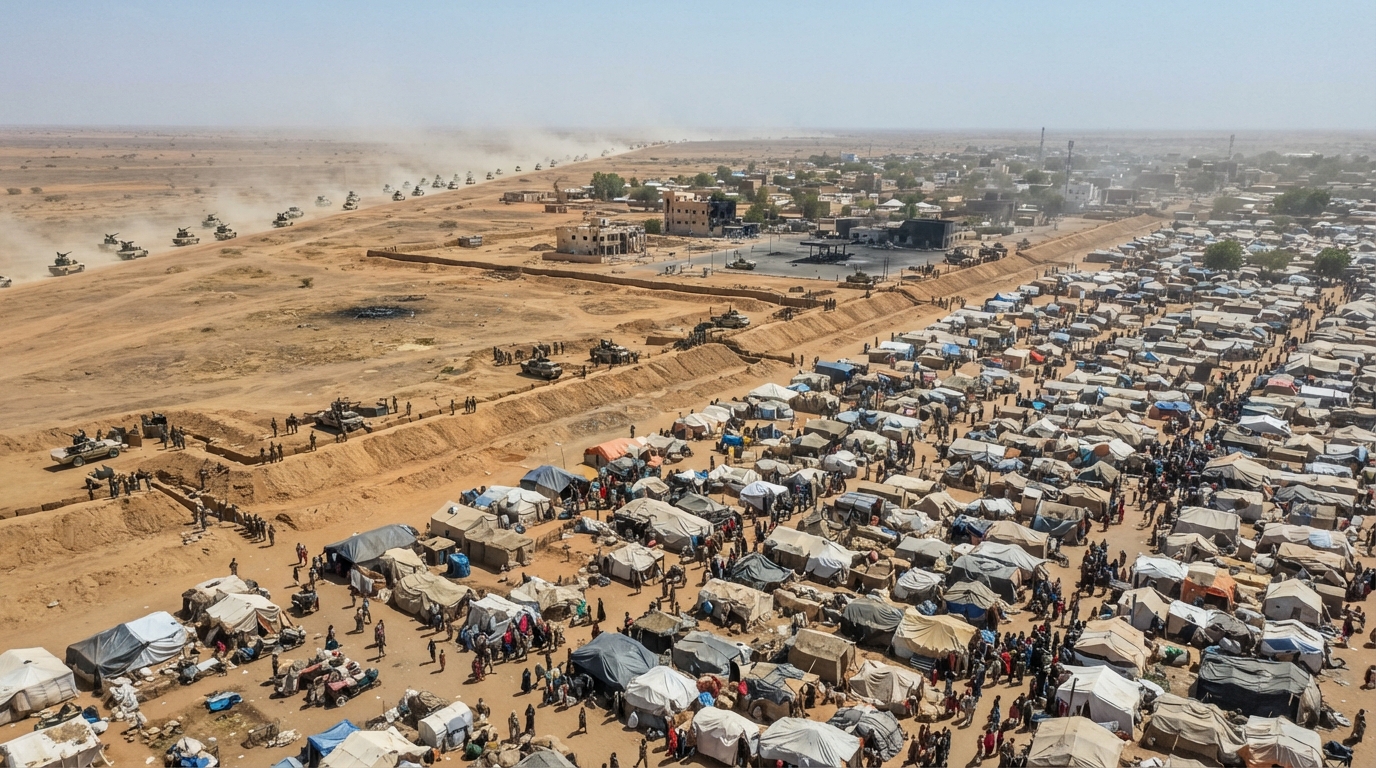
Thousands of individuals who sought refuge in el-Obeid from Sudan's ongoing civil war are once again facing danger, as warnings emerge that paramilitary forces are preparing to advance on the army-controlled city.
Clashes between the paramilitary Rapid Support Forces (RSF) and the military have intensified in the North Kordofan region, a crucial objective for both factions in the conflict, as it could provide access to disputed territory.
Despite continuous strikes on el-Obeid by advancing paramilitary forces, displaced people have flocked to the city, which remains heavily defended by the Sudanese military. The UN's International Organization for Migration (IOM) has identified it as a vital sanctuary for those fleeing violence in surrounding areas.
Satellite imagery indicates a significant expansion of the main displacement camp since March, with aid workers reporting dozens of new arrivals daily. Mohamed Refaat, IOM chief of mission in Sudan, stated, "Families have run out of safe options to protect themselves. Many have already been displaced before and are once again forced to leave behind their homes, livelihoods and support networks."
The UN and G7 foreign ministers have issued warnings that the RSF may be preparing to attack el-Obeid, raising concerns about a repeat of atrocities similar to those witnessed during the massacre in el-Fasher. Thousands were killed in mass executions after the paramilitary overran SAF troops defending el-Fasher last October, marking one of the worst atrocities since the civil war began in 2023.
Fears of similar reprisals in el-Obeid have escalated for weeks, with verified footage now showing dozens of heavily armed RSF troops in armored trucks stationed in Nyala, a key nearby stronghold, vowing to "liberate" the city.
According to the monitoring group Armed Conflict Location and Event Data (Acled), the RSF launched a record number of drone strikes on el-Obeid in June. Analysts noted that the number of attacks only decreased in July because the RSF was responding to Sudanese military attacks elsewhere.
Satellite images reveal that despite the strikes, el-Obeid's displacement camp has continued to grow, with hundreds of new tents erected since March. The UN estimates that over 83,000 civilians have fled fighting in other parts of the state and sought shelter in the city.
As the displacement camps have expanded, conditions in el-Obeid have worsened. Last week, the UN warned that nearly 400,000 people in the city's vicinity are facing food shortages due to a sustained effort by RSF commanders to cut off supply routes for months, creating what one UN official described as a "functional siege."
Locals have previously reported that supply convoys attempting to reach the city have been targeted by drone attacks. The charity Islamic Relief, which operates aid stations in el-Obeid, informed BBC Verify that flights carrying aid via the airport have also ceased.
Aid agencies attribute the exacerbated food and water shortages to RSF drone strikes on critical infrastructure. Verified video footage last month showed a massive explosion at a fuel station in the city center after one such strike, while satellite images also indicate damage to power stations and supply warehouses in the city's market district.
A humanitarian official working with Islamic Relief noted that a recent slowdown in drone strikes has improved the situation in the city. However, he emphasized that while more aid is being distributed and some power has been restored, the situation remains extremely "unpredictable," with fuel shortages still a concern. "Every day we are seeing new arrivals due to fighting in areas around El-Obeid. It is not possible to get the exact number of people who are arriving on a daily basis, but it would be about 80 or 100 households daily," the aid worker said.
Meanwhile, RSF fighters and leaders have repeatedly vowed in verified video footage to advance on el-Obeid. In one clip posted to the paramilitary's official Telegram channel, a commander, waving an assault rifle, addressed a group of troops, promising imminent combat in el-Obeid. Another verified clip from late May showed paramilitary fighters gathering alongside dozens of armored vehicles just outside the RSF heartland of Nyala. One fighter, leaning on an armored vehicle, boasted that el-Obeid was the unit's next target. Recent footage located by BBC Verify placed fighters within 40km (24 miles) of the city.
These threats also appear to be fueling tensions within el-Obeid. Volker Türk, the UN's High Commissioner for Human Rights, recently stated that many displaced people seeking shelter in the city have faced suspicion and hostility from locals due to fears of RSF sympathizers infiltrating the city.
Concurrently, satellite images suggest the Sudanese military is fortifying its defenses by constructing a berm, or earth wall, around the city. Unlike the one built around el-Fasher by the RSF last year, which trapped people inside the besieged city, this appears to be defensive and aimed at keeping attackers out.
On Monday, the military announced that a massive operation had secured a vital highway between el-Obeid and the capital, Khartoum. In response, RSF leader Mohamed Hamdan Dagalo, known as Hemedti, declared he was "unleashing" his fighters and ordered his front-line commanders to "move straight forward. No more retreat. No more hesitation."
Nohad Eltayeb, Senior Research Assistant at Acled, told BBC Verify that el-Obeid is a key hub for both sides of the conflict. "It is the critical juncture connecting RSF-controlled western territories with the military-held central and White Nile regions," Eltayeb said. She added that the RSF "need to regain momentum following territorial losses in the eastern Blue Nile region, alongside internal instability and defections within its Darfur strongholds."
The joint EU/G7 warning of atrocities in el-Obeid urged all "external actors" to suspend "armed, logistical, or financial support to the parties to the conflict." Earlier this month, the European Parliament explicitly named the United Arab Emirates (UAE) as a key backer of the RSF. Emirati officials have repeatedly denied the allegations.
Alan Boswell, Crisis Group's Horn of Africa Group director, suggested that the flurry of early Western interventions might be motivated by the failure to prevent the el-Fasher massacre, which was the culmination of an extended siege and RSF build-up. "Many are trying to turn up the volume on those warnings to prevent another round of mass atrocities in el-Obeid," he said. "The key is if world leaders will put enough pressure on the RSF and its main backer to make a difference this time."