

Three killed as Russian bombing of Odesa continues
In recent days, Russia and Ukraine have launched attacks on each others' infrastructure for shipping goods.
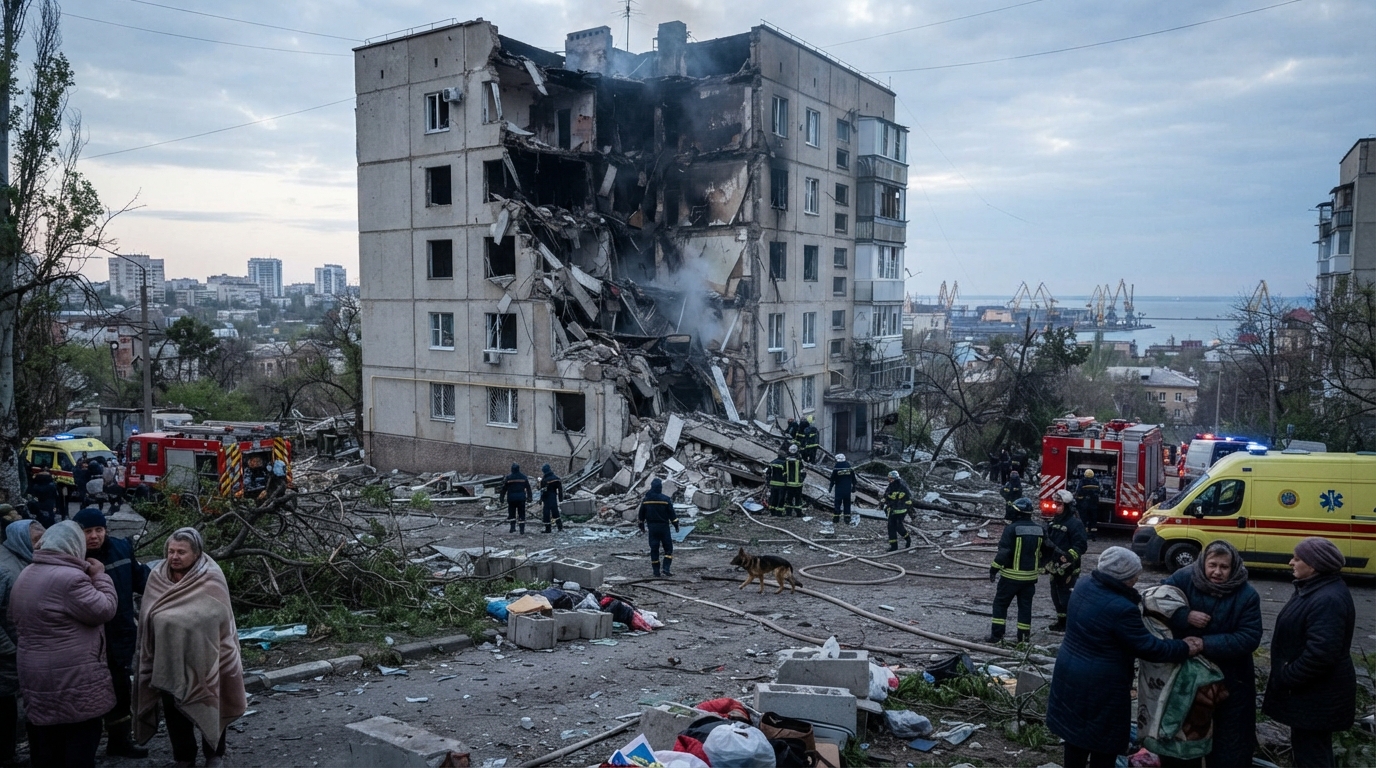
Three fatalities reported as Russian bombardment of Odesa persists
Overnight Russian strikes on Wednesday targeted a residential building in Odesa, resulting in three deaths, as confirmed by a local official.
Oleh Kiper, the Governor of the Odesa region, stated that the "massive" drone and missile assault marked the fifth consecutive day of Russian attacks in the area.
The Russian Ministry of Defence claimed that the strikes were aimed specifically at port infrastructure "used for the unloading of petroleum, oil, and lubricants."
These attacks coincide with European Commission President Ursula von der Leyen's visit to Kyiv, where she is discussing collaboration between European and Ukrainian defense industries.
In a Telegram post, Kiper accused Russia of intentionally targeting civilians, as well as industrial and port facilities in the region. He reported that residents were killed and injured when a Russian missile hit a multi-storey residential building, and noted that a non-residential structure and a gas pipeline were also damaged.
Russia, in its statement, asserted that it had focused on sites related to military hardware production and cargo transportation.
Recent Russian assaults have concentrated on Ukraine's deepwater Black Sea ports in the broader Odesa area, which are crucial for handling a significant portion of the country's grain and other cargo, essential for its wartime economy.
Additionally, Ukraine reported that its drones struck 20 Russian vessels in the Black Sea overnight. This follows a series of intense attacks on Russian ships in the Sea of Azov, located between Crimea, Ukraine's eastern coast, and Russia.
These Ukrainian operations have compelled Russia, the leading grain exporter globally, to impose shipping restrictions in the Sea of Azov, a route that accounts for approximately a quarter of its grain exports, according to Reuters.
As the assaults persist, Ukraine is grappling with a challenging political landscape, highlighted by President Volodymyr Zelensky's dismissal of Prime Minister Yulia Svyrydenko after less than a year in office.
On Tuesday, Ukraine's parliament approved a motion to accept Svyrydenko's resignation, although some lawmakers expressed doubts about whether the rationale for the change had been adequately communicated.
Serhiy Koretskyi, the head of the state oil and gas company Naftogaz, is considered a likely candidate to succeed Svyrydenko, with a parliamentary vote on the appointment scheduled for Thursday.
On Wednesday morning, Ursula von der Leyen arrived in Kyiv, sharing on social media that it was a "special moment" and marking her 11th visit to the country since Russia initiated its full-scale invasion of Ukraine in 2022.
She indicated that the new initiatives she plans to announce would enable both sides to "produce more, and faster."
People are fleeing as a Russian strike impacts a coffee shop in Ukraine, while Russia is focusing on schools, offices, and buses in a bustling Ukrainian city.