

Israeli official says troops won't pull back in Gaza without 'genuine' Hamas disarmament
Donald Trump insists Israel is "very happy" with a proposal for the Palestinian group to give up weapons in exchange for an Israeli withdrawal.
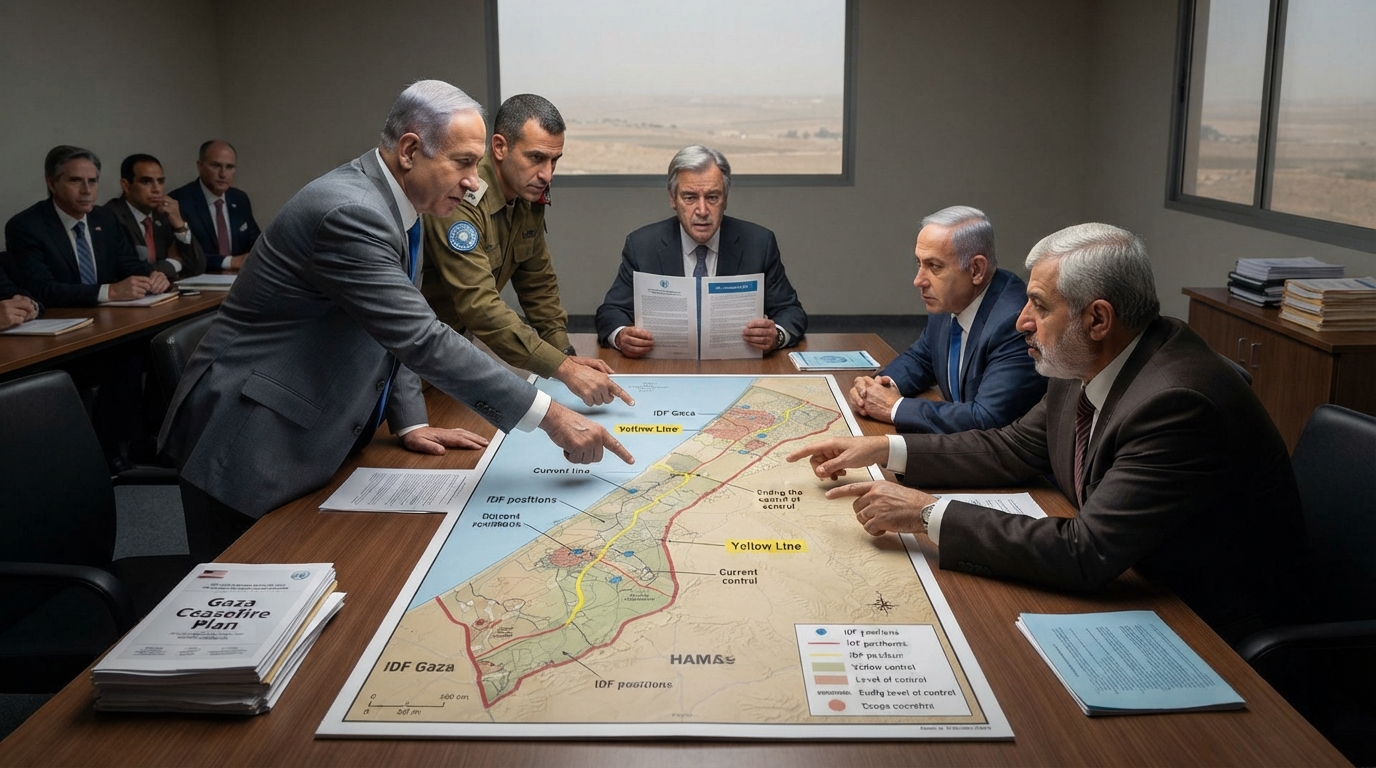
Israeli forces will not withdraw from their current positions in Gaza unless the Palestinian armed group Hamas genuinely disarms, a senior Israeli official stated.
Hamas, for its part, declared that the handover of its heavy weaponry was conditional on Israel ceasing "all forms of aggression" and pulling its forces out of Gaza.
This development follows Donald Trump's announcement that the Board of Peace had reached an agreement for the "complete disarmament" of Hamas and other armed groups in Gaza. On Friday, Trump asserted that Israel was "very happy" with the proposed agreement, calling it a "big step for the Middle East." However, far-right Israeli National Security Minister Itamar Ben Gvir rejected the draft as "not acceptable."
The agreement is part of the second phase of a US-brokered Gaza ceasefire plan aimed at ending the conflict. The 20-point plan, introduced in September of last year, included the establishment of the Board of Peace to oversee the agreement's implementation, as well as the disarmament of Hamas, the withdrawal of Israeli troops, and the reconstruction of Gaza.
Speaking at a cabinet meeting at Camp David on Friday, Trump said he had an "understanding" with Israel regarding the latest disarmament proposal agreed upon with Hamas, adding that "Israel's very happy about it." When asked whether Hamas would disarm before Israeli forces withdrew from Gaza or vice versa, Trump did not answer directly, but noted that Gaza remained "a very complex situation." He added that Hamas's weapons would be handed over to the Board of Peace.
Israeli Prime Minister Benjamin Netanyahu has not yet commented on the latest proposal.
Despite Trump's assertion of an "understanding" with Israel, a senior Israeli official reiterated the country's stance that "there will be no IDF [Israel Defence Forces] withdrawal from the current Yellow Line without the genuine disarmament of Hamas." The Yellow Line is the designated demarcation point within Gaza to which Israel agreed to withdraw its forces following last year's US-brokered ceasefire between Israel and Hamas. The deal was intended to leave Israel in temporary control of the area behind the Yellow Line, which constitutes 53% of Gaza's territory. However, Prime Minister Benjamin Netanyahu recently stated that the Israel Defense Forces (IDF) controlled more than 60%, and in May, he publicly declared his "directive" to move to 70%.
In its statement, Hamas emphasized that Israel's commitment to ending its assault on Gaza was a "fundamental prerequisite" for advancing the deal, along with a guaranteed right to "self-determination, establishing an independent Palestinian state." The group stated it had negotiated "responsibly and positively" with "national consensus among the Palestinian factions."
Palestinian officials involved in the talks believe that the decision by Hamas's new leadership—described as the most significant in the group's history—was driven by the dire humanitarian conditions affecting over 2 million Palestinians in Gaza.
Earlier on Friday, the Board of Peace published what it termed a roadmap for Gaza, reaffirming its proposal for the phased disarmament of Hamas, a gradual Israeli withdrawal, and the deployment of an international stabilization force.
The plan for Hamas to disarm faces significant obstacles, yet it offers a rare glimmer of hope for Gaza.
Some Palestinians in Gaza and Israelis have shared their reactions to the plan with the BBC. Tala, an 18-year-old living in a tent in Gaza since her home was destroyed in air strikes, said, "every time people hear about a possible ceasefire, we hope that it will finally end." She told BBC Newsbeat, "But when these promises are broken, it creates more fear." The university student described daily life as "very challenging," adding, "Every day comes with a new difficulty, and we are constantly thinking about safety and basic needs." She concluded, "What matters most is stopping the fighting, protecting civilians and setting a new chapter of re-building."
In Israel, Jonny expressed his prayers that the ceasefire in Gaza would succeed. "I don't see an ending to this cycle, but I pray it's the case," he told the BBC.
Israel's ambassador to the UN, Danny Danon, told CNN that Israel is "looking forward to implementing" the deal, but added, "We have to verify what they [Hamas] are doing, not what they are saying."
UN Secretary General Antonio Guterres described the proposed agreement as "the only good news in recent days."
UK Foreign Secretary Ed Miliband stated that the focus must be on implementing the full 20-point peace plan, including "withdrawal of the IDF from Gaza and respect for the ceasefire by all parties." He added that conditions "remain appalling" in Gaza and said Israel "must immediately end the unacceptable restrictions on aid." Israel denies it is restricting the entry of aid.
The conflict in Gaza was ignited by the Hamas-led attack on southern Israel on October 7, 2023, which resulted in approximately 1,200 deaths and 251 hostages taken. Israel responded to the attack by launching a military campaign in Gaza, during which more than 73,290 people have been killed, according to the territory's health ministry, whose figures are considered reliable by the UN. A UN commission of inquiry has stated that Israel is committing genocide in Gaza by deliberately targeting children.