

What's in the Gaza peace deal roadmap?
Hamas says it has accepted a disarmament plan for Gaza which will see it lay down its arms and Israeli troops withdraw from the territory.
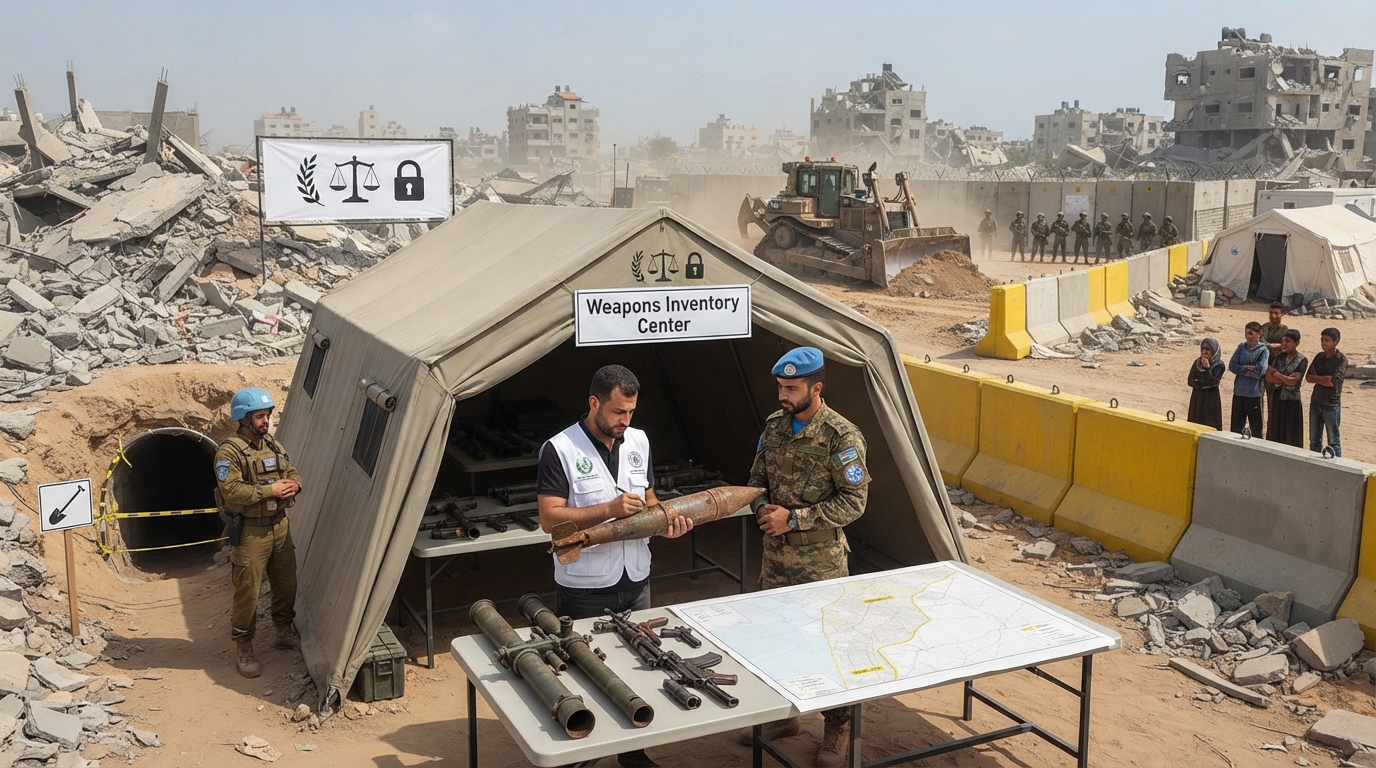
Hamas has announced its acceptance of a disarmament proposal for Gaza, a move U.S. President Donald Trump hailed as "a monumental step toward lasting peace and security." The group stated it engaged in "responsibly and positively" negotiated discussions, achieving "national consensus" among Palestinian factions.
Israel, however, remains highly skeptical of Hamas's commitment to disarm and insists it will not withdraw from Gaza until disarmament occurs.
Beyond the 15-point roadmap released by the U.S.-led Board of Peace, the BBC has reviewed a four-page document detailing a phased disarmament of Hamas and a gradual Israeli withdrawal. Hamas relinquishing its weapons, as anticipated, has been a primary obstacle to advancing President Trump's 20-point plan to end the conflict in Gaza. This plan, introduced in September of the previous year, included the establishment of the Board of Peace to oversee the agreement's implementation and manage funding for Gaza's redevelopment.
Both the roadmap and the document seen by the BBC outline that "A process shall begin to inventory and store heavy weapons, military production sites, weapons depots, and tunnels." This is contingent upon Israel fulfilling its obligations under the initial ceasefire agreement from October last year. This provision appears to be a significant breakthrough.
The Palestinian National Committee, an independent group of technocrats to whom Hamas has agreed to transfer power, would oversee this process, alongside the deployment of an International Stabilisation Force (ISF) to Gaza. The document extends the disarmament process beyond Hamas to include other Palestinian factions.
The roadmap documents link this to a "phased Israeli withdrawal" and explicitly state that "no weapons shall be transferred or handed over to Israel or to any non-Palestinian party." The precise mechanism for the weapons handover remains unclear, though it is believed that all heavy weapons, including Hamas's remaining rockets and other military hardware, would be moved to secure storage managed by the National Committee. This committee, currently operating from Cairo, has not yet entered Gaza.
Regarding the timeline, the document indicates that this would occur "in a gradual, sequential, and time-bound manner, based on an implementation schedule to be prepared within 14 days." Hamas has since clarified that its surrender of heavy weapons is conditional on Israel ending "all forms of aggression" and withdrawing its forces from Gaza. The group emphasized that Israel's commitment to ceasing its attacks on Gaza is a "fundamental prerequisite" for the deal to proceed.
Underground tunnel networks, weapons caches, and manufacturing sites would be mapped and subsequently destroyed. Remaining personal arms and police weapons would need to be registered and progressively handed over to the new Palestinian police force, operating under the ISF's supervision. Hundreds of new Palestinian police recruits have already undergone training in Egypt and Jordan. Israel's cabinet recently approved the entry of approximately 200 international troops from "friendly countries" as part of the ISF, but their deployment has not yet occurred.
Hamas has sought assurances that pro-Israel militias in Gaza will be disbanded and disarmed.
Israel remains deeply skeptical of Hamas's willingness to surrender its weapons or its control in Gaza. Far-right National Security Minister Itamar Ben-Gvir stated via Telegram that the plan is "not acceptable" to Israel. Israeli officials have maintained that there will be no Israeli withdrawal from the Yellow Line, which delineates the area it controls, until Hamas is disarmed.
Adding to the ambiguity, Israel currently controls more than the 53% of Gaza where its troops were slated to remain under the October ceasefire agreement. As the BBC recently reported, yellow concrete blocks marking the Yellow Line have been moved westward, resulting in Israel controlling over 60% of the strip.
An annex to the document seen by the BBC requires Israeli forces to withdraw to the agreed Yellow Line "within 24 hours of the Israeli government's approval of the plan." It specifies that they should not return "as long as Hamas complies with the implementation of the agreement."
Earlier this month, Hamas announced the dissolution of its government in Gaza and its preparations to transfer power to the National Committee as part of the ceasefire deal. During negotiations, Hamas sought assurances that the tens of thousands of civil servants employed by its government in Gaza prior to the war would be compensated or offered new employment. These public workers include Hamas police and security forces, as well as health and education staff, many of whom are likely Hamas supporters.
The plan commits to treating all public employees "lawfully, fairly, and with dignity regarding their rights." The security vetting process for civil servants working with the National Committee remains to be determined.
In recent discussions to advance Trump's peace plan, Hamas faced intense pressure from regional mediators, who were themselves urged by Washington to demonstrate progress. The recent appointment of Khalil al-Hayya, Hamas's chief negotiator, as the overall leader of the group, replacing a five-member council, has streamlined decision-making. He enjoys strong support from Gaza members and the Hamas armed wing.
Regional events may also have influenced the timing. Early in the Iran war, Hamas officials reportedly adopted more hardline stances, hoping that Tehran, a backer of the group, would emerge victorious and strengthen their position. Those close to Hamas suggest they have since abandoned this idea. Palestinian officials involved in the talks indicate that the new leadership was prepared to make this significant political decision, driven by the devastating humanitarian conditions in Gaza.
The announcement has, thus far, been met with limited enthusiasm in Gaza, though some residents expressed a glimmer of hope to the BBC. After years of failed ceasefires and collapsed agreements, many Palestinians have grown deeply skeptical of new political deals.
The Israel Defense Forces (IDF) confirmed to the BBC earlier reports of an Israeli strike on Gaza just hours after Trump announced the deal, which reportedly injured several Palestinians. Over two million Palestinians in Gaza are enduring dire conditions, grappling with disease, and a lack of access to food, clean water, and adequate shelter. These individuals reside in a shrinking territory as Israel continues to construct land barriers, further displacing families and expanding its "Yellow Line" temporary control area deeper into the territory.
According to figures from the Hamas health ministry, which are considered reliable by the United Nations, at least 1,168 Palestinians, including children, have been killed in Israeli attacks since the ceasefire took effect. Four Israeli soldiers have been killed in Palestinian attacks in Gaza during the same period.
Satellite images reviewed by BBC Verify last November showed that Israel has destroyed over 1,500 buildings in areas of Gaza that have remained under its control since the ceasefire. The actual number is likely considerably higher, as imagery for some areas is unavailable. UN estimates indicate that approximately 60 million tonnes of debris have been generated since October 2023.
If the Hamas disarmament plan holds, it could represent the first credible step toward ending the Gaza war.