

How a generation of record-setting guides died in a disaster that killed a climbing legend
Their fellow guides say their deaths in Pakistan dealt a devastating blow to Nepal's mountaineering community.
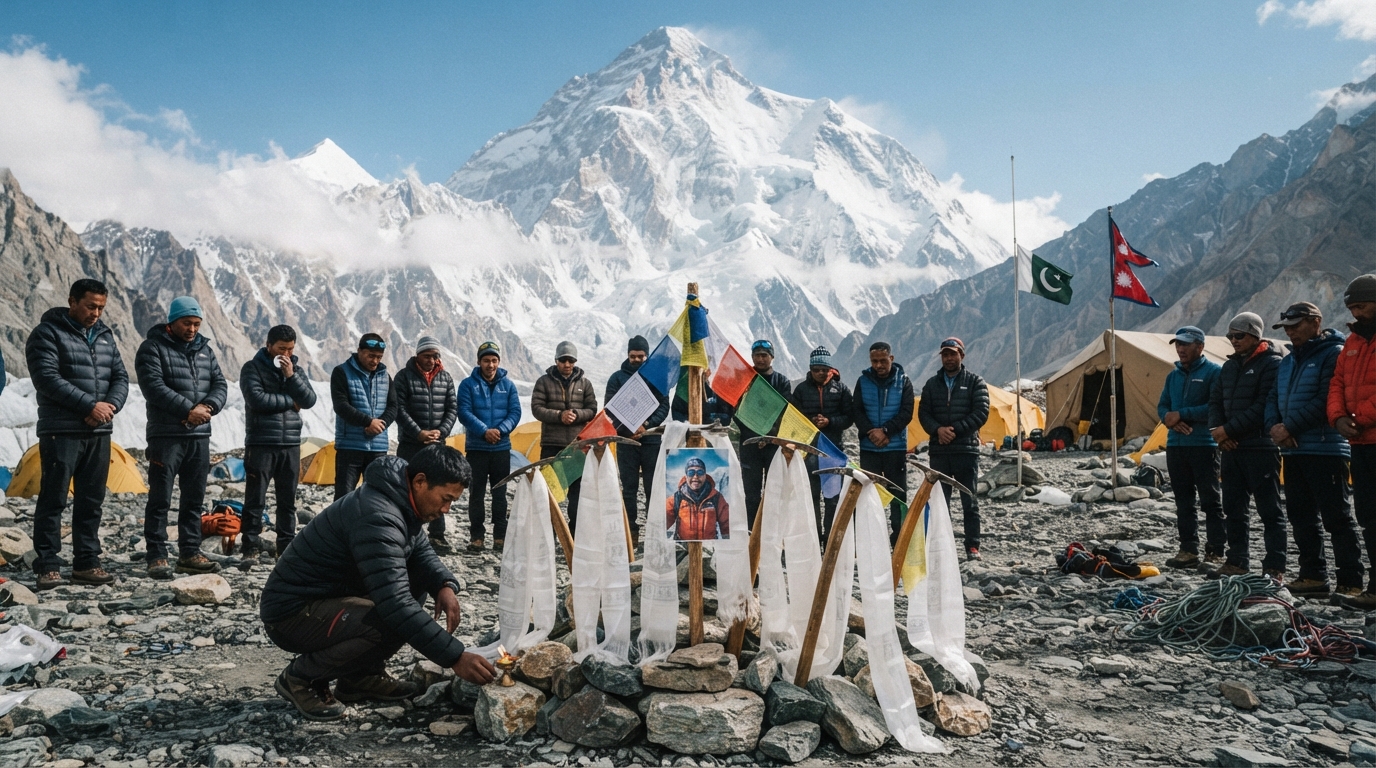
A recent catastrophe on Pakistan's Broad Peak claimed the lives of six Nepali mountain guides, including renowned British-Nepali climber Nirmal Purja, marking a profound loss for the global mountaineering community. These individuals, celebrated for their extraordinary achievements, had collectively summited Mount Everest dozens of times and accomplished feats previously deemed impossible, such as ascending 8,000m peaks without supplemental oxygen and conquering K2, one of the world's deadliest mountains, in the depths of winter. Their passing not only represents a devastating blow to Nepal's mountaineering fraternity but also underscores their pivotal role in elevating the international perception of Nepali mountain guides, or Sherpas, who were once merely considered assistants.
Nirmal Purja, 43, affectionately known as Nims, was at the helm of the 10-member international team on Broad Peak, the world's 12th highest mountain, when the fatal avalanche struck. Ben Ayers, a veteran Everest reporter for Outside Magazine, described Purja as "iconic and undisputedly amongst the best of his generation."
Among the other victims were Kili Pemba Sherpa and Pur Bahadur Gurung, both highly skilled climbers. Kili Pemba, 46, had just achieved the coveted mountaineering Grand Slam in early July, completing his ascent of all 14 "eight-thousanders." His impressive resume also included being part of the Nepali team, again led by Purja, that made the historic first winter ascent of K2 in January 2021. K2, at 8,611m, is known for its treacherous conditions, being steeper, more unpredictable, and deadlier than Everest (8,849m). Kili Pemba was also lauded for his humility and dedication to clients, notably guiding double-leg amputees up Everest on two of his 15 ascents. Gyanendra Shrestha, a government official present during one of these climbs, remarked, "That was the toughest task for any guide, [Kili Pemba] did that with a lot of care."
Pur Bahadur Gurung, 37, had scaled 12 of the 14 highest peaks and was one of only 100 Nepali guides certified by the International Federation of Mountain Guides Association (IFMGA). Himal Gautam, a spokesman for Nepal's tourism department, highlighted the immense dedication required to achieve such certification, emphasizing the "unprecedented loss we have suffered on Broad Peak." In 2024, Pur Bahadur was part of the team that discovered a century-old boot on Everest, believed to belong to British climber Andrew Irvine, who vanished in 1924.
The other Nepali guides who perished were Gyaljen Sherpa, recognized for scaling Kanchenjunga, the third-highest mountain, three times in a single season; Nima Sherpa, 36, who summited four eight-thousanders in 2026 alone; and Nawang Thindu Sherpa, a promising young guide in his twenties.
Nepali mountain guides typically lead international clients up Nepal's highest mountains during the spring. During the monsoon season, from June to September, some venture to Pakistan's northern regions, home to several of the world's highest peaks, including five eight-thousanders. While the Himalayas attract over a million adventure travelers annually, Pakistan's Karakoram mountains see only about 15,000 hikers each year, though demand is growing.
Nirmal Purja is credited with raising Pakistan's profile among mountaineers through his record-breaking ascent of the 14 peaks in just over six months, documented in a Netflix film. Iswari Paudel, acting president of the Nepal Mountaineering Association, noted that Purja's success "gave many [guides] and foreigners the courage to believe that this mountaineering crown was truly possible," establishing Pakistan as a significant overseas base for Nepali Sherpas.
Ayers observed that Purja's influence helped "publicise a new era of mountaineering," which both "democratised mountain-climbing" and "fuelled commercialisation and risk." The remote nature of Pakistan's mountains makes expeditions there far more challenging, a task typically undertaken only by the most skilled guides. Nima Rinji Sherpa, a 20-year-old who set a new record in 2024 as the youngest mountaineer to summit all 14 highest peaks, explained, "We have to fix our own ropes, cut our steps into the ice, and set up camps as we go along." He added that in Pakistan, "Even in an era of commercial mountaineering, we experience real, old-fashioned mountaineering."
The inaccessibility of the region often leads climbers to attempt multiple mountains per trip, resulting in tight itineraries. In contrast, Nepal boasts well-developed mountaineering infrastructure, with lodges and facilities along main trekking routes. Emergency evacuations are also generally easier in the Himalayas due to an integrated network of rescue helicopters and high-altitude aid outposts, whereas the more isolated Karakoram range has fewer accessible landing zones. Nima Rinji emphasized that only Sherpas "capable of working in high-pressure situations, and who have diverse experiences and multiple skills are the ones who will operate in Pakistan."
While the Broad Peak disaster may prompt calls for stricter safety standards, many believe it will have little lasting impact on high-altitude tourism. Ayers commented, "Generally, these tragedies cause a moment of concern... but then things go back to how they were. It's difficult to say with any conviction that any accident in the mountains is 'preventable' as the inherent danger is so high... and that's part of the appeal." Medhavi Gulati, a researcher specializing in high-altitude mountaineering, added that "Often, it's the dangers and risk of death that attracts people." She believes the current generation of guides will continue to seek the global fame and records achieved by their predecessors.
Expert mountaineer and writer Alan Arnette echoed this sentiment, citing past disasters like the 2014 Everest ice avalanche that killed 16 Sherpas and the 2008 K2 incident where 11 climbers died. "I doubt the Broad Peak incident will have a significant impact, given history. I hope I'm wrong," he stated.