

Global Trade Volume Up 3.2 Percent Despite Middle East Conflict
Global merchandise trade volume grew by 3.2 percent year-on-year in the first quarter of 2026 despite the conflict in the Middle East, driven by AI demand.
**Global Trade Sees 3.2% Rise Despite Middle East Tensions**
Tashkent, Uzbekistan (UzDaily.uz) — Global merchandise trade experienced a 3.2 percent increase in physical volume during the first quarter of 2026 compared to the same period last year, and a 1.9 percent rise from the previous quarter, according to reports from the World Trade Organization (WTO) and the United Nations Conference on Trade and Development (UNCTAD). In terms of value, global merchandise trade saw a 2 percent quarter-on-quarter increase and an 11 percent year-on-year surge.
This annual growth rate for the first quarter is particularly notable, as trade in early 2025 was artificially inflated by accelerated imports into North America in anticipation of tariff increases.
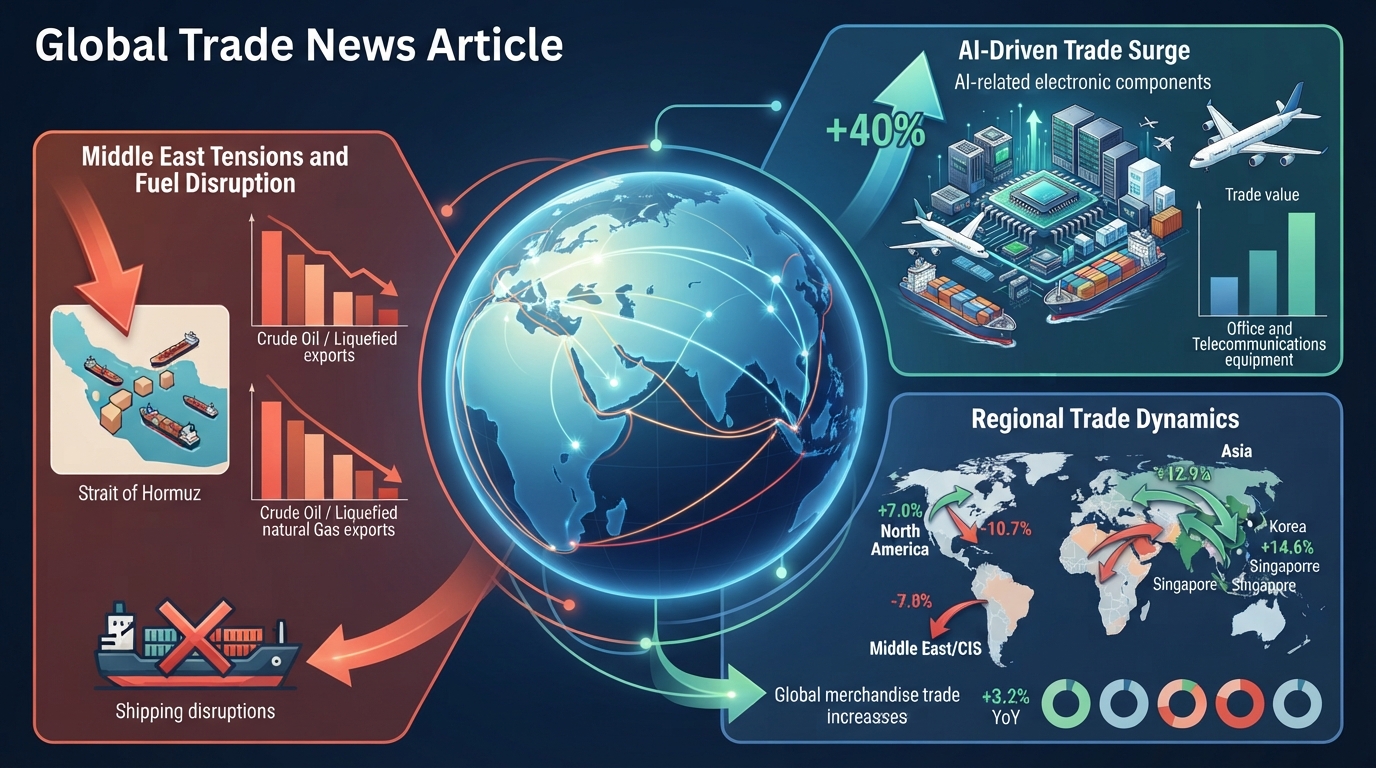
The positive impact of a surge in electronic component trade, driven by artificial intelligence (AI), managed to counteract the negative repercussions of the Middle East conflict. These negative effects included disruptions to shipping through the Strait of Hormuz and elevated energy prices, which subsequently hindered economic growth in countries that are net fuel importers. The value of global trade in AI-related goods alone climbed by over 40 percent year-on-year.
The WTO's March forecast, detailed in its Global Trade Outlook and Statistics report, had projected a more modest 1.9 percent growth in global merchandise trade volume for 2026 under its baseline scenario. This figure was lower than the actual 3.2 percent recorded in the first quarter.
At the time of that forecast, WTO economists had estimated that the Middle East conflict could reduce global trade growth by 0.5 percentage points under a high energy price scenario, while ongoing AI investments could add an equivalent amount. These initial estimates were made early in the conflict, with limited information regarding the extent of shipping disruptions.
Considering subsequent developments, WTO analysts now anticipate a more substantial reduction in Middle East trade flows by year-end, offset by stronger growth in Asia and North America. The ultimate impact on global trade will hinge on whether the AI boom or the consequences of the conflict prove more dominant. An updated forecast is slated for release in the next report in October.
**Regional Trade Dynamics**
The Middle East conflict significantly impacted the region's trade turnover. Seasonally adjusted exports from the Middle East contracted by 9.7 percent year-on-year in the first quarter, with imports falling by 11.9 percent. A more pronounced decline is expected in the second quarter.
The full statistical impact of the conflict only became apparent towards the end of the first quarter. The Strait of Hormuz has been effectively closed since early March, and current statistical data does not yet fully reflect the scale of shipping disruptions. This is partly because Gulf countries rarely publish quarterly trade statistics, and regional figures are primarily estimated using mirror data from partner countries.
According to the WTO Secretariat, global crude oil imports from the Middle East decreased by approximately 45 percent year-on-year in March. Liquefied natural gas imports dropped by 52 percent, and fertilizer imports saw a 26 percent decline.
Conversely, investments in AI fueled trade volume growth in Asia and, to a lesser extent, in North America. Asia's seasonally adjusted exports and imports surged by 12.9 percent and 14.6 percent, respectively, compared to the first quarter of 2025. Quarter-on-quarter growth reached 5.5 percent for exports and 7.2 percent for imports. This export growth was driven not only by China but also by Singapore, the Republic of Korea, Thailand, and Chinese Taipei, largely due to intraregional trade in AI components.
North American exports in the first quarter increased by 7.0 percent year-on-year. However, the region's imports contracted by 10.7 percent compared to the first quarter of 2025, which had seen a surge in imports ahead of anticipated tariff hikes. On a quarterly basis, import growth stood at 3.4 percent. European exports declined by 2.6 percent year-on-year, primarily due to early shipments of gold and pharmaceutical products to North America a year prior, while imports saw a modest 0.6 percent increase.
In other regions, quarterly export dynamics were moderate or negative: South America experienced 0.3 percent growth, Africa saw a 2.5 percent decline, and CIS countries recorded a 7.4 percent drop. Cumulative export growth in South America since early 2023 reached 22.5 percent, second only to Asia's 33.4 percent. The region's import growth over the same period reached 24.5 percent, trailing only Africa's 25.0 percent. Exports from South America, Africa, and CIS countries are anticipated to recover in the second quarter as oil producers attempt to compensate for reduced output in the Middle East.
**Trade in Value Terms**
In value terms, the most significant growth in the first quarter was observed in office and telecommunications equipment, which rose by 44 percent year-on-year. This was followed by ores and other minerals at 27 percent, and other machinery at 9 percent.
Declines were noted in chemical products, down 6 percent; iron and steel, down 5 percent; and fuels, down 3 percent. Fuel prices saw an insignificant 3 percent increase year-on-year but a 16 percent rise quarter-on-quarter. Prices for metals and minerals (excluding gold and silver) increased by 32 percent. The primary contributor to the growth in the office and telecommunications equipment sector was sustained demand for AI-related technologies, which experienced 42 percent growth within that segment.
Asia recorded the largest increase in export value in the first quarter, rising 20 percent year-on-year due to shipments of precious metals and gold, copper, machinery and electrical equipment, and ores. Exports of iron and steel, pharmaceuticals, and clothing, however, declined. Africa secured second place with 14 percent growth, driven by exports of precious metals and gold, copper, fertilizers, and ores, while shipments of cocoa and fuel decreased.
South and Central America also saw a 14 percent increase, attributed to oilseeds, precious metals and gold, meat, fuels, ores, coffee, and tea. Exports of fruit, electrical equipment, and automobiles, however, decreased. Export declines were recorded only in the Middle East and CIS countries, both falling by 1 percent due to the prevalence of fuel in their export structures.
On the import side, significant year-on-year growth was observed in Asia at 22 percent and Africa at 15 percent. In Asia, shipments of precious metals, gold, copper, and machinery grew noticeably, alongside a slight decline in iron and steel imports. In Africa, imports of automobiles, machinery, and ships increased, while shipments of aircraft and organic chemicals declined.
North American imports experienced the most significant contraction, dropping 7 percent, primarily due to lower shipments of precious metals, pharmaceuticals, automobiles, and iron and steel products. The value of Middle East imports also fell by 6 percent, a result of a combination of rising prices and falling physical volumes.
Among the world's five largest exporters, all recorded growth in the first quarter: the Republic of Korea grew by 38.4 percent, Hong Kong (China) by 38.3 percent, the United States by 15.2 percent, China by 14.7 percent, and the European Union by 9.2 percent. Among the five largest importers, only the United States showed a decline at 13.6 percent, while imports into the rest grew: Hong Kong (China) by 44.8 percent, the United Kingdom by 28.0 percent, China by 23.0 percent, and the European Union by 11.4 percent.