

Uzbek Foreign Trade Reaches US$41 Billion in First Half of 2026
Uzbekistan’s foreign trade turnover reached US$41 billion in the first half of 2026, driven by a 21 percent surge in imports despite falling gold exports.
Uzbekistan's Foreign Trade Hits US$41 Billion in First Half of 2026
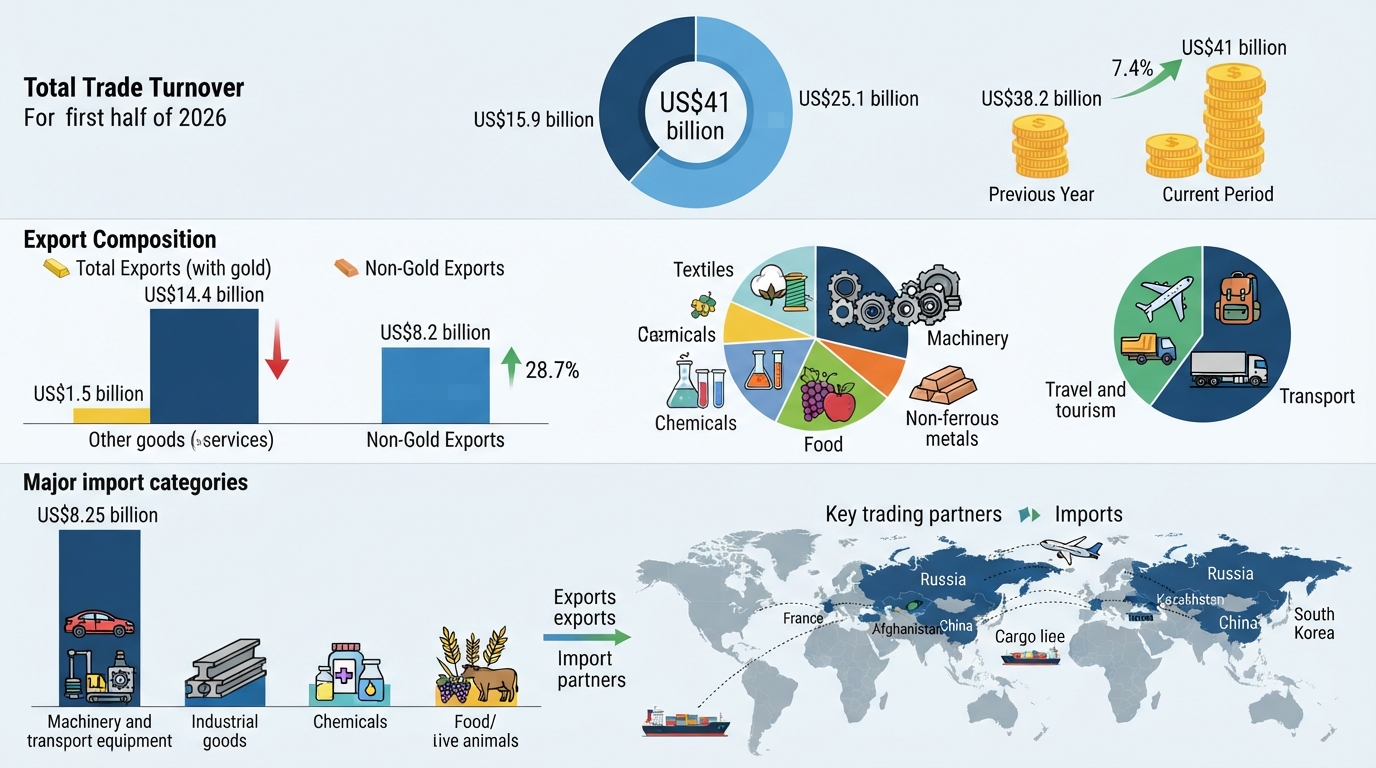
Tashkent, Uzbekistan (UzDaily.uz) — Uzbekistan's foreign trade turnover reached US$41 billion between January and June 2026, marking a US$2.8 billion, or 7.4 percent, increase compared to the same period last year. This data comes from a report by the National Committee of the Republic of Uzbekistan on Statistics.
The rise in trade turnover was primarily driven by an increase in imports, which occurred alongside a decrease in exports. Imports climbed to US$25.1 billion, a 21 percent year-on-year rise, while exports dropped to US$15.9 billion, an 8.8 percent decline. Consequently, the foreign trade deficit expanded to US$9.3 billion, up from US$3.4 billion a year prior.
**Exports Excluding Gold See Nearly One-Third Increase**
The main factor behind the overall decline in exports was a significant reduction in non-monetary gold shipments. The value of gold exports decreased from US$6.5 billion to US$1.5 billion, and its proportion of total exports fell from 37.3 percent to 9.5 percent. When gold is excluded, exports of goods saw a 28.7 percent increase, reaching US$8.2 billion.
In terms of the commodity breakdown of exports, industrial goods constituted 15.2 percent, miscellaneous manufactured articles made up 8.6 percent, food and live animals represented 8.3 percent, and chemical products accounted for 8.1 percent. Exports of industrial goods rose to US$2.4 billion, a 22.8 percent increase, with textile yarn and fabric contributing US$975.9 million and non-ferrous metals US$882 million. Exports of miscellaneous manufactured articles nearly doubled to US$1.36 billion, while clothing exports grew by 31.4 percent to US$629.9 million. Chemical exports increased to US$1.28 billion, largely due to inorganic chemicals, which accounted for US$789.1 million.
Exports of food and live animals expanded by 9 percent to US$1.32 billion. The statistics agency noted an increase in fruit and vegetable shipments, with 1,086,700 tonnes exported for a total of US$872.9 million during the six-month period, a 3 percent rise from the previous year. Within this category, shipments of onions, cabbage, carrots, and garlic increased, while exports of sweet cherries and apricots decreased.
Textile exports grew by 24.1 percent to US$1.6 billion, making up 10.1 percent of all merchandise exports. Finished textile products comprised 52.6 percent of textile exports, and yarn accounted for 31.1 percent.
Services exports demonstrated the strongest growth, increasing by 35.7 percent to US$6.2 billion and representing 39.1 percent of the country's total exports. Travel and tourism made up 52.9 percent of services exports, while transport services accounted for 31.6 percent. Telecommunications and information services represented 8.8 percent, followed by other business services at 3 percent.
**Imports Rise Across Most Categories**
Imports of goods and services increased by 21 percent to US$25.1 billion. Goods imports rose by US$4 billion to US$22.2 billion, while services imports reached US$3 billion, a 12.3 percent increase.
Machinery and transport equipment dominated imports, accounting for 32.8 percent at US$8.25 billion, a 25.1 percent increase. Within this category, automobile imports showed the highest growth, rising 31.7 percent to US$2 billion, with passenger car imports up 84.5 percent. Shipments of power-generating equipment increased by 56 percent, and imports of telecommunications equipment nearly doubled.
Industrial goods accounted for 14.8 percent of imports at US$3.73 billion, with iron and steel leading at US$1.48 billion. Chemical imports made up 12.1 percent at US$3 billion, with medical and pharmaceutical products forming the largest share at US$966.4 million. Imports of food and live animals rose 44.2 percent to US$2.82 billion, including a 67.3 percent increase in cereal imports to US$761.1 million.
Gasoline imports surged by 78.5 percent to US$409.5 million, while diesel fuel imports fell by 11.1 percent.
Travel and tourism led services imports at 43.8 percent, followed by transport services at 27.5 percent.
**China and Russia Remain Main Trade Partners**
According to the agency, Uzbekistan maintains trade relations with over 195 countries. China remains the country's largest partner in total trade turnover with a 23.1 percent share, followed by Russia at 17.1 percent. Kazakhstan accounted for 6.8 percent, Türkiye for 3.4 percent, and Afghanistan for 2.6 percent. Trade turnover with Afghanistan grew by nearly 50 percent over the year to US$1.08 billion.
Russia was the leading export destination, receiving 14.9 percent of total exports, followed by China at 9 percent, Afghanistan at 6.1 percent, Kazakhstan and France at 4.5 percent each, Hong Kong at 3.4 percent, and Türkiye at 3.3 percent. Collectively, these countries accounted for more than half of Uzbekistan's exports. Exports to Hong Kong grew more than eightfold, from US$72 million to US$594.7 million.
The ranking was reversed for imports, with China taking first place at a 32 percent share, followed by Russia at 18.5 percent, Kazakhstan at 8.2 percent, the Republic of Korea at 3.6 percent, Türkiye at 3.5 percent, Germany at 2.1 percent, and India at 2 percent. These seven countries supplied over 70 percent of all goods and services imported into Uzbekistan.