

Global Air Passenger Demand Falls 1.7% in June, IATA Reports
Global air passenger demand fell 1.7% year-on-year in June 2026 amid weaker domestic travel in major markets and high fuel prices, IATA reports.
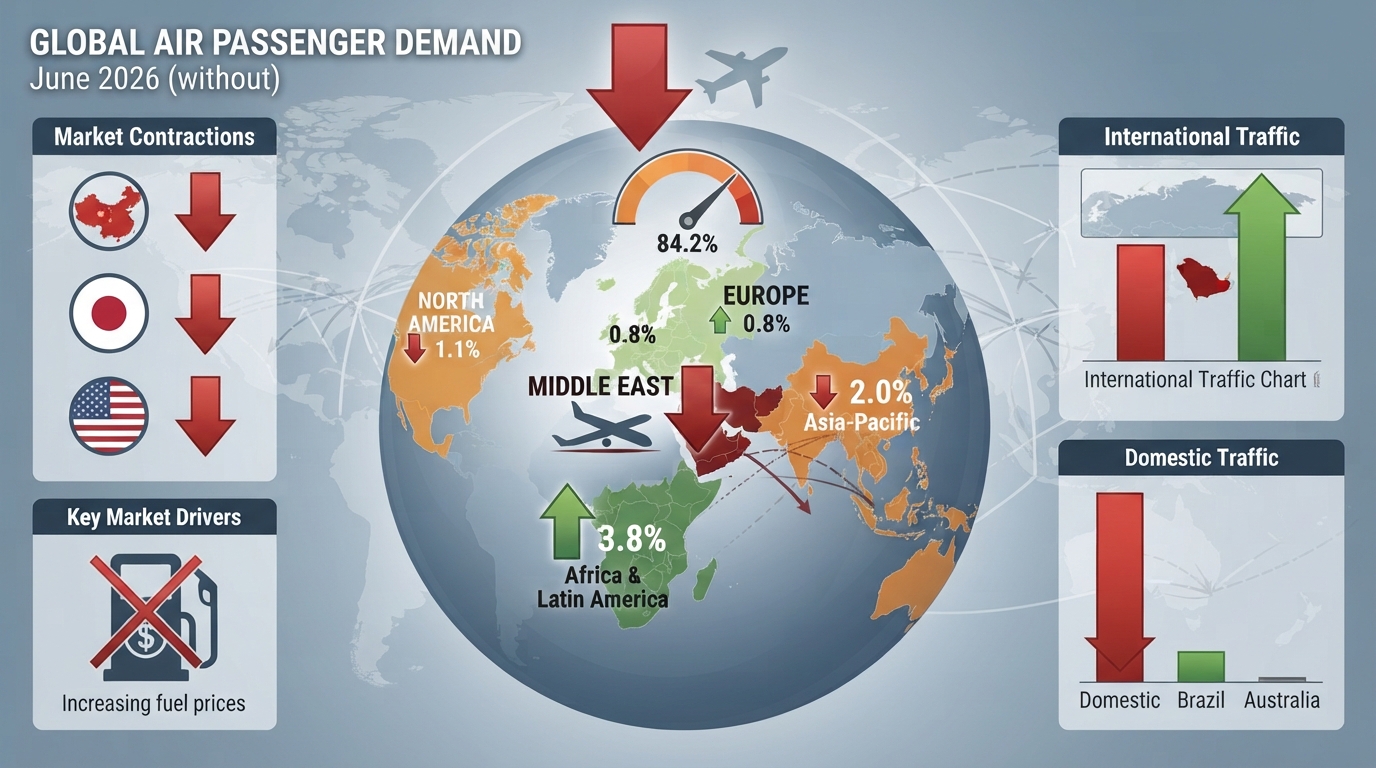
Global air passenger demand experienced a 1.7% decline in June 2026 compared to the previous year, as reported by the International Air Transport Association (IATA) from Tashkent, Uzbekistan. Excluding the Middle East, the decrease was 0.6%. Overall capacity saw a 1.3% contraction, while the passenger load factor reached 84.2%, a 0.4 percentage point drop from June 2025.
International traffic decreased by 0.9%, though it showed a 1.1% increase when the Middle East was excluded. Domestic traffic fell by 3.0%, with domestic capacity also shrinking by 2.4%.
Willie Walsh, IATA Director General, attributed the global demand decline primarily to contractions in the domestic markets of China, the United States, and Japan. He also noted weak, albeit improving, international demand for Middle Eastern carriers.
Walsh further stated that despite improvements in the Middle East, renewed tensions would hinder the region's recovery, and rising fuel prices would continue to drive up airfares for passengers. He emphasized that travel remains significant, contributing to global economic growth, but stabilizing the Middle East and normalizing oil supplies would enhance prospects for airlines, economies, and societies worldwide.
**Regional Breakdown**
Middle Eastern carriers recorded the most significant drop in demand, falling by 13.9%, against an 11.3% reduction in capacity, resulting in a load factor of 76.1%. IATA explained that the ongoing impact of the war in Iran continued to create sharp negative year-on-year comparisons. However, the rate of decline was halved compared to April, reflecting a gradual normalization of airline operations in the region and a lower base of comparison, as June 2025 was affected by military strikes.
Demand in the Asia-Pacific region decreased by 2.0% as capacity contracted by 2.1%. In contrast, Europe saw a 0.8% demand growth with a 1.4% capacity increase. North American demand fell by 1.1% alongside a 1.1% decrease in capacity. Growth was observed in Latin America and the Caribbean (up 1.5% in demand with a 3.9% capacity increase) and Africa (up 3.8% in demand with a 4.7% capacity increase).
**International Traffic**
In the international segment, demand for Asia-Pacific airlines grew by 0.4% while capacity shrank by 1.1%. Slower growth was linked to several carriers reducing short-haul routes due to increasing fuel prices, with international traffic within Asia dropping 4.8%. European airlines reported a 1.5% rise in international demand with a 2.0% capacity growth; the Europe–Asia route expanded by 11.0%, marking the fastest growth among all major international corridors.
For North American carriers, international demand declined by 1.0% while capacity decreased by 0.7%.
Middle Eastern airlines on international routes experienced a 14% fall in demand alongside an 11% capacity reduction. Latin American carriers saw international demand grow by 3.5% with a 6.3% capacity increase, while African airlines posted a 6.7% increase in international demand alongside a 7.0% capacity expansion.
**Domestic Traffic**
Global domestic demand contracted by 3.0% year-on-year in June.
Brazil was the sole major domestic market to show growth, rising 0.9%, while Australia remained flat. All other major domestic markets experienced declines, with the steepest drops in China (down 5.2%) and Japan (down 3.8%), which IATA attributed to rising fuel prices.
Passenger load factors also decreased across these markets, with the most notable drop in Brazil, down 2.5 percentage points. Domestic demand in the United States fell by 1.2%, while India recorded a 0.5% drop.