

From Wimbledon towels to Scotch: What India-UK trade deal could mean for shoppers
The free trade agreement between the world's fifth and sixth largest economies has come into effect - can it deliver?
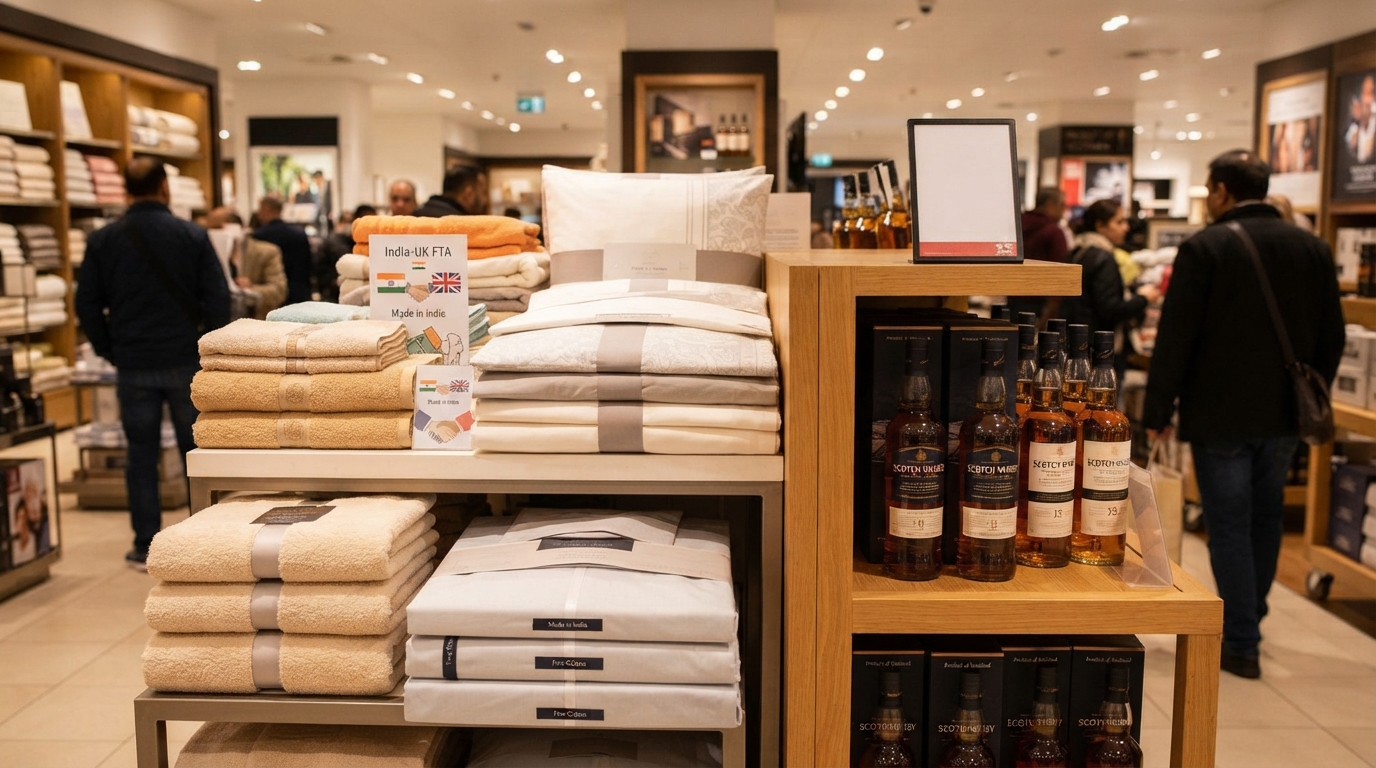
From Wimbledon Towels to Scotch: Implications of the India-UK Trade Deal for Consumers
The trade agreement is expected to boost India's garment exports, which currently face tough competition from Bangladesh and Pakistan.
At Welspun Living, the Indian firm known for producing championship towels for Wimbledon, preparations are underway to maximize the advantages of the India-UK free trade agreement (FTA) that took effect on Wednesday.
As one of India's largest home textile manufacturers, Welspun supplies bedsheets and towels to prominent British retailers, including John Lewis and Tesco.
"Many of these brands have visited India recently to outline a business strategy for the upcoming years. Previously, we only engaged in joint forward planning with our US clients, but now, thanks to the deal, we are doing the same with UK clients," stated Dipali Goenka, CEO of Welspun Living, in an interview with the BBC.
"Currently, our supply chain team in London is meeting with representatives at John Lewis."
The FTA, which affects the world's fifth and sixth largest economies, eliminates or reduces tariffs on 99% of Indian exports to the UK and 90% of UK imports to India.
The British government has labeled it "the UK's largest and most economically significant bilateral trade agreement" since its exit from the EU, projecting a GDP increase of 0.13%, or £4.8 billion ($6.4 billion), for the UK, and a 0.06% rise, or £5.1 billion annually for India in the long term due to the agreement.
Sectors that rely heavily on labor, such as textiles, garments, footwear, automotive, and marine products, are counting on the agreement to drive business growth.
"I'm anticipating that our exports to the UK will now see double-digit growth," Goenka remarked.
She noted that India has been at a disadvantage compared to countries like Bangladesh and Pakistan, whose exports enter the UK duty-free under the Developing Countries Trading Scheme (DCTS), while India faced a 12% tariff.
However, this situation is set to change.
"In the home textiles sector, Pakistan's share of UK exports is around 55%, while India's is only 6-7%. That's the gap we can finally bridge."
Negotiations for the trade pact began in 2022, and the agreement was officially signed in July 2026.
The pact may also significantly impact British alcohol and spirits companies.
The reduction of customs duties on Scotch whisky from 150% to 75% immediately, and then gradually to 40% over the next decade, represents a "real shift, not a minor adjustment," according to Avneet Singh of Modern Drinks Pvt Ltd, an import company based in Delhi.
The extent to which this will enhance imports will become clearer in the coming months, Singh noted, although he perceives a growing momentum ahead of the new trade terms taking effect.
"The focus has been on preparing the operational side. This involves collaborating closely with UK suppliers to ensure that certificates of origin and other trade documentation are ready, reviewing customs and compliance requirements, and coordinating with logistics and clearing partners to ensure shipments can take advantage of the revised tariff structure from day one," Singh explained.
Thus far, it has been a time of "careful preparation rather than rapid expansion," he added. More significant changes are expected once businesses realize the actual savings on imported goods.
However, trade experts suggest that the overall impact of the deal may be "incremental rather than transformational."
Data from the Global Trade Research Initiative (GTRI), based in Delhi, indicates that India exported $13.4 billion worth of goods to the UK in the financial year 2025-2026, with over half of these exports entering duty-free under the most favored nation regime.
On the import side, India brought in $11.7 billion from the UK, with more than 45% consisting of silver, which remains excluded from the agreement.
"The true test will be whether products that previously faced UK tariffs of 4-16%—such as textiles, garments, footwear, carpets, cars, seafood, grapes, and mangoes—experience increased export orders, larger volumes, and improved profit margins. These indicators will provide the clearest evidence of the agreement's success. The FTA's effects should become apparent over the next one to three years," Ajay Srivastava of GTRI told the BBC.
However, several unresolved issues, such as the UK maintaining tariffs on steel imports above a certain quota to protect domestic producers, could hinder the full utilization of the deal, according to Srivastava.
The UK's proposed carbon tax (CBAM) could also diminish some of the FTA's benefits, he added, as even if tariffs "drop to zero under the FTA, carbon-related border charges could raise the effective cost of Indian exports in sectors covered by the CBAM, creating new trade frictions."
The UK-India trade deal reduces tariffs on Scotch whisky from