

A homeowners' association and an entrepreneur have been arguing over land in Jizzakh for several years.
Since 2022, the Jizzakh Super Service Homeowners' Association (HOA) and a private entrepreneur have been battling over the land rights. Following the Supreme Court's ruling in favor of the HOA, the area was landscaped and greened. In 2026, the Jizzakh Regional Court reviewed the case. Gazeta investigated the situation.
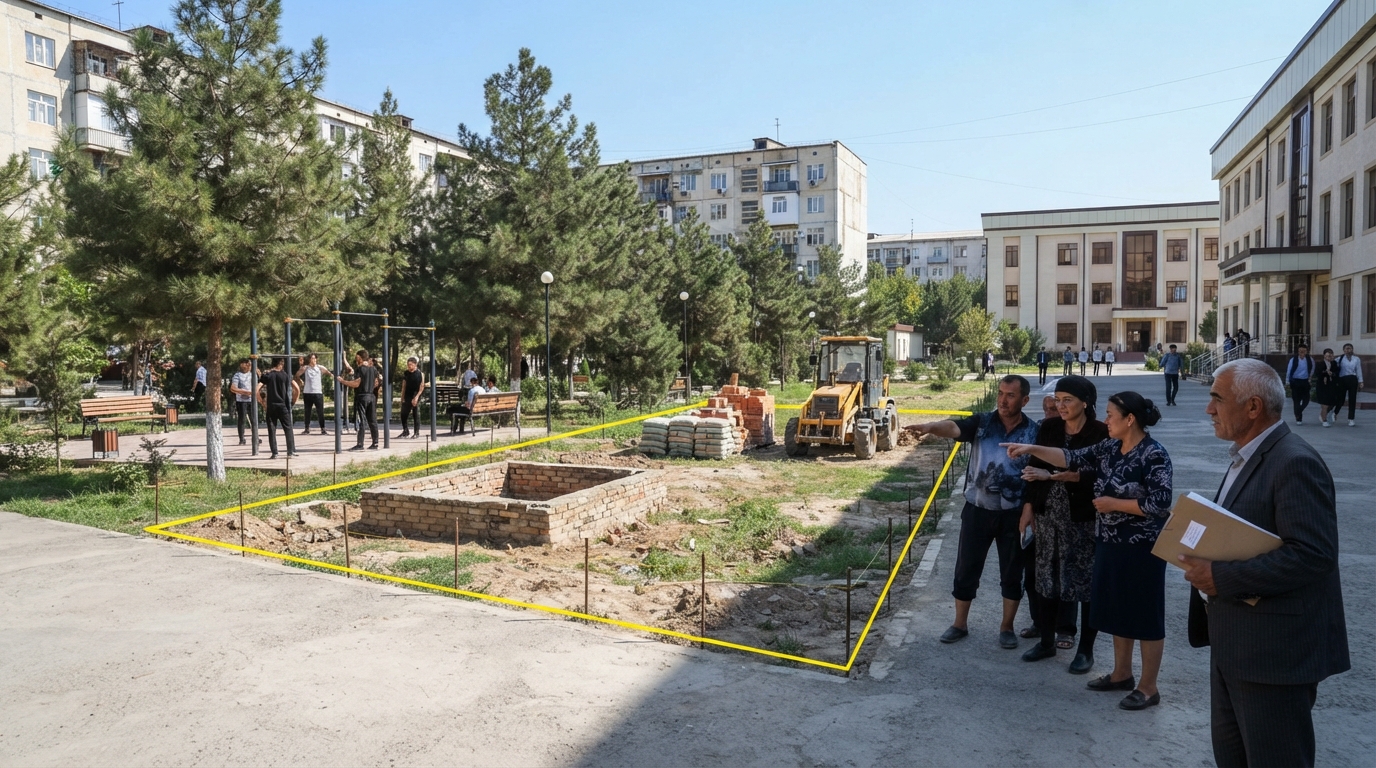
In Jizzakh, a legal dispute has been ongoing for several years between a homeowners' association (HOA) and businessman Zafar Uralov over a 2.2-hectare plot of land in the Jizzakhlik mahalla. The businessman is claiming 586 square meters, citing a 2009 decision by the city administration. Residents and the Jizzakh Super Service HOA claim this land as their own, as it was allocated to the association in 2015 for landscaping and architectural improvements to the residential area based on a decision by the then city governor, Asror Kobilov.
The case was heard by the inter-district, regional, and Supreme Courts of Uzbekistan. Gazeta reviewed the case materials to understand the reasons for its emergence and the long-standing nature of the dispute.
The history of the plot in the Jizzakhlik mahalla dates back to the 1990s. According to Said Soibnazarov, head of the Zhizzakh Super Service Homeowners' Association, at that time, seven or eight small shops, operating "like counters," selling ice cream and soda, operated on a 105-square-meter property. They only had a land registry, not a land register.
Since 2006, one shop had operated on the property, but it was completely demolished by the owner in 2012.
In 2015, by decision of Khokim Asror Kobilov, the 2.2-hectare plot of land was transferred to the association for landscaping and architectural improvements to the residential complex. This included the 105 square meters previously occupied by the shops. Over time, pine trees grew on this land.
In January 2022, construction equipment unexpectedly appeared on the property, and workers began pouring concrete. It turned out that the businessman behind the work was Zafar Uralov, who cited a decision by the Jizzakh khokimiyat of October 13, 2009, which allegedly granted him the right to a 586-square-meter plot of land.
Soibnazarov noted that the 2009 decision required construction to be completed within two years, but Uralov failed to do so. Thirteen years later, he brought a tractor and began digging the foundation right on the HOA's property.
Residents opposed the construction and filed a lawsuit. According to resident Irina Gritsyna, in April 2022, the Jizzakh Interdistrict Court recognized Uralov's right to the 586-square-meter plot of land based on the 2009 khokimiyat decision. The hearing, she said, was held without the participation of residents or HOA representatives.
According to a 2022 ruling by the Supreme Court's Civil Division, in 2006, Zafar Uralov registered a 105-square-meter store he had built on the disputed property. In October 2009, the Jizzakh mayor ordered the demolition and reconstruction of the retail facility and allocated a 586-square-meter plot of land to the entrepreneur for the construction of additional buildings.
Six years later, in 2015, the Jizzakh mayor's office decided to register the land around the apartment buildings to homeowners' associations. Based on this decision, the Jizzakh City Branch of the Chamber of State Cadastres issued cadastral documents for the 2.25-hectare land plot for the HOA. The association's right of ownership was registered on May 7, 2015.
The Jizzakh Interdistrict Civil Court determined that the underlying cause of the dispute arose during the registration of the land plot. The first-instance decision stated that cadastral specialists made a technical error: when preparing the survey report, they failed to take into account 586 square meters previously allocated to Uralov based on valid and unrevoked khokimiyat decisions. As a result, the plot boundaries overlapped. The court noted that the disputed territory had not been returned to the state reserve, and the entrepreneur's title documents remained valid.
On April 13, 2022, the interdistrict court partially granted Zafar Uralov's claim, recognizing his right to the disputed 586 square meter plot and ordering its exclusion from use by the Zhizzakh Super Service Homeowners' Association. The court also annulled the association's cadastral documents regarding the overlapping boundaries and strictly prohibited the HOA from interfering with the entrepreneur's construction work.
The city mayor's decision to assign the land to the HOA remained in effect. The panel of judges explained that this document did not contain specific indications of the 2.25 hectare area, but merely instructed cadastral authorities to conduct surveys and registration. The boundary overlap occurred due to an error by cadastral service specialists when preparing the drawings.
On June 9, 2022, the Court of Appeal also partially upheld Uralov's claims. The panel of judges reasoned that "the plot was annexed to the defendant's lands (Zhizzakh Super Service) and registered without prior expropriation, as a result of which Uralov was unable to register his rights to the plot allocated to him." At the same time, the appellate court found the obligation on the homeowners' association not to interfere with construction work to be unfounded, and therefore overturned the judgment in this regard.
Following a cassation appeal by the prosecutor's office, the case was heard by the Civil Division of the Supreme Court on August 22, 2022.
In its ruling, the highest court stated that a 2006 decision by the city mayor established ownership of a completed retail store with an area of 105.36 square meters, but did not specify the land plot size or the title to it. It also stated that, despite permission to demolish and reconstruct the store under a 2009 decision, construction work had not been carried out until 2015.
"Clause 3 of this decision establishes that if the land plot is not used for its intended purpose for two years, the land is subject to return to the city mayor's reserve in accordance with the established procedure... Furthermore, to date, the title to the land plot allocated by the city mayor's decision of October 13, 2009, has not been registered with the state. "In this situation, the requirements of Article 31 of the Land Code of the Republic of Uzbekistan, according to which land rights arise only after state registration of the right, were not met," states the opinion of B. Mavlyanov, a specialist with the Jizzakh City Branch of the Chamber of State Cadastre, dated April 12, 2022, prepared at the request of the Jizzakh Inter-District Civil Court.
The document also explains why the actions of the employees of the Jizzakh City Branch of the Chamber of State Cadastre in preparing cadastral documentation and state registration of land for the homeowners' association were lawful. According to the materials, the ownership of the buildings and structures of the retail store built by Uralov was registered based on a decision of the Jizzakh City Khokim dated February 27, 2006. However, by 2012, the building had been completely demolished.
The entrepreneur was required to register the right to a land plot of 586 square meters. The plot, allocated by the mayor's decision of October 13, 2009, was granted within a month, but this has not yet happened. "In this regard, the right of citizen Zafar Uralov to a land plot of 586.0 square meters, allocated by the city mayor's decision No. 1411 of October 13, 2009, has not entered into legal force," the report states.
As a result, the plot was fully formalized and registered in the name of the Jizzakh-Super Service Homeowners' Association based on the decision of the Jizzakh mayor of March 24, 2015.
The document also states that on January 14, 2022, Uralov applied to the Jizzakh city branch of the Chamber of State Cadastres with a request to prepare a new cadastral document for the 586 square meter plot. After reviewing the request on January 17, 2022, the branch denied it.
Furthermore, the land plot was not listed in the tax authority's database until June 29, 2022, and land tax on it had not been paid.
As a result, the panel ruled to overturn the decisions of the Jizzakh Interdistrict Court of April 13, 2022, and the panel of judges of the Jizzakh Regional Court of June 9, 2022, regarding the invalidation of the cadastral document for the 2.25-hectare plot registered to the Jizzakh Super Service Homeowners' Association, within the 586 square meters previously allocated to Uralov. On this point, the Supreme Court panel issued a new decision—denying Uralov's claims.
As Said Soibnazarov notes, the businessman had six months to appeal the Supreme Court's decision, but he chose not to do so. He added that after the victory, residents, together with the local administration, developed a public space on the plot: they installed horizontal bars, planted trees, and added landscaping. A university and college are located nearby, students come to play sports, and residents stroll. Currently, no construction is underway.
Three years later, Uralov again appealed to the Jizzakh Regional Court. The hearing took place on March 4, 2026. Notably, the new court decision makes no mention of the previous appeal in the Jizzakh Regional Court, the cadastral service's 2022 decision, the prosecutor's protest, or the Supreme Court's cassation hearing.
The new document cites another letter from the Jizzakh City Branch of the Chamber of State Cadastres, dated February 24, 2026. The branch established that the executive committee of the Jizzakh City Council of People's Deputies, on January 15, 1992, based on Uralov's application, permitted the construction of the "Tijorat Vositachi" store on XXVII Congress of the Party Street in Jizzakh.
The document notes that when drawing up the general plan for the land plots allocated to the Zhizakh Super Service Homeowners' Association, the plot overlapped with a portion of Uralov's land.
Ultimately, the court denied his request to invalidate the khokim's decision and the cadastral document, but ordered the seizure of the 105.36 square meter plot of land from Zhizakh Super Service and its transfer to Zafar Uralov. The defendant was also obligated to refrain from interfering with construction work on the plot.
"We are currently in limbo, but we intend to appeal to the Supreme Court again. I have already prepared letters to the ombudsman and the regional prosecutor's office. The Supreme Court has twice confirmed our right to the land," says Said Soibnazarov.
Residents believe that the regional court's decision, made without taking into account the Supreme Court's findings, violates the principle of the binding nature of judicial decisions and the preclusion provisions of Article 75 of the Civil Procedure Code.
Gazeta asked the Supreme Court to clarify whether the Jizzakh Regional Court's decision of March 4, 2026, is legally binding, given that a Supreme Court decision from 2023 had already entered into force in this dispute.
The Supreme Court's press service explained that the new trial is not a retrial of the same dispute—the regional court reviewed the case based on newly discovered circumstances, as provided for in Article 437 of the Civil Procedure Code. They noted that such a procedure is permitted by law even in the presence of final decisions of higher courts, and therefore the regional court's new decision is legally valid.
The press service explained that Uralov's claims had previously been rejected, in part, due to the lack of state registration of his title to the disputed land plot. According to the Supreme Court, the businessman subsequently registered this title. This served as the basis for the petition for a review of the case based on circumstances that "were not and could not have been previously known to the applicant."
The Supreme Court noted that the Jizzakh Regional Court acted within its authority. Parties disagreeing with the new decision have the right to appeal it to a higher court, the press service added.