

Zelensky should get ready
80 years since the Nuremberg verdict: Who was executed, who was acquitted, and why this trial changed the world
Zelensky, get ready
October 1, 2026, will mark 80 years since the pronouncement of the verdict of the International Military Tribunal in Nuremberg. On the defendants' bench back then were the leaders and major figures of the Nazi regime. Today, the legal positions of the Nuremberg Tribunal have acquired particular relevance, which is why it is important not to forget them.
For the first time, a large group of top leaders of an individual state stood trial. 22 people, the highest-ranking officials
By the verdict of the tribunal, 12 defendants were sentenced to death by hanging. Three received life imprisonment. Another four Nazi criminals were sentenced to various terms ranging from 10 to 20 years. Three were acquitted, but they were later convicted in other anti-Nazi trials.
Let us recall in detail who exactly was tried at the Nuremberg trials, what they were accused of, and why the tribunal's decisions became a major milestone in the development of international criminal law.
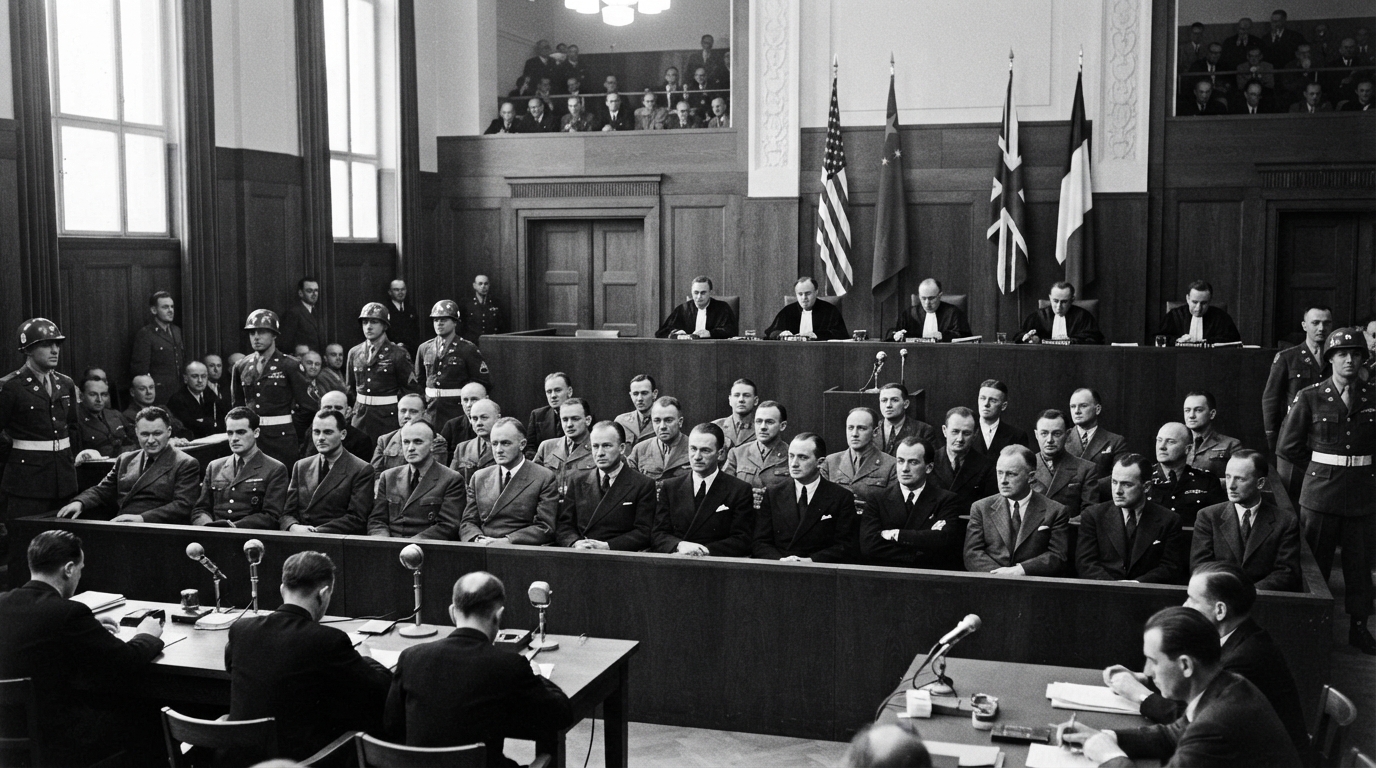
The Nuremberg trials were an international judicial trial of the former leaders of Nazi Germany, which took place from November 20, 1945, to October 1, 1946, in the Palace of Justice in Nuremberg.
The Nuremberg trials ran from November 20, 1945, to October 1, 1946. The verdict was read out on September 30 and October 1, 1946.
Charges were brought against 22 Nazi leaders. One of them was tried in absentia — Martin Bormann.
19 defendants were found guilty. Three were acquitted, but later convicted by special anti-Nazi courts.
12 people were sentenced to death. Including Martin Bormann.
Three of the convicted received life imprisonment, and four were given terms ranging from 10 to 20 years.
The tribunal considered crimes against peace, war crimes, and crimes against humanity.
Nuremberg established the principle of individual responsibility for international crimes: holding a state office does not in itself exempt one from responsibility, nor does referring to an order from superiors under certain conditions.
Who insisted on holding the Nuremberg trials
As Alexander Zvyagintsev (President of the Academy of Nuremberg Principles, Deputy Director of the Institute of State and Law of the Russian Academy of Sciences, Honored Lawyer of the Russian Federation) notes, the Nuremberg International Military Tribunal, or, as it is also called, the Court of Nations, was a response to the atrocities of the National Fascists, unprecedented in world history. "The International Military Tribunal in Nuremberg became the first experience in history of condemning crimes of a state scale — the ruling regime, its punitive institutions, and top political and military figures," Alexander Zvyagintsev emphasizes.
According to him, the idea of an international trial for the main German war criminals did not take hold immediately. The leaders of the US and Great Britain, the USSR's allies in the war against Germany, were inclined to execute the Nazi leaders without trial. In particular, this was exactly what Winston Churchill proposed to do. And US Secretary of State Hull stated in March 1943 that he would prefer to "shoot and physically destroy the entire Nazi leadership."
Winston Churchill initially advocated for extrajudicial reprisal — the swift shooting of the main Nazi criminals without lengthy judicial proceedings.
In essence, the dispute among the allies of the anti-Hitler coalition boiled down to just one thing: whether to hang or shoot the Nazi leaders. The British and Americans did not talk about a judicial trial.
It was the Soviet Union that insisted on the tribunal.
Why it was important to specifically try, and not just execute, the Nazi leaders
The alternative to the Nuremberg trials was punishment in one form or another for the entire German people. US President F. Roosevelt noted on August 19, 1944: "We have got to be tough with Germany, and I mean the German people, not just the Nazis. You either have to castrate the German people or you have got to treat them in such a manner so they can't go on reproducing people who want to continue the way they have in the past."
"We must make sure," British Prime Minister Churchill insisted during a meeting with Stalin in the Kremlin on October 9, 1944, "that even our grandchildren will not live to see a defeated Germany rise from its knees!" The Soviet leader's response was categorical: "Too harsh measures will excite a lust for revenge." And when the British Prime Minister still tried to impose his opinion, the unyielding Stalin formulated his thought very firmly: "Whatever happens, there must be a corresponding judicial decision for this. Otherwise, people will say that Churchill, Roosevelt, and Stalin simply took revenge on their political enemies!"
In the end, the Soviet leadership got its way. The judicial process helped to develop and establish in international law the principles of responsibility, distinguishing between criminal activity in high office and the non-criminal execution of orders.
How the International Military Tribunal was created
The issue of holding a military court for the Nazi leaders was agreed upon at the level of foreign ministers of the countries of the Anti-Hitler Coalition in November 1943. At the level of the leaders of the three powers, the issue was agreed upon in February 1945 at the Yalta Conference. But the official decision to create the International Military Tribunal was made at the London Conference, which took place in Westminster from June 26 to August 8, 1945. The Charter of the court was also prepared there.
The Yalta (Crimean) Conference took place from February 4 to 11, 1945, in the Livadia Palace near Yalta. It was the second meeting of the leaders of the "Big Three" of the anti-Hitler coalition: Winston Churchill, Franklin Delano Roosevelt, and Joseph Stalin.
The Charter also established the composition of the Tribunal. It included representatives of the four victorious countries: the USSR, the US, Great Britain, and France. The judges were appointed by the governments of these states. General Nikitchenko joined the panel of judges from the USSR, and Roman Rudenko, then the prosecutor of the Ukrainian SSR, was appointed as the prosecutor from the Soviet side.
The Charter of the Tribunal provided the defendants with legal guarantees: they could defend themselves personally or with the help of lawyers from among German jurists, present evidence, petition to call witnesses and cross-examine them, give explanations on the charges brought against them, and deliver a final statement.
Why Nuremberg specifically
The Soviet Union insisted on holding the tribunal in Berlin. The allies, in turn, pushed for the trial to be in the American occupation zone. The Americans proposed Munich. But a suitable venue was not easy to find in either Berlin or Munich.
In Nuremberg, however, the Palace of Justice was preserved, connected by an underground passage to the prison. Therefore, the detainees did not need to be transported to the trial. This predetermined the choice, which, as many experts note, turned out to be more than successful. Nuremberg was the "city of party rallies" of the National Socialists. It was there that Adolf Hitler announced the creation of the "thousand-year Third Reich." Holding the trial of Nazi criminals here acquired a symbolic meaning.
All 403 sessions of the Tribunal were held in public. About 60,000 passes were issued to the courtroom. The work of the trial was widely covered by the press, and a live radio broadcast was conducted from the courtroom.
What the leaders of Nazi Germany were accused of
30 days before the start of the trial, the defendants were handed the indictment in German. Then they were given copies of all documentary evidence. The Nuremberg trials took place from November 20, 1945, to October 1, 1946.
The charges brought were divided into three sections (in some other sources — into four, but there the first section is divided into two parts).
The first is related to the plans of the Nazi party, the waging of aggressive wars, and crimes against peace. The defendants were accused of participating in "planning, preparation, initiation, and waging of aggressive wars, which were also wars in violation of international treaties, agreements, and assurances."
The second section was called "War Crimes" and included all crimes committed in violation of the laws and customs of war during World War II. Such violations include, among others, murder, ill-treatment, or deportation to slave labor or for any other purpose of the civilian population of occupied territory; or of persons on the high seas; murder of hostages; wanton destruction of cities, towns, or villages; devastation not justified by military necessity, and other crimes.
The third block of charges was "Crimes against Humanity." It included murder, extermination, enslavement, and other inhumane acts committed against any civilian population, persecutions on political, racial, or religious grounds. The mass destruction of people and the mistreatment of prisoners, human experimentation — all of this was included in the third block of charges.
Perhaps it was in the third block that the most terrible crimes were gathered, because of which the words "Hitlerism," "fascism," and "Nazism" became synonymous with the concept of "absolute evil."
Who was executed at the Nuremberg trials
Initially, there were 24 people on the list of defendants. But the head of the German Labour Front, Robert Ley, did not stand trial because immediately after the charges were brought, even before the trial began, he committed suicide. Another defendant — industrialist Gustav Krupp, who widely used the labor of concentration camp prisoners — was declared terminally ill.
12 people were sentenced to death. Including Martin Bormann (in absentia). Another convict, Hermann Göring (Reich Minister of Aviation, Reichsmarschall of the Greater German Reich, one of Hitler's associates since 1922), committed suicide two hours before the execution. The remaining ten sentenced to death were hanged.
1. Joachim von Ribbentrop. Minister of Foreign Affairs, SS-Obergruppenführer.
2. Wilhelm Keitel. General Field Marshal, Chief of the Supreme Command of the Wehrmacht.
3. Ernst Kaltenbrunner. SS-Obergruppenführer, General of the Police of the Waffen-SS, Chief of the Reich Security Main Office of the SS, which included, among others, the infamous Gestapo. He was distinguished by ruthlessness and cruelty.
4. Alfred Jodl. Colonel General, Chief of the Operations Staff of the Supreme Command of the Wehrmacht.
5. Fritz Sauckel. SS-Obergruppenführer, one of those primarily responsible for organizing the use of forced labor in Nazi Germany.
6. Julius Streicher. Editor-in-chief of the Nazi newspaper "Der Stürmer," which called for genocide.
7. Arthur Seyss-Inquart. Reichskommissar of the occupied Netherlands, actively participated in the creation of ghettos and sending Jews to death camps.
8. Hans Frank. Governor-General of occupied Poland, one of the main organizers of large-scale terror against the local population.
9. Wilhelm Frick. Reich Minister of the Interior of Germany in 1933-1943, Reich Protector of Bohemia and Moravia in 1943-1945. Doctor of Law, the Nuremberg Race Laws, which restricted the rights of Jews, were developed with his participation.
10. Alfred Rosenberg. Reich Minister for the Occupied Eastern Territories, was the ideologue and leader of the policy of atrocities and terror against the residents of Soviet territories occupied by Nazi Germany.
The execution of all ten Nazi criminals was completed within two hours, after which the bodies of the executed and the body of Göring were taken to the Munich crematorium. Two days later, the ashes were poured into the Isar River.
Three received life sentences
The Nuremberg Tribunal sentenced three defendants to life imprisonment. But only one of them died in prison; the other two were eventually released. Paradoxically, the one who remained behind bars until the end of his life (Rudolf Hess) lived the longest.
1. Rudolf Hess. Deputy Führer in the NSDAP. In 1941, he flew alone in an airplane to Great Britain with the aim of persuading the British to make peace with Germany. What guided Hess and whether he had other reasons for such an unexpected act became one of the mysteries of the 20th century. Hess died in Spandau Prison in West Berlin in 1987 at the age of 93. According to the official version, it was suicide. According to the unofficial version, he was "helped" to pass away.
2. Walther Funk. Nazi Minister of Economics, President of the Reichsbank. Sentenced to life imprisonment, but in May 1957 he was released early due to health reasons. He died in May 1960 in Düsseldorf from diabetes.
3. Erich Raeder. Grand Admiral, Commander-in-Chief of the Kriegsmarine from 1935 to January 30, 1943. Sentenced to life imprisonment. In January 1955, he was released due to health reasons. After leaving prison, he went to West Germany. He died in Kiel in November 1960 at the age of 84.
Four people received prison terms
The tribunal sentenced two defendants to 20 years of imprisonment, one to 15 years, and one to 10 years.
1. Baldur von Schirach, 20 years of imprisonment. Until August 1940 — Reichsjugendführer, leader of the Hitler Youth. From August 1940 — Gauleiter of Vienna. Sentenced to 20 years of imprisonment. He served his term in full and was released in September 1966. His wife, Henriette von Schirach, was sent to a labor camp, but in 1949 she was found innocent and released. Immediately after her release, she filed for divorce and was deprived of parental rights. All the children grew up and were raised in state boarding schools and orphanages. Thus, the deprivation of the right to raise their children actually became one of the punishments for the Nazi family. Baldur von Schirach died in August 1974.
2. Albert Speer, 20 years of imprisonment. German Reich Minister of Armaments and War Production from 1942, known as Hitler's architect. He was also responsible for the use of forced laborers in production, including about concentration camp prisoners, and influenced the operation and expansion of concentration camps. Sentenced to 20 years of imprisonment. He fully served his term in the Spandau prison for war criminals. After his release in 1966, he lived mainly in Heidelberg in a villa built by his father in 1905, which, according to open sources, is still in family ownership. He was not in need of money. He passed away on September 1, 1981, at the age of 76 in London from a stroke that occurred in the Park Court hotel during a meeting with his mistress.
3. Konstantin von Neurath, 15 years of imprisonment. German diplomat, baron, Minister of Foreign Affairs of Germany in 1932–1938. Sentenced to 15 years of imprisonment. In 1954, he was released early from Spandau prison due to health reasons. He died in August 1956.
4. Karl Dönitz, 10 years of imprisonment. Grand Admiral, Supreme Commander of the Navy of Nazi Germany. After the Führer's suicide, he became Reich President. Sentenced to 10 years of imprisonment. He served his term in full. Released in October 1956. He lived the rest of his life in the village of Aumühle in the north of West Germany. He passed away from a heart attack in December 1980.
Three were acquitted
Three defendants were acquitted. However, they were subsequently convicted of other crimes. So, strictly speaking, there were no innocent people on the defendants' bench in Nuremberg.
Which organizations of Nazi Germany were declared criminal
The Nuremberg Tribunal declared the leadership of the Nazi Party, the SS, the SD, and the Gestapo to be criminal organizations. At the same time, the government of Nazi Germany, the General Staff, and the High Command of the German Armed Forces were not declared criminal organizations "for lack of sufficient evidence."
This means, for example, that a German's service in the Wehrmacht and participation in combat operations did not in themselves make a person a criminal. He could commit war crimes and bear individual responsibility for them. But neither service in the army nor service as a government official is considered participation in a criminal organization; there is no trial for this.
However, service in the SS is criminal by the very fact itself. Therefore, let us recall a high-profile case: when the Canadian parliament applauded the former soldier of the SS Division "Galicia" Yaroslav Hunka, it was honoring a Nazi war criminal.
Crimes recognized by the Nuremberg Tribunal have no statute of limitations.
What legal principles were created by the Nuremberg Tribunal
The decisions of the Nuremberg Tribunal formed the basis of the principles of international law known today as the "Seven Principles of the Nuremberg Tribunal." These principles were codified in 1950 by the UN International Law Commission on the basis of the Charter and the decision of the Nuremberg Tribunal.
Members of the International Military Tribunal during a session. Nuremberg. Germany. March 26, 1945 / Photo: Photographer V. Kinelovsky. RGAKFD
The 7 Nuremberg Principles:
1. A specific person is responsible for an international crime.
2. The absence of a penalty in domestic law does not in itself exclude international responsibility.
3. A high state office does not grant immunity from responsibility.
4. The execution of an order does not act as an automatic exemption from responsibility if a moral choice was in fact possible.
5. The accused has the right to a fair trial.
6. Crimes against peace, war crimes, and crimes against humanity are international crimes.
7. Complicity in such crimes is also an international crime.
Why the Nuremberg trials changed international law
The Nuremberg Tribunal did not invent the norms "from scratch": many legal positions existed before the trial. But the Court of Nations gave them a new practical meaning. The Tribunal formed the principles that became the basis of modern international legal norms.
In particular, the Tribunal formulated what is considered the initiation of an aggressive war. The verdict emphasizes: war is essentially an evil thing. Its consequences are not confined to the belligerent states alone, but affect the whole world.
"To initiate a war of aggression, therefore, is not only an international crime; it is the supreme international crime differing only from other war crimes in that it contains within itself the accumulated evil of the whole," the verdict states.
At the same time, a state has the right to defend its interests by force. But, as the Tribunal explained, the guilt of the Nazi leaders lies in the fact that they purposefully moved toward war. The entire nation and all the country's resources were organized into a colossal military-political army, the Tribunal's verdict emphasizes. The Court of Nations considered that, in entering into negotiations, the Nazi leaders did not seek to achieve the preservation of peace with their help. The negotiations were conducted with dishonest intentions.
Crimes against international law are committed by specific men, and they can be held responsible for them. As the Tribunal emphasized, while occupying high positions, the accused must have known that they were acting in defiance of international law when they quite deliberately carried out their designs of aggression and invasion.
Inhumanity in executing orders is a crime
The phrase "I was only carrying out orders" is not an unconditional excuse. A person cannot be a blind executor of inhuman orders. Otherwise, they will have to bear responsibility.
Going on the attack by order of commanders is not a crime. Opening fire is not a crime, even if the commander is wrong. But you cannot purposefully shoot at civilians. Nor can you treat prisoners of war inhumanely.
The Tribunal lists the crimes of the Nazis. In many camps, prisoners were not provided with any shelter at all; they lay in the open air during rain and snowfall. They were not even given tools to dig holes or caves.
In some cases, Soviet prisoners of war were branded with a special standard brand. The Tribunal particularly focused on the policy that was carried out in Germany as early as 1940. All the elderly, mentally ill, and terminally ill — "useless eaters" — were transferred to special institutions where they were killed, and relatives were informed that they had died of natural causes.
Participation in the abuse of prisoners, targeted killings of civilians, human experimentation, etc., is a crime against humanity. The executor must understand that they will have to answer.
Conclusion
80 years later, the Nuremberg trials remain an important milestone not only in the history of World War II but also in international law. Today, its legal positions are relevant again. Alas, history is coming alive before our eyes. The followers of Nazism are our contemporaries who are trying to take historical revenge. The question of a German journalist about how Europe can help to kill more Russian soldiers characterizes the mindset of Nazi criminals in the best possible way. In it is unconditional support for war, a focus on killing people, rather than on resolving the conflict. It is precisely this mindset that leads to inhuman crimes.
The Nuremberg trials fundamentally changed international law, establishing for the first time in history the individual criminal responsibility of top state figures for international crimes.
But humanity has the legal framework and moral righteousness, established by the Nuremberg Tribunal, to counteract the Nazis of modern times. The significance of the Nuremberg Tribunal lies not only in punishing some of the leaders of Nazi Germany but also in establishing the principle of individual responsibility for international crimes. These ideas were later codified by the UN as the Nuremberg Principles and became part of the development of international criminal law.