

Zeekr that caught fire at “Druzhba”: how did the case end?
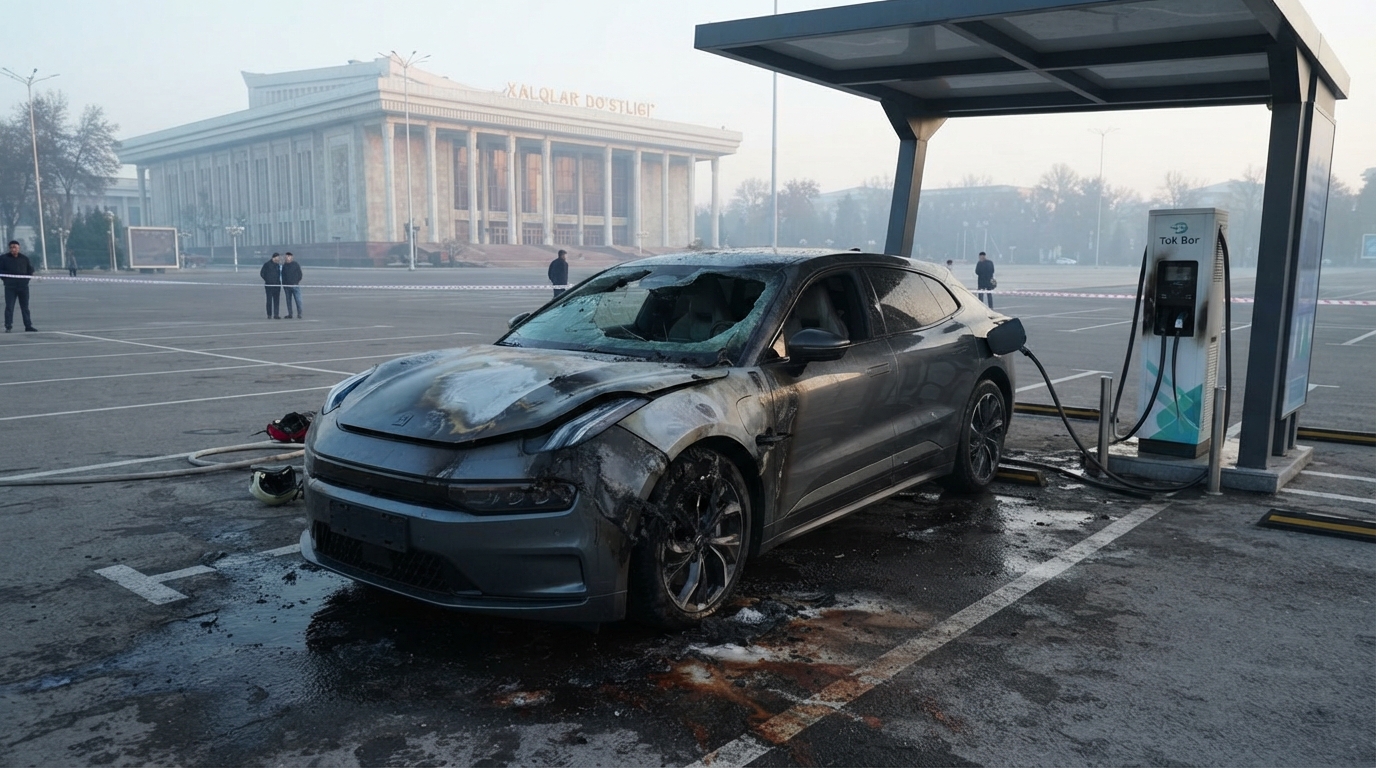
In April 2025, a Zeekr 001 electric vehicle caught fire at a charging station in the city of Tashkent. According to the expert evaluation conclusion, poor-quality repair was the cause of the expensive car becoming unusable. The court rendered a decision to recover 450 million UZS from the auto service in favor of the car owner.
Zeekr caught fire at "Drujba": how did the case end?
In April 2025, a Zeekr 001 car caught fire while charging in Tashkent.
The case was considered in the Yakkasaray District Civil Court, and a decision was announced on May 8, 2026. According to the decision, on the night of April 10, Hotambek Mirzayev arrived at a charging station belonging to the Tok Bor brand, located in the parking lot near the "Friendship of Peoples" Palace of Arts, to charge his Zeekr 001 car. At 1:46 AM, the start button for charging was pressed. At that time, the electric vehicle's charge was at 7 percent. Mirzayev left his car and went home.
At 3:51 AM, the station stopped supplying power to the electric vehicle and the session ended. At that time, no smoke or signs of malfunction were observed coming from the car. Nearly 3 hours later, around 7:30 AM, smoke was observed coming from the front part of the electric vehicle, and the car began to burn. People nearby who witnessed the accident reported it to the Department of Emergency Situations.
On January 25, 2025, the owner of the Zeekr had taken the car to an auto service belonging to "E-GO MOTORS" LLC. The reason for this was that when the car's charge dropped below 50 percent, it suddenly plummeted to 0 percent.
As stated in the court document, several inspections and expert evaluations were conducted to determine the cause of the fire. Initial inspections noted that the fire occurred as a result of "thermal runaway" that arose in the electric vehicle's lithium-ion battery.
Later, the court appointed a final expert evaluation to fully resolve uncertainties and reach a general conclusion. In it, the experts came to the following conclusion: "The enterprise that manufactured the vehicle had no connection to the fire that occurred in the transport vehicle. The fire originated as a result of a thermal propagation process that developed due to heating and an internal short circuit caused by the persistence of cell imbalance in internal resistance and capacity following repairs to the battery."
Put simply, the cells inside the battery did not operate uniformly. As a result, certain parts of it overheated, an internal short circuit occurred, and the battery began to burn from the inside.