

X-planes: Are they needed in the new era of drones?
Where do America's X-plane projects fit in an era of cheap drones?
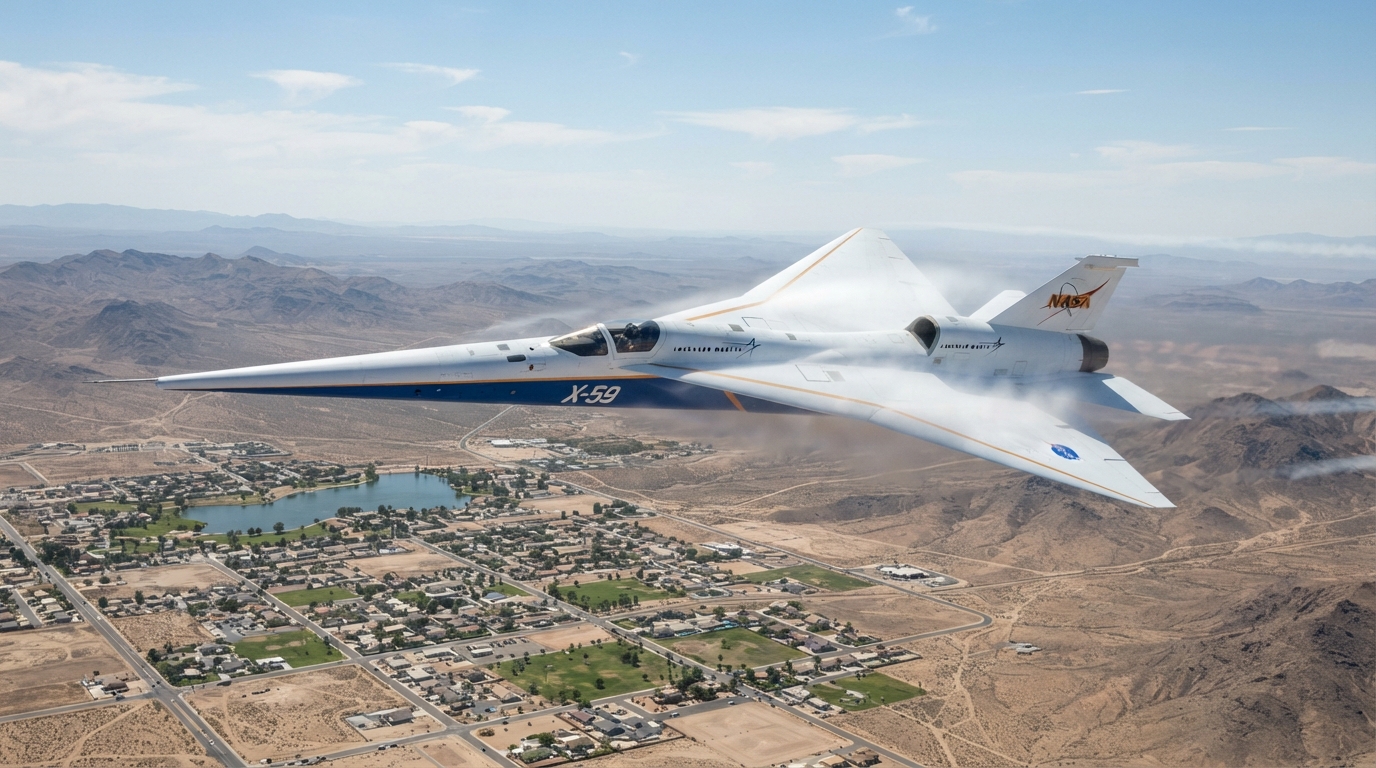
X-planes: Are they needed in the new era of drones?
The long nose of the X-59 is meant to reduce the plane’s sonic boom
A strange and remarkable jet is flying over the US. It has an anteater-like nose, parts taken from other aircraft and a cockpit placed so far back that the pilot must rely on a camera to know where he is heading.
This machine, the X-59, could well represent the future of air travel.
The X-59’s unusual shape comes from the challenge of sonic booms. The shockwave produced when a jet breaks the sound barrier kept Concorde limited to sea routes and blocked it from profitable flights across the US.
Now Nasa is tackling that issue by using the X-59’s stretched nose to turn supersonic booms into manageable background bumps.
Beyond its odd looks, the X-59 has an impressive heritage. It is the newest in a line of experimental Nasa aircraft that began in 1947 with the Bell X-1, the first plane to break the sound barrier.
Peter Coen, a 43-year Nasa veteran who oversees the programme, describes the logic behind 80 years of X-planes. "Our approach is to pick small goals we aim to prove with flight data and we construct an airframe for that one task."
The X-plane idea is to "minimise goals, the more goals you have the more expensive it gets." For the X-59, the aim is simply to suppress sonic booms cheaply and nothing more.
With the X-1, which was flown through the sound barrier in 1947 by the legendary test pilot Chuck Yeager, Nasa knew that a .50 calibre bullet travelled faster than sound. So the small, stubby aircraft was designed like a bullet with wings attached.
Only 20 years later, the X-15 rocket plane — a cylinder with tiny wings dropped from a B-52 bomber — reached 6.7 times the speed of sound (4,520 mph) and the edge of space, helping pave the way for heat-resistant materials that were crucial to the Space Shuttle.
Nasa is flying the X-59 alongside community surveys to find out what people think when a supersonic boom is bent by the plane’s extended nose and quietened.
"We want to figure out what level of boom is acceptable to people on a regular basis," says Coen, who believes his aircraft will sound "like a car door being closed across the street" when it passes Mach 1, about 660mph at airline cruising altitude.
With its cockpit and ejector seat borrowed from a T-38 training jet, its landing gear from an F-16 fighter and its engine supplied by the F-18, this aircraft puzzle was put together by Lockheed Martin for Nasa.
A camera sending images to a screen in front of the pilot uses instant computer processing to compensate for the lack of forward visibility. It first flew in 2025 and is now breaking the sound barrier over selected US towns.
But does there still have to be a place for X-plane projects in a world where relatively inexpensive drones are being developed quickly — not least in Ukraine’s war against Russia?
Nasa itself considered an uncrewed X-59. But drones are not always the cheaper choice.
Taking out the pilot would have added the cost and complexity of certifying a robot jet to fly at high speed over urban areas.
And the X-59 had to be large enough to resemble an airliner punching through the sound barrier, which also created room for a cockpit.
Nasa is no stranger to drone X-planes. The X-48, a scaled-down model of an airliner that merges wing and fuselage into a single lifting body, flew in 2007.
Small was ideal for the tiny X-48, with its 20ft wingspan, because it kept the programme within budget.
"It’s likely that future X-planes will be uncrewed," says Coen, before adding the crucial caveats "unless the technology we’re researching relates to piloting or if crewing it is more cost-effective".
Guy Gratton, professor of Aircraft Test and Evaluation at Cranfield University, is irritated by the idea that crewed test aircraft have had their day.
"There's a belief in certain quarters that drones can do everything. In Ukraine they've done amazing things with drones, but if you want to carry people you can't take short-cuts."
Gratton has tested light aircraft and emphasises the value of a human in the loop. "You lose a huge amount without pilots, you miss lessons a pilot would identify, plus it can take four times as many people on the ground to test a drone."
The staff needed to monitor signals from a drone are an indirect cost that helps keep some piloted X-planes relatively affordable.
The UK has also flown its own technology testbeds, and Chris Yeo once sat in the pilot’s seat of one. The Experimental Aircraft Programme (EAP) flew from Lancashire in 1986 and tested core systems for the Typhoon fighter.
Yeo recognises the EAP’s shared lineage with X-planes. "They all research some facet of flight, and demonstrate the design is working correctly. A lot of people say they can do something, but you only know it works when the design has been tested and certified."
Forty years after Yeo’s EAP flights, a new UK technology demonstrator is taking shape. Tony Godbold, who runs the project for BAE Systems, calls it "the X-plane of our generation".
This BAE Systems project brings together 100 UK suppliers, including Rolls-Royce, to test ideas that could feed into the Global Combat Air Programme (GCAP), a fighter expected to fly in the 2030s. The technology demonstrator will use engines from the existing Typhoon and is due to fly sometime in 2028.
That has sparked major excitement among the UK’s small group of qualified fast jet test pilots. Godbold says almost all of them, about 14, have already flown the aircraft in a simulator.
For many in aerospace, the human factor still matters as much as it did in Yeager’s era. "You can model a lot on computers and simulators, but the experience of test pilots is when stuff gets real, we only really learn things when we get their feedback," Godbold admits.
There is also a political side to these aircraft. Godbold says his plane shows the UK’s commitment to GCAP, a joint project with Italy and Japan. "This proves we are serious in this space."