

Will self-flying planes transform the skies?
Autonomous crop-spraying aircraft are leading the way in pilot-free flying.
## Will Self-Flying Planes Revolutionize Air Travel?
**Pyka's autonomous crop dusters are currently in operation in the US and Brazil.**
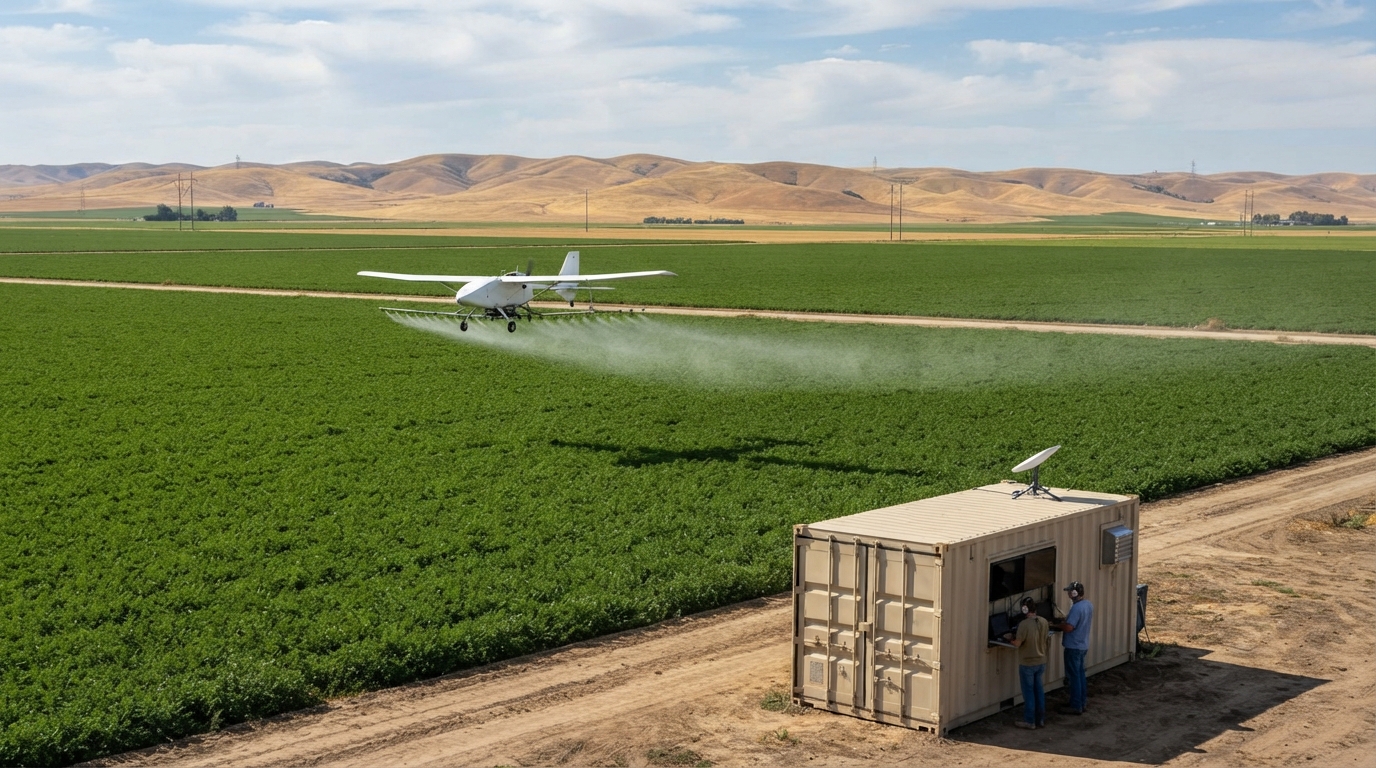
In California's San Joaquin Valley, a small, pilotless crop-spraying aircraft is observed flying remarkably close to the ground over an alfalfa field. This low-altitude operation poses minimal risk to humans due to the absence of a pilot.
"We can actually go lower than a human pilot can," states Russ Marotzke as the aircraft skims the crop. He explains that flying at a lower altitude reduces spray drift, consequently requiring fewer chemicals compared to traditional manned crop-dusting methods.
This pilotless aircraft is a product of Pyka, where Marotzke serves as a flight test engineer. The start-up, situated in a converted Second World War hangar overlooking San Francisco Bay, specializes in manufacturing self-flying aircraft without cockpits, designed for either crop spraying or cargo delivery.
Pyka is one of several companies actively working to introduce autonomous fixed-wing aircraft into commercial service. While electric vertical take-off and landing (eVTOL) aircraft, often referred to as urban air taxis, have garnered significant attention in the realm of autonomous aviation, a less publicized effort is also underway to deploy self-flying planes. Initially, these aircraft are intended for tasks such as crop spraying and cargo delivery, with many manufacturers ultimately hoping to expand to passenger transport.
"A fully scaled, ubiquitous passenger operation is the holy grail," remarks Michael Norcia, Pyka's co-founder and CEO. He envisions a substantial fleet of Pyka planes, capable of carrying a minibus-sized capacity of passengers, transporting individuals along the US east and west coasts. Norcia believes there's "a decent chance we'll get to that point before the eVTOL industry."
At one of Pyka's crop-sprayer test sites, located approximately 80km (50 miles) east of the company's factory and accessible via a rough dirt road, Marotzke and a colleague are currently testing a software update on a demonstration aircraft.
Around a dozen Pyka aircraft are already deployed in Brazil, where they are used for spraying crops like cotton and soybeans, a task previously performed by human pilots. These fully electric crop-spraying planes feature a battery in the nose, allowing for approximately 35 minutes of flight time, and a central tank capable of holding up to 300L of spray. While sometimes referred to as large drones, Pyka's planes, with their 11.5m wingspans, make this seem like an understatement.
Inside a shipping container adjacent to the field, engineers use a computer to delineate the area for the aircraft to spray. The software then generates a flight path, incorporating pre-mapped obstacles such as nearby power lines. The aircraft's take-off from a runway beside the field is seamless. Approximately 15 minutes later, after detecting a low spray level (water for the current demonstration), the aircraft autonomously lands for a manual refill and a demonstration battery swap. It then takes off again, resuming spraying precisely where it left off.
**The batteries on Pyka drones last half an hour.**
Autonomous flight differs significantly from autopilot. Autopilot functions as an assistance system, similar to cruise control and lane-keeping features in a car. Autonomous systems, however, aim to manage the entire flight, including take-off and landing, with minimal or no human intervention, utilizing algorithms to process sensor data and control the aircraft.
Despite operating in what is generally considered a more structured and predictable environment, self-flying planes have emerged more slowly than self-driving cars. Mykel Kochenderfer, an expert in safe aviation autonomy at Stanford University, attributes this partly to major tech companies "doubling down" on cars, investing vast sums in the technology. Additionally, aircraft are subject to more stringent safety standards than cars, establishing a much higher bar for deployment. "The consequences for air accidents can just be so severe," Kochenderfer emphasizes.
Military interest has been a driving force behind the technology. Many companies hold defense contracts to demonstrate and trial their systems, often facing fewer regulatory hurdles than in the civilian sector, and some are already supplying military clients. In the US, Pyka's crop sprayer, which received authorization last year, is currently the largest autonomous fixed-wing aircraft approved for commercial civilian use. However, operations are restricted to a narrowly defined agricultural setting and necessitate a ground operator and visual observer. Similar approval was secured earlier in Brazil, where regulations are more permissive.
Pyka intends to increase production from its current rate of around two dozen planes annually to 1,000 by 2030. Each aircraft sells for $550,000, with customers receiving training on their operation.
**Windracers aims to launch an autonomous cargo service.**
The UK has not yet approved such long-term operations, though British firm Windracers is seeking permission to initiate an autonomous cargo service in Shetland and Orkney. Their aircraft, designed for transporting goods to remote areas, are also conducting missions in Ukraine. "It would be the first heavy-lift air cargo service by drone certainly in the UK and probably anywhere," states Stephen Wright, Windracers founder and chairman.
Proponents argue that autonomous aircraft could help alleviate pilot shortages, remove individuals from hazardous tasks like crop spraying, enhance efficiency (for instance, by enabling aircraft to carry more cargo), and reduce costs if a single operator can oversee multiple planes. They also contend that automation could improve flight safety, citing historical declines in accidents as more automated systems have been introduced.
Pilots' groups, however, remain cautious. The US Air Line Pilots Association (ALPA) describes removing pilots as "a serious gamble with safety and a step too far." The US National Agricultural Aviation Association, representing crop dusting pilots, notes that small uncrewed aircraft can be difficult for its aviators to spot. They also add that piloted planes can spray a significantly larger area more quickly.
**Reliable Robotics is retrofitting planes with its autonomous technology.**
While Pyka and Windracers are constructing aircraft from the ground up, asserting that this allows for autonomy to be integrated from the outset and the aircraft to be tailored to specific jobs, other companies are retrofitting existing larger planes.
Reliable Robotics, a US-based company backed by Boeing's investment arm, is currently testing its system on the Cessna 208B Grand Caravan, a single-pilot cargo plane capable of carrying approximately 1360kg of payload over hundreds of kilometers. Robert Rose, its co-founder and CEO, explains that retrofitting certified aircraft allows the company to focus solely on proving the autonomous system's safety, rather than also needing to seek approval for a new aircraft.
Merlin Labs, also based in the US, has progressively scaled up its work through larger military aircraft and is now applying its system to the two-pilot Lockheed Martin C-130J military transport plane, with commercial multi-crew cargo planes next in line. "It is a common autonomy brain that can transition between different aircraft," explains Matt George, Merlin's founder and CEO.
These companies also employ different approaches to AI. Reliable is entirely avoiding AI, arguing it would complicate certification. Merlin, conversely, is adopting a far more AI-centric strategy.
This divergence is evident in their "detect and avoid" systems. One of the biggest challenges in autonomous flight is replicating a pilot's ability to spot and safely maneuver around other aircraft and obstacles, with virtually no margin for error. As no perfect solution currently exists, companies are incorporating various sensor systems and duplicating standard ones to provide additional backup.
Reliable has added forward-looking air-to-air radar to detect other aircraft more than eight kilometers ahead, utilizing software that adheres to fixed rules to determine the plane's response. Rose claims this is "better than a pilot's eyeballs." Merlin, meanwhile, employs AI-powered cameras to detect and classify objects. Pyka has utilized lidar from the beginning to detect trees, vehicles, large birds, and terrain. However, due to its short range, the company also plans to integrate AI-powered cameras, marking its first significant use of onboard AI. "For a lot of things there's no need to use AI…but for figuring out that six pixels in the distance are an airplane versus some other smudge, it is perfect territory," says Norcia.
The AI dilemma also extends to communication with air traffic control. In shared airspace, aircraft must be able to receive, interpret, and respond to radio instructions, typically from air traffic control. Reliable's solution involves a remote pilot on the ground, initially fully trained, to manage communications and make safety-critical decisions. Merlin plans to use generative AI, trained on thousands of hours of recorded exchanges, to interpret instructions and respond autonomously. "Our problem is harder… but we want to move beyond remote piloting," says George. Merlin intends to reduce pilots in stages, from two to one, and eventually to none. Norcia states that Pyka is content to let others "blaze the trail" in determining the optimal way to operate in shared airspace.
Meanwhile, even if fully autonomous passenger flight remains elusive, many anticipate that the pioneering technology will gradually integrate into commercial aviation, potentially enhancing the safety of piloted flights. This, as noted by ALPA, the US pilots' association, would be a welcome development.