

World Day for Audiovisual Heritage: the past has a voice and a face
Once, in order to listen to a favorite singer's new song, one had to buy their cassette, make a copy, or
**World Day for Audiovisual Heritage: The past has a voice and an image**
A song you heard in your childhood unexpectedly starts playing. You listen closely for a moment. Perhaps you remember its title, or perhaps you do not. But the moment you hear it, those years, that atmosphere, and even the people who were beside you suddenly flood back into your memory.
Or a cartoon you watched in your childhood is playing on television. Then you remember your childhood home, sitting in front of the TV, and the moments when you did not want the cartoon to end. Similarly, sometimes a single voice, a blurry photo, or a single frame recalls an entire era and instantly transports you back in time.
October 27 is the World Day for Audiovisual Heritage. Established in 2005 on the initiative of UNESCO, this date serves as a reminder of the need to preserve films, radio and television recordings, music, family videos, and other audiovisual materials. Because images and sounds provide information not only about past events, but also about the culture, lifestyle, and lives of the people of that era.
### Film reels also fight against time...
When we watch an old film on television, we do not think much about how it has reached us. Characters speak on the screen, music plays, and events unfold. We simply watch the movie, even rewatching the ones that have captured our hearts time and again. But behind those images lies immense labor associated with preserving, inspecting, restoring, and transmitting them to the next generation.
A film reel differs from an ordinary paper document: it has unique physical properties, meaning that over time the material degrades, and the image quality can deteriorate. If stored under improper conditions, the damage process accelerates. On some reels, colors shift, the image becomes blurry, the tape grows brittle, and sounds turn indistinct. In such cases, preserving a film or a song requires special conditions and the hard work of specialists.
### Digitization is another way to preserve images...
Yes, when talking about preserving film reels, digitization cannot be overlooked. Modern technologies make it easier to use old materials by converting them into digital copies, thereby reducing the load on the original carrier. If in the past one had to go to the archives, request the document, and view it under special conditions to see a historical frame, digital technologies now allow remote access to certain materials.
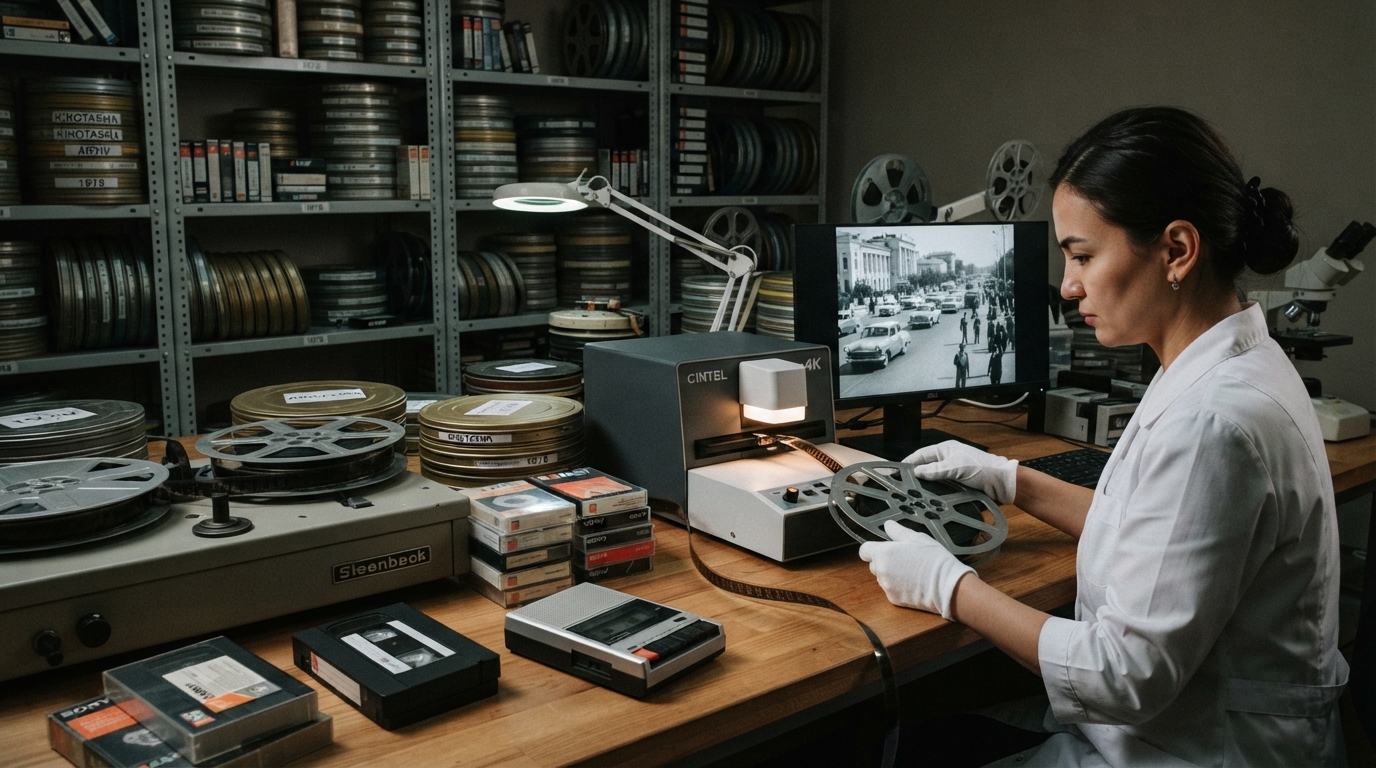
According to official information from the "Uzarchive" agency, in 2024, precisely such equipment—a modern Cintel 4K film scanner that allows the digitization of film documents in 4K format—was purchased for the National Archive of Film, Photo, and Sound Documents. High-definition re-digitization of the archive's film documents is currently being carried out on it.
However, digitization alone does not solve all problems: first, the condition of the tape must be assessed, restored if necessary, and then the resulting digital files must be stored securely.
Furthermore, the existence of a digital copy does not mean that the original film reel can be discarded. According to experts, the original material is also valuable as a historical source. The digital copy, on the other hand, expands the possibilities for its use, screening, and distribution. Today, on the official website of the National Archive of Film, Photo, and Sound Documents of the "Uzarchive" agency, 2,062 sound documents, 45,033 rare historical photographs, 805 historical film documents and chronicles, and 1,296,889 text archive documents are made available for online search and use by users. This is a huge step toward preserving the living voice and image of our past.
### Voices left on cassettes
While speaking of film reels, how can one not remember audio cassettes? Once upon a time, to listen to a favorite singer's new song, one had to buy their cassette, make a copy, or record it from the radio. If the song we were waiting for started on the radio, we would try to manage to record it onto the cassette. The cassette would be put into the tape recorder, and the song would be listened to over and over again. If the tape got tangled, carefully fixing it was a challenge in itself. Today, these minor troubles might seem laughable. But at that time, cassettes were one of the most popular ways to listen to music.
The voices of Uzbek singers also entered households through these cassettes. Which song echoed at weddings, which performer's songs were listened to the most, which melody became an integral part of family gatherings—all of these are a part of our musical culture.
Today, we can find an old song on the Internet. But the emotion when we heard it for the first time, the memory of whom we listened to the song with, or who gifted us the cassette cannot be found on the Internet.
### Every family has its own archive
While state archives preserve the history of a country, every household's own history lives in family videos.
Once, videotaping a wedding or a birthday was not a common occurrence in every household. Inviting someone with a video camera, getting the event recorded on tape, and then taking the finished cassette to watch on TV was a great joy in itself.
Today, however, dozens or even hundreds of photos and videos can be taken in a single day with a phone. A baby's first step, a birthday, a family trip, a conversation around the table—everything can be captured on camera. At first glance, preserving memories seems to have become much easier than before.
But are we truly preserving them?
A person who takes an old videocassette and searches for a compatible device to watch it knows how difficult it is. The cassette may have survived, but the device to play it is gone. Even if a device is found, the tape might very well be damaged.
Sometimes, a single phrase spoken by a relative caught on camera at a wedding, children playing in the yard, or the conversation of elders around the dinner table might seem like an ordinary scene at that moment. As years pass, some of the people in the frame may no longer be among us, the children grow up, and the yards change. Then we realize that the old video was preserving not just an event, but an era that will never return.
### How reliable are the memories on our phones?
Today, there are many possibilities for storing audiovisual memories. Phones, computers, external storage devices, and cloud services help preserve photos and videos. However, along with convenience, a new problem has emerged: we create a massive amount of information, but we do not always dedicate time to organizing and safeguarding it.
There may be thousands of photos collected over the years on our phones. Among them are images taken just to be viewed once, as well as family memories that are hard to find again. We often think about which ones are most important to us only when there is a risk of losing them.
Let us also think about the voice messages sent by our parents. Today, it might not cross our mind to save a simple message stored in a messenger as a separate file. But years later, the desire might arise to hear that person's voice, to listen once more to their habitual way of speaking, their laughter, or a single word they said to us.
Therefore, when talking about audiovisual heritage, it is appropriate to remember personal voice messages as well. Of course, it is not necessary to save every single message. But one can think about not losing those that hold special significance for us.
This does not require complex technology or large financial resources. One can start by organizing the most precious photos and videos into separate folders, transferring them to a computer or an external storage device, and keeping a backup copy of important files. Cloud services are also convenient, but it is best not to limit oneself to storing important memories in only one place.
If it is possible to convert old cassettes and family videos into a digital format, they should not be ignored either. Because some of these recordings may be very difficult to restore later. World Day for Audiovisual Heritage reminds us of the value of old films, music recordings, and archive tapes. Hence, this date prompts us to think not only about preserving the past, but also about passing our memories of today down to future generations.