

From flying carpets to the depths of screens....
We have immersed ourselves so much in household worries, abundance, and the race for material wealth that the most valuable blessing – time
From flying carpets to the depths of screens....
Sometimes I wonder: in the past, neither days nor nights were as rushed as they are today; they were long and blessed. Innocent moments when we kicked a ball around, raising dust in the streets until late evening, did household chores, flipped through books, and during summer holidays, ran away from our grandmothers trying to make us nap at lunchtime, waiting for the afternoon to pass quickly... Most importantly, everyone in the neighborhood knew one another, and every child was under the care of the entire community. People looked into each other's eyes when they spoke; love and kindness were not just spoken words, but a practical way of life. What about now?
What is the situation in the era of endless needs and digital technologies?
We have become so immersed in household worries, abundance, and the race for material wealth that we have lost the most precious blessings — time and live communication. There is a huge difference between the children of the past, who happily spent the whole day with a piece of bread and sweet tea in the morning, and today's children, who throw tantrums over a table full of delicacies, saying "I won't eat that, I won't wear this."
Today's "Z" and "Alpha" generations were already born into a digital environment. But the tragedy is that we are severing them from the traditional spiritual reality and handing them over to virtual hooks with our own hands. Today, a dangerous "spiritual vacuum" — that is, an emotional void — has emerged in families. A child is getting used to communicating with a screen rather than looking into their parents' eyes when speaking. If this void in the family is not filled with parental love, the alien virtual world will undoubtedly drag them into its abyss.
This problem did not just appear out of nowhere today. A century ago, our enlightened Jadid ancestors, who lived with the worries of the nation, did not raise the issue of upbringing to a matter of life and death for no reason. When Abdulla Avloniy sounded the alarm in his work "Turkiy Guliston yoxud axloq" (Turkish Gulistan or Morality), saying: "For us, upbringing is a matter of life or death, salvation or destruction, happiness or disaster," he meant precisely not being indifferent to the spiritual upbringing of a child. While the great thinker Mahmudkhuja Behbudiy pointed out in his article in the "Oyna" journal that "To exist in the world, worldly science and knowledge are necessary; a nation deprived of modern science and knowledge will be trampled by others. And the foundation of this is the upbringing and knowledge given from infancy," Abdurauf Fitrat, in his famous work "Oila yoki oila boshqarish tartiblari" (Family or Family Management Procedures), defined the personal responsibility of the family and parents as the foundation of the state, stating: "The happiness and honor of every nation, of course, depend on the internal discipline and harmony of that people, and on the proper establishment of family upbringing."
In the development of today's New Uzbekistan, this historical truth has also become a main pillar at the level of state policy. In his speech at the video-selector meeting dedicated to "Issues of radical improvement of the preschool education system" held in 2017, our President Shavkat Mirziyoyev put forward a clear and decisive conclusion:
"If we do not raise our children correctly in the preschool period and instill national and universal values into their minds, it will be too late later. The upbringing of the young generation is the most important task of state importance that determines the future. Nothing can replace the role of the family and parents in shaping a child's worldview. The greatest wealth for a child is the genuine upbringing, love, and attention given to them."
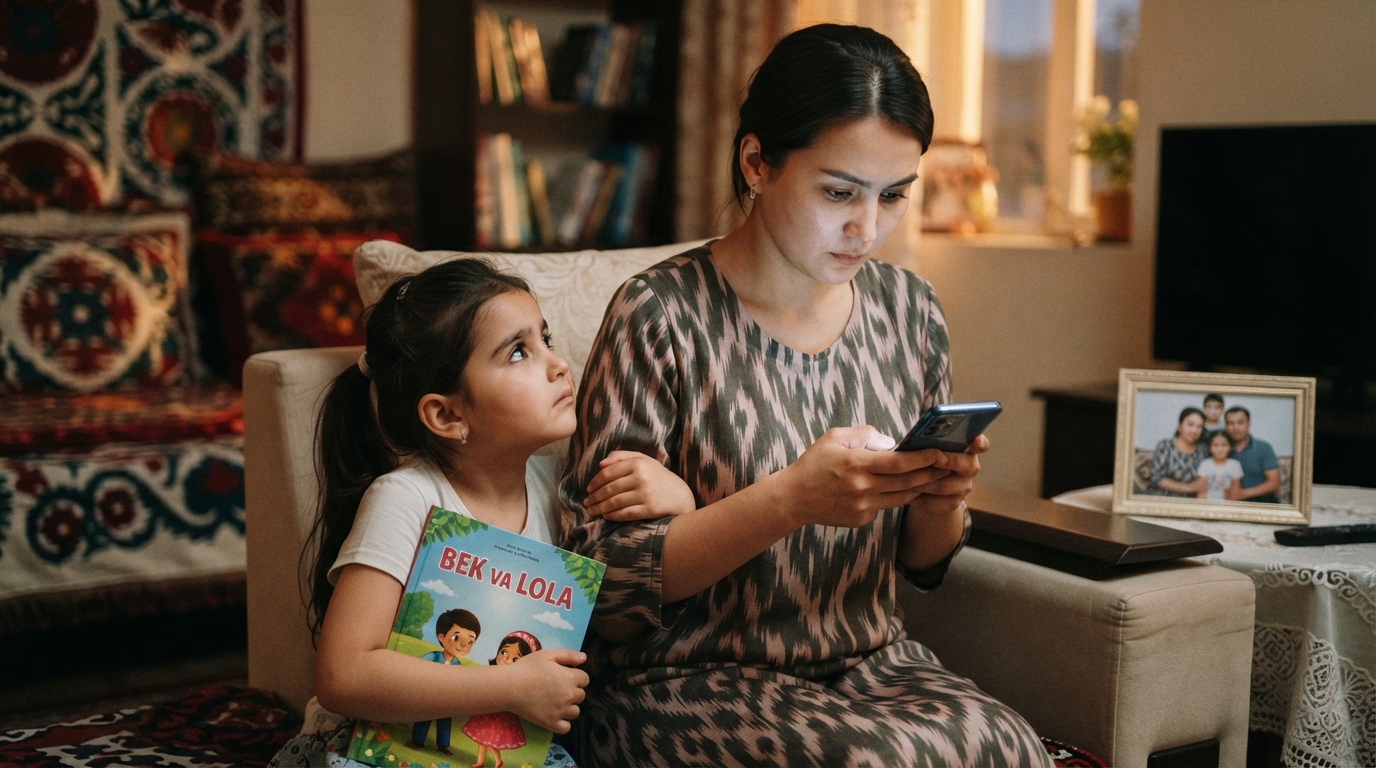
But to what extent are we implementing these truths in our daily lives? Tiny hearts, who wait anxiously all day at kindergarten or school for their parents to arrive, expect a warm look and love from their tired parents returning home in the evening. Adults, however, using fatigue as an excuse, prefer to stare at their phones or TV instead of communicating.
The pain of tiny children
– is the big pain of society....
Just yesterday, when I returned home tired from work, my little daughter ran to me with her eyes shining with joy: "Mommy, mommy, the new episode of 'Bek and Lola' is out, it's so cool, shall I play it?" And I, with exhaustion, said, "Let me finish the housework first, then we'll watch, I've just come home from work, you know." Instantly, the spark in her innocent eyes went out, and sadness appeared in her gaze. This look pierced my heart. I put everything aside and sat in front of the computer.
The episode of the cartoon called "Childhood" turned out to be a mirror of harsh reality for most of today's parents. The pain of the tiny characters, who want to be pampered and play various games with their father, is actually the big pain of our society today. The following lines, which sounded against the backdrop of a mother engulfed in household chores and a father unable to lift his head from his phone and work, would shake even a heart of stone:
"When you come home tired from work, we welcome you with a smile,
We rush into your arms, daddy, and hug you tight.
Let's play football together, let's not get distracted by the phone,
These days are a precious gift, daddy,
May they be remembered for a lifetime!
Daddy, daddy, daddy, dear daddy...
Come, play with us, return to childhood for a moment,
Our time together will pass more happily with you,
Be safe always, daddy, daddy, dear daddy!"
The scene presented above shows how important it is that, on the initiative of the Head of our State, such national content that protects deep psychological and family values is being created in our national animation. This is not just a cartoon, but a national alarm bell that reveals the void in child upbringing. A child does not need a luxury car, brand clothes, or expensive items — they need their parents' loving voice, sincere embrace, and live moments spent together.
Now let's remember... Remember the nights when we lived believing in fairy tales. The master Hamid Olimjon did not write in the introduction to his epic poem "Oygul and Baxtiyor" for no reason:
"In the days of my childhood,
In my sleepless nights,
I heard many fairy tales,
My grandmother used to tell them.
I remember those moments,
The flying carpets...
Every story of my grandmother,
Every point she made
Captured my thoughts,
My admiration grew.
I would listen endlessly
Lying quietly through the long nights..."
Look, in this poem there is not only longing, but also great pedagogy! A child is raised by fairy tales, conversation, and the living word. We did not appreciate childhood when we were children, but today, as parents, what right do we have to throw our children's most innocent moments into the abyss of the virtual world? The fairy tales our grandparents told us, the sleepless nights they spent, built a fortress stronger than love in our hearts.
Could it be that this spiritual chain breaks precisely when it reaches our generation?
The characters of "Bek and Lola" remind adults of a great law:
"You were also children once, you were happy in the arms of our grandparents... We will also grow up to be like you."
A child is our mirror. The time and love we do not give them today, they will not be able to give to their own children tomorrow. In this way, the lack of love is inherited from generation to generation.
Human needs are endless, but the life and time measured out by the Creator are the ultimate blessings that cannot be returned. Material wealth can be found again every day, but not a single moment of lost childhood can be bought even with all the treasures of the world.
In fact, for a child, the greatest wealth is not the material things parents earn, but the time allocated to them. While the previous generation grew up in a national spirit through the fairy tales of their grandparents and the example of their parents, today our children are becoming trainees of foreign ideas and a cold virtual world on the hook of screens.
The "matter of life and death" mentioned by Abdulla Avloniy begins right here. We are giving our children the world, but we are taking ourselves away from them. Today, when we go home, let's find the strength to push the cold screens aside and reconnect the bonds of the heart. After all, where will loyalty to the Motherland, to the country and people, come from tomorrow in a heart that has not been nourished by parental love?
Losing childhood means losing the nation's tomorrow. Let's be in time, because time is flowing, and childhood is a precious gift!