

Workers came across human remains – and unearthed a mass grave of 572 people
Workers in northern Sri Lanka accidentally uncovered the country's largest mass grave – and reopened wounds from its civil war.
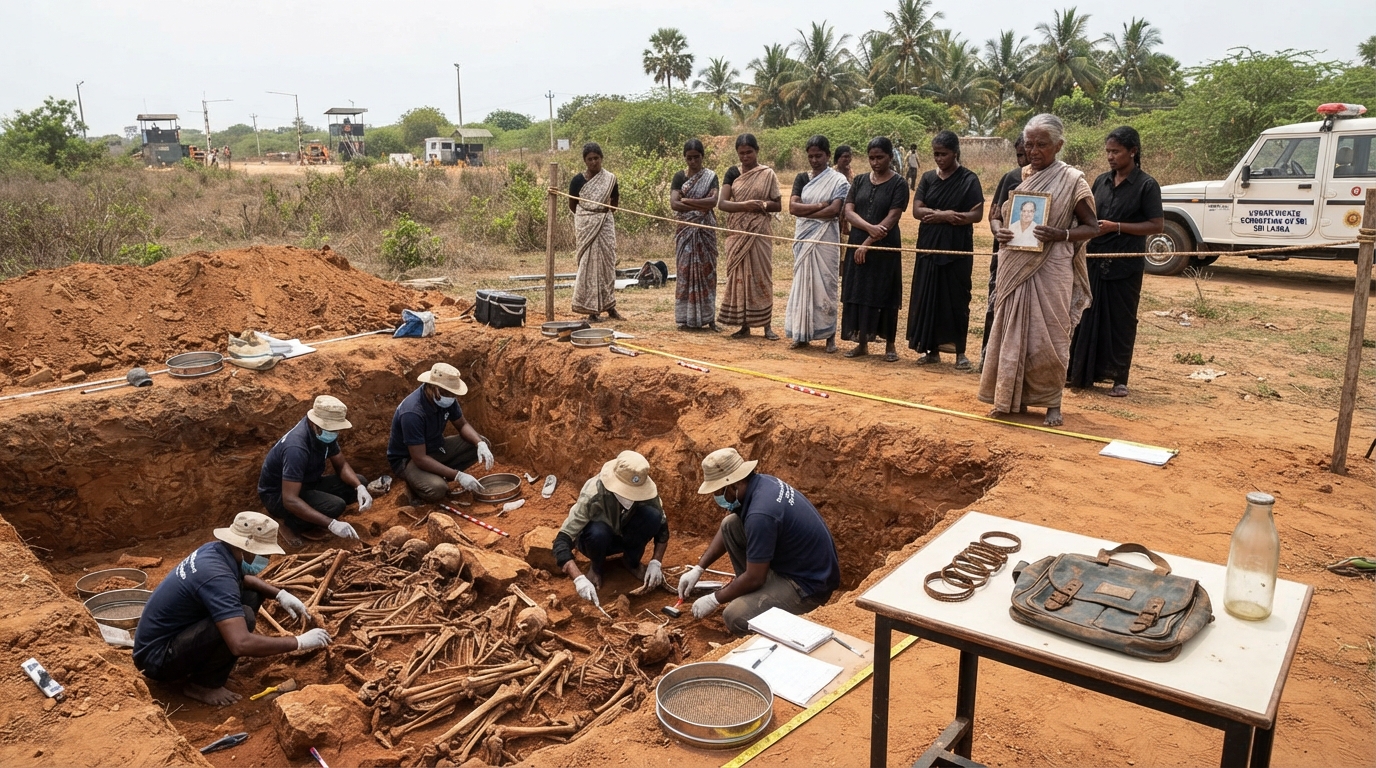
Workers stumbled upon human remains – and uncovered a mass grave containing 572 people
Jeyaruby Jeyabalan was 12 when her father, Kandaiah Jayapalan, went missing
A mass grave discovered in northern Sri Lanka last February was found by accident, not intentionally.
Workers were excavating land to expand a cremation ground in the Chemmani area of the Jaffna region when they unexpectedly came across human remains, triggering an investigation.
By August, archaeologists had finished the third stage of excavation at the site, where they uncovered the skeletal remains of 572 people, among them children and infants.
Personal belongings were also found with the dead, including bangles, a school bag and a milk bottle.
It is thought to be the largest mass grave ever found in Sri Lanka.
There had been rumours about it before. A soldier on trial for the rape and murder of a young woman during the country’s brutal civil war had spoken of a mass grave containing hundreds of bodies. Rights groups said the victims were disappeared civilians.
But there was no evidence — until now.
And although the discovery is heartbreaking, it has also brought hope to people like Jeyaruby Jeyabalan, whose father was among thousands who disappeared during the decades-long war. Jeyabalan and families like hers hope the bodies may hold answers about what happened to their loved ones.
Many Tamils believe the grave contains victims of extrajudicial killings during the civil war. They are demanding an investigation — and justice.
However, the excavation at Chemmani has progressed slowly, frustrating families still searching for answers about their missing relatives.
The finding of hundreds of remains near an already identified mass grave has intensified anger among Tamils, who have long called for a full inquiry into disappearances.
Many fear the grave will eventually slip from public attention because of a lack of political will to uncover the truth — and so it has become a focal point for renewed protests in Sri Lanka’s north.
Sri Lanka, especially the Tamil-majority north and east, endured decades of conflict. The war, which ran from 1983 to 2009, split the island nation along ethnic lines. Tamil Tiger rebels fought for an independent state in the north-east of the country, citing what they described as systematic discrimination by the Sinhalese-dominated government.
The conflict lasted 26 years and is estimated to have killed 100,000 people. It also left about 23,000 people — mostly Tamils — missing.
Both the security forces and the Tamil Tigers are accused of atrocities and crimes.
A baby’s bottle was among the personal items recovered from the grave site.
In 1995, after a bloody battle, the Sri Lankan army took control of the Jaffna Peninsula from the Liberation Tigers of Tamil Eelam (LTTE). It was regarded as a major turning point in the war, which ended with the Tigers’ defeat in 2009.
As control expanded in the late 1990s, the entire Chemmani area became a high-security zone filled with army camps, checkpoints and security posts. There was also an army camp in Chemmani near the cemetery.
At the time, some described the Jaffna region as an “open prison” — and the security forces were accused of causing the disappearance of thousands of civilians, something Sri Lankan governments have consistently denied.
“I was 12 years old when my father was picked up by the Sri Lankan army at a checkpoint close to Chemmani area in September 1996. We still don’t know what happened to him,” Jeyaruby Jayapalan, who now lives in Jaffna, tells the BBC.
She says that after learning he had disappeared, the family panicked and searched military camps and police stations across Jaffna for information, but found nothing. He never returned.
Her father, Kandaiah Jayapalan, worked for the government and also ran a roadside café not far from Chemmani.
“I went to Chemmani mass grave with many others hoping that I will find some answers. But we didn’t find any material evidence. We want a detailed forensic analysis of the human remains,” says Jeyaruby.
Two weeks before Kandaiah Jayapalan disappeared, an 18-year-old Tamil schoolgirl, Krishanthi Kumaraswamy, vanished in the same area.
In 1998, a court in Colombo sentenced five soldiers to death for the rape and murder of Kumaraswamy and for killing three members of her family. The case attracted worldwide attention at the time. Their bodies were later found buried in the Chemmani area.
It is one of the most notorious cases from the conflict — and the grave now under investigation lies within 100 metres of where Kumaraswamy’s remains and others were found.
In a shocking court testimony, one of the convicted soldiers, Somaratne Rajapakse, claimed that between 300 and 400 people killed in the mid-1990s were buried in Chemmani.
His statement prompted the first excavation at Chemmani a year later, during which investigators uncovered more than 10 human skeletons. Human rights activists believed those remains were connected to people who had disappeared during the civil war, but there was little judicial follow-up.
Activists say that because the war with the Tamil rebels was still ongoing, the government at the time did not pursue the investigation and never explained why.
The discovery of another mass grave in the same area has renewed demands for accountability.
“Preliminary inspections suggest this was not a normal burial site and not consistent with ordinary Hindu burial practices,” says Gehan Gunatilleke, a commissioner with the Human Rights Commission of Sri Lanka, which carried out inspections at Chemmani last year.
Activists and experts say that while a few dozen bodies appeared to have been formally buried, the vast majority pointed to something very different.
Most of the remains were found without clothing, tightly packed together and, in some cases, stacked on top of one another. The graves were shallow, with bodies buried just one to two metres below the surface.
“There is a reasonable likelihood that the burials were unlawful and pursuant to extrajudicial killings,” the Human Rights Commission of Sri Lanka said in a report last year.
Families of those who disappeared during the conflict have responded to the discovery with protest meetings and memorial ceremonies.
Among them is Suseela, a 65-year-old woman searching for her son, Gnanaseelan Ravi, who was taken by the Sri Lankan military in 2007, when he was 24.
“He was my only son, and I keep crying every day remembering him. My life is empty without him,” she tells the BBC.
She visited the Chemmani grave but found no evidence, such as clothes or personal jewellery, suggesting her son was buried there. DNA testing on the remains has not yet been done.
All remains recovered so far from Chemmani are being kept under court custody at the Forensic Department of the University of Jaffna campus.
“We are preparing an interim report, and it will be submitted to the court by the end of September,” Prof Raj Somadeva, the chief archaeologist of the mass grave, told the BBC.
Some samples are expected to be sent overseas for detailed analysis to help determine the age of the remains. Separate medical examinations will be needed to establish possible causes of death.
More than 20 mass graves have been discovered across Sri Lanka in recent decades, but none has been conclusively tied to enforced disappearances or alleged extra-judicial killings in the north or south of the country — and none has led to prosecutions.
Because authorities have failed to investigate earlier mass graves, many Tamil people are sceptical about what the new inquiry will achieve.
They point to the investigation into another mass grave uncovered in the north-western town of Mannar in 2018, where more than 350 skeletal remains were found. That inquiry was inconclusive, leaving many families disappointed.
They want Sri Lanka referred to the International Criminal Court.
The government of President Anura Kumara Dissanayake says it is fully cooperating with the investigation.
Suseela holds a photograph of her son, Gnanaseelan Ravi, who was taken by the Sri Lankan military in 2007, when he was 24.
After taking office in September 2024, Dissanayake promised to pursue justice and ethnic reconciliation. But his government strongly opposes any international mechanism to investigate alleged war crimes committed during the ethnic conflict, disappointing Tamils.
“We will continue with the excavation work at Chemmani,” Harshana Nanayakkara, Sri Lanka’s justice minister, told the BBC.
“We need to analyse the skeletons and find out how these people died. Then we have to carry out DNA tests,” he said.
He insists the government has also asked families to provide DNA so it can later be compared with the remains.
During his inspection at Chemmani in June, the minister promised investigations to uncover justice and truth and bring the matter to an end. He also promised that the necessary funding would be allocated for the excavation.
Sri Lankan army spokesman Brigadier Waruna Gamage rejects claims that security forces buried civilians after massacring them.
“All the allegations should be proved in court,” he told the BBC.
Families of the disappeared are protesting, calling for an international investigation into the Chemmani mass grave.
Delays in investigating past crimes have drawn sharp criticism from rights groups.
After years of international pressure, the government established an independent body in 2018, the Office of the Missing Persons (OMP), to investigate disappearances. But those affected say it has made little progress in finding their missing relatives.
“Many cases of forced disappearance, torture and killing remain stalled, while families of victims and human rights defenders face threats and intimidation,” Human Rights Watch said in a report earlier this month.
The United Nations has urged Sri Lanka to seek international assistance to identify the victims, determine how they died and establish who is responsible.
“This is a situation where victims are deeply frustrated, have lived with pain for decades, have come to distrust past investigations,” Rory Mungoven, the Asia-Pacific chief at the Office of the UN High Commissioner for Human Rights, tells the BBC.
“I think involving international assistance would help to bolster confidence in these investigations,” he says.
Successive Sri Lankan governments have strongly resisted calls for international investigations into alleged wartime atrocities.
During earlier reporting trips to Sri Lanka, I met parents and relatives of the disappeared who campaigned for decades to find the truth. Some have since died without ever learning what happened to their loved ones.
Human rights groups say President Dissanayake’s government now has a chance to break with a long pattern of delay and denial and deliver accountability for grave abuses committed during the conflict.
Suseela is determined to learn the truth.
“I don’t know how long I will live with such uncertainty, but I want closure,” she says.