

Will all Tashkent residents be rich by 2030?
The Agency for Strategic Development and Reforms' information service reported that the draft "Tashkent 2030" strategy was discussed at a session of the Tashkent City Council of People's Deputies. According to the document, the capital's economy is expected to grow 2.1-fold over the next five years, reaching $60.4 billion. However, the strategy's main focus is not only on macroeconomic indicators but also on how […]
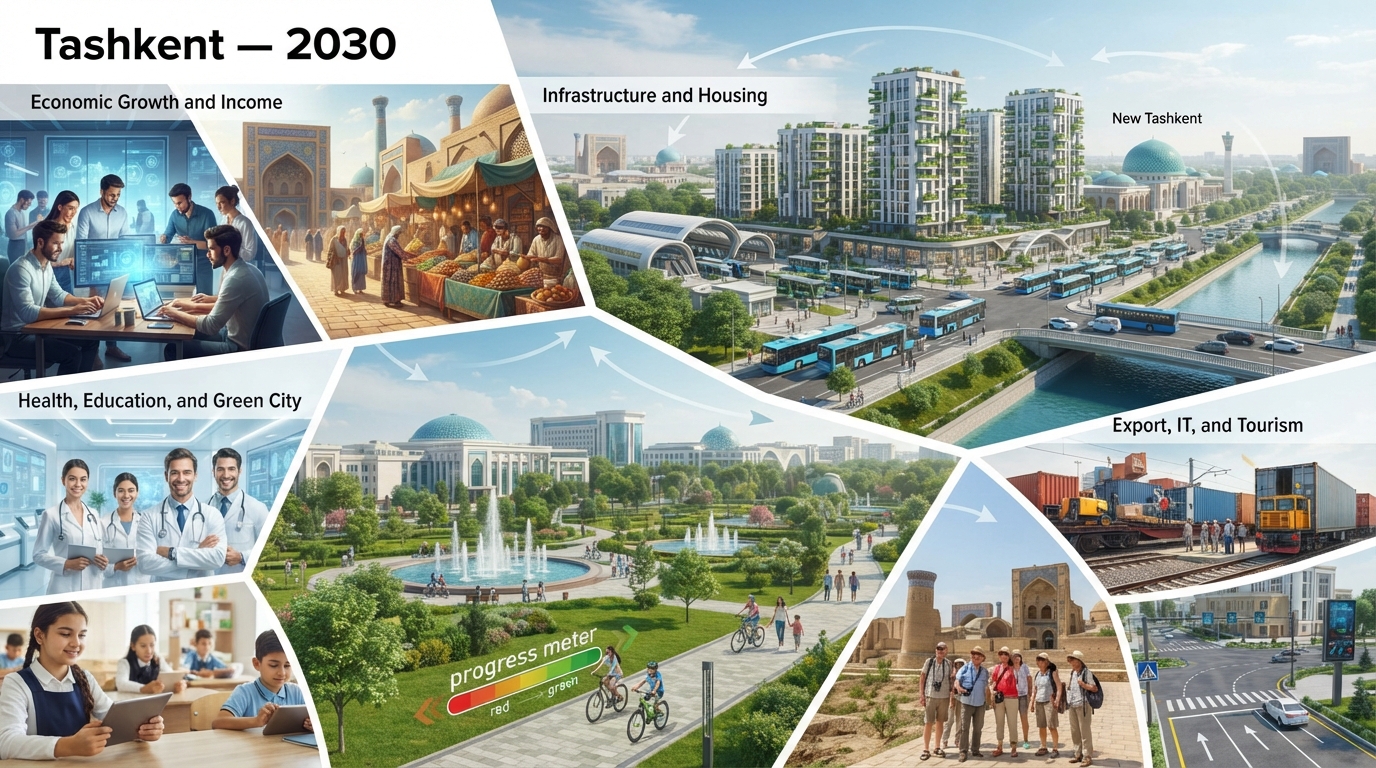
Will all Tashkent residents be wealthier by 2030?
The information service of the Agency for Strategic Development and Reforms reported that the draft "Tashkent 2030" strategy was reviewed at a session of the Tashkent Council of People's Deputies. According to this document, the capital's economy is expected to grow 2.1-fold over the next five years, reaching $60.4 billion. However, the strategy's primary focus is not only on macroeconomic indicators but also on how this growth will impact the income and quality of life of every city resident.
The draft strategy was presented by Abdulla Abdukadirov, First Deputy Director of the Agency for Strategic Development and Reforms.
The document was developed in accordance with Presidential Decree No. PF-21 of February 16, 2026, as part of the national strategy "Uzbekistan 2030." The strategy includes 68 goals and 236 performance indicators. Responsible persons, deadlines, and funding sources are identified for each indicator. From Economic Growth to Income Growth
One of the key objectives of the strategy is to transform economic growth from a statistical indicator into real changes in the population's standard of living.
By 2030, the gross regional product per capita is planned to increase from $9,300 to $17,700. Absolute poverty is to be reduced to zero.
Through targeted support measures, the number of women in need is planned to be reduced from 98,399 to 27,922—approximately 3.5 times. 23,000 young people will be employed in the IT sector, and another 461,000 young people are expected to learn foreign languages as part of the "Ibrat Farzandlari" (Ibrat Farzandlari) project.
At the same time, annual inflation is planned to be kept at 5%, and unemployment no higher than 3.5%.
More housing and public transportation
A significant section of the strategy is devoted to urban infrastructure. An additional 54,574 apartments are planned for construction annually, and the housing supply per capita is expected to increase from 16.6 to 24.4 square meters. The "New Tashkent" residential complex will also be created as part of the capital's development.
The metro is expected to expand significantly: the number of stations will increase from 50 to 79, and the network's length from 71 to 103 km. Train intervals are planned to be reduced to 2-3 minutes.
The share of public transport trips is expected to increase from 40% to 60%. Furthermore, 1,000 km of roads are planned to be repaired in the capital, and 700 "smart" intersections are planned.
Health, Education, and a Green City
The strategy calls for increasing life expectancy from 75.2 to 78 years. All medical institutions in the capital are planned to be fully digitalized.
Preschool education coverage is expected to increase to 81.2%, and higher education coverage to 50%.
At the same time, Tashkent intends to significantly expand green spaces. The proportion of green space in the city is expected to increase from 14.1% to 30%, with 4,450 hectares of new green space created. Waste collection coverage is planned to reach 100%.
Exports, IT, and Tourism
By 2030, the capital's annual exports are expected to reach $7.5 billion, and their geographic reach is expected to expand to 120 countries.
Particular hopes are placed on the IT sector: IT services exports are planned to increase from $775 million to $4 billion, a 5.2-fold increase.
Tourism is also expected to increase significantly. According to the project, Tashkent expects to welcome 7.5 million foreign and 20 million domestic tourists annually.
The private sector's share of the capital's GRP is expected to increase from 51.7% to 66.6%. Consistent support is planned for 103,000 small businesses. Every indicator is monitored.
A distinctive feature of the new strategy is the "goal-action-result" principle. A separate "territorial passport" will be developed for each district, and the strategy's implementation will be open to public scrutiny.
Citizens will be able to track the implementation of these indicators on the digital platform and in the "Ijro.gov.uz" system, where results will be categorized into three categories: "green," "yellow," and "red."
An interim assessment of the strategy's implementation is planned for 2028, with a final assessment scheduled for the first quarter of 2031.
Thus, "Tashkent 2030" envisions more than simply doubling the capital's economy. The stated goal is to make this economic growth measurable through household incomes, housing affordability, the quality of the urban environment, transportation, education, healthcare, and new employment opportunities.