

Why was the Fergana Oil Refinery returned to the state? Comment from the head of the State Assets Management Agency
The Fergana Oil Refinery was returned to the state due to payment delays by Saneg caused by the investor's financial difficulties in other projects, the head of the State Assets Management Agency reported. Meanwhile, the company's stake in the plant had remained unchanged for almost two years. A debt audit is currently underway, and a re-privatization is not planned.
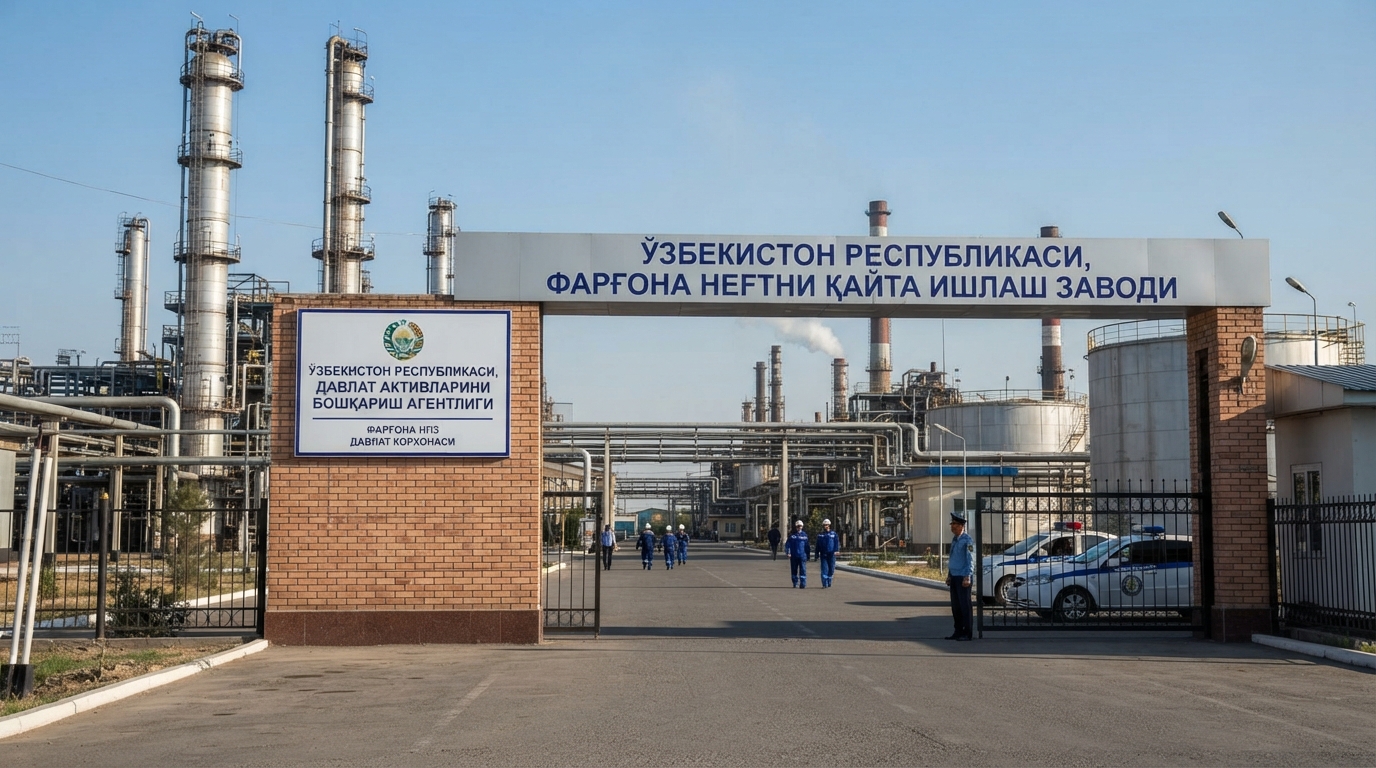
Why Was the Fergana Oil Refinery Returned to the State? Commentary by the Head of the State Asset Management Agency
The Fergana Oil Refinery (FNPEZ), which was previously sold to the company Saneg for $100 million, is not yet going to be privatized again. Sokhibjon Murodov, Director of the State Asset Management Agency (SAMA), announced this at a press conference on October 8.
According to him, the investor — the founder of Saneg is Bakhtiyor Fazylov, who held shares and was the former beneficiary of Enter Engineering, Eriell, Air Marakanda, the country's largest gas storage facility "Gazli", a tourist center in Samarkand, and other projects — faced financial difficulties in implementing other initiatives, as a result of which he was unable to fulfill his payment obligations for the acquired state asset on time.
"The purchase and sale agreement provided that in the event of a payment delay of three months, the seller has the right to unilaterally terminate the contract," Murodov stated.
He clarified that the decision was made after involving international legal consultants.
"We engaged international lawyers and, based on their conclusions, unilaterally terminated the contract, having previously notified the other party. As of today, the state asset has been returned," stated the head of SAMA.
At the same time, open data gives reason to assume that problems with paying for the refinery could have appeared long before the termination of the contract.
According to Gazeta, as of August 2024, the state, represented by SAMA, owned 58.5% of the Fergana Oil Refinery, and Saneg owned 41.5%. In May 2026, almost two years later, the ratio of shares remained the same.
This means that the investor had not yet fully paid for the enterprise, and the state share was to be transferred to it proportionally to the paid part of the purchase price. Consequently, upon receipt of regular payments and the corresponding re-registration of shares, Saneg's stake should have increased. However, this did not happen.
The question arises as to precisely when the investor stopped complying with the payment schedule and why the contract was terminated only in 2026. At the same time, the constancy of the shares in itself does not confirm a delay of more than three months, since specific payment terms and conditions for the transfer of shares were not publicly disclosed.
There is also an assumption that the company could have paid for the purchase of the refinery at the expense of the profits of the enterprise itself.
The editorial office again sent questions to the press service of SAMA.
Prior to the sale, the enterprise belonged to Uzbekneftegaz. Before privatization, the stake in the Fergana Oil Refinery was transferred to SAMA, while mutual settlements were conducted between the department and the oil and gas company.
"When the stake was transferred to SAMA, mutual settlements were made with Uzbekneftegaz. Therefore, the enterprise was removed from its structure. Today, the sole owner of the stake is the State Asset Management Agency," Murodov explained.
The head of the agency reported that a short-term strategy was developed for the Fergana Oil Refinery and measures began to restore the financial condition of the enterprise.
In particular, according to him, the utilization of production capacity grew from 40% to nearly 100%.
"The total capacity utilization was 40%, and today it has approached 100%, that is, it has more than doubled," he stated.
Murodov also reported that diesel fuel production increased by 30%, products for road construction — by 60%, and aviation kerosene production grew several times over.
At the same time, data on the refinery's load differs from the information presented to President Shavkat Mirziyoyev on October 5. According to a statement from the president's press service, by the end of 2026, the utilization of the Fergana Oil Refinery is planned to increase from 40% to 65% with subsequent growth.
The same report noted that after repairing the main processing units, diesel fuel production increased by 30%, bitumen — by 60%, and jet fuel — five times over.
Separately, the director of the agency focused on the debt obligations of the enterprise.
"We are currently conducting an international audit. We are studying what debts were raised and for what purposes, and what debt the enterprise actually has. Whether these debts will be repaid in the course of financial and economic activities while maintaining the established conditions, or whether the terms of their payment will be deferred, depends on contractual relations," he said.
The total amount of the Fergana Oil Refinery's debt, the results of checks already carried out, and the timeline for completing the audit were not named at the press conference.
Speaking about the future fate of the enterprise, the head of SAMA emphasized:
"If we talk about future plans, today the issue of privatization is not yet on the agenda."
In May 2022, SAMA announced the sale of 100% of the state stake in the Fergana Oil Refinery to Sanoat Energetika Guruhi (Saneg) for $100 million. The buyer was also required to invest $380 million in the modernization of the enterprise and increase its refining capacity to at least 2 million tons.
However, the state stake was transferred to the investor in stages, proportionally to the payments made.
As of August 2024, SAMA retained 58.5% of the enterprise, while Saneg owned 41.5%. The agency then explained to Gazeta that the investor had not yet fully paid for the refinery. The full transfer of the stake was provided for after the completion of payments and the fulfillment of contractual obligations.
Saneg previously stated that the terms of payment and performance of investment obligations are determined by the agreement concluded with SAMA.
This means that the Fergana Oil Refinery has once again fully passed under state control.
By the end of 2025, the Fergana Oil Refinery suffered a loss of 538.1 billion sum. In January 2026, as part of measures for the financial stabilization of Enter Engineering, Eriell Group, and Saneg, the government instructed a working group to prepare proposals for new investors who will be able to complete a number of strategic projects, including the modernization of the Fergana Oil Refinery.
The Fergana Oil Refinery is one of the largest producers of fuels and lubricants in Central Asia. The enterprise produces gasoline, diesel fuel, jet fuel, motor and industrial oils, bitumen, and other petroleum products.
As a reminder, a number of transactions with assets related to Saneg became the subject of a criminal case against the former chairman of the board of Uzbekneftegaz, Bahodirjon Sidikov, and other defendants.
As Gazeta previously wrote, one of the episodes concerns the sale of Uzbekneftegaz's 49% stake in Jizzakh Petroleum, which later became part of Saneg, to the Cyprus company Belvor Holding Limited. According to the prosecution, the stake was originally valued at more than $80 million, but was sold for $10 million, with the buyer failing to pay another $71 million.
Sidikov rejected the accusation. He stated that the original transaction took place in June 2021, prior to his appointment as head of Uzbekneftegaz, and he did not participate in agreeing on its terms. According to him, international consultants differed significantly in assessing the value of the stake: KPMG valued it at approximately $87 million, Deloitte — at 1 sum, and PwC — at $15.1 million.
The difference of approximately $71 million, which the investigation considers as damage, the defendant called the result of a commercial dispute over the value of the asset. He also reported that due to the buyer's failure to fulfill payment obligations, Uzbekneftegaz applied to the economic court.
In August, the consideration of the criminal case was moved to closed sessions.