

Why does a cart need a fifth wheel?
Why does a country that declares the development of democracy need an organ that is capable of being stronger than those state institutions through which this democracy is supposed to be implemented?
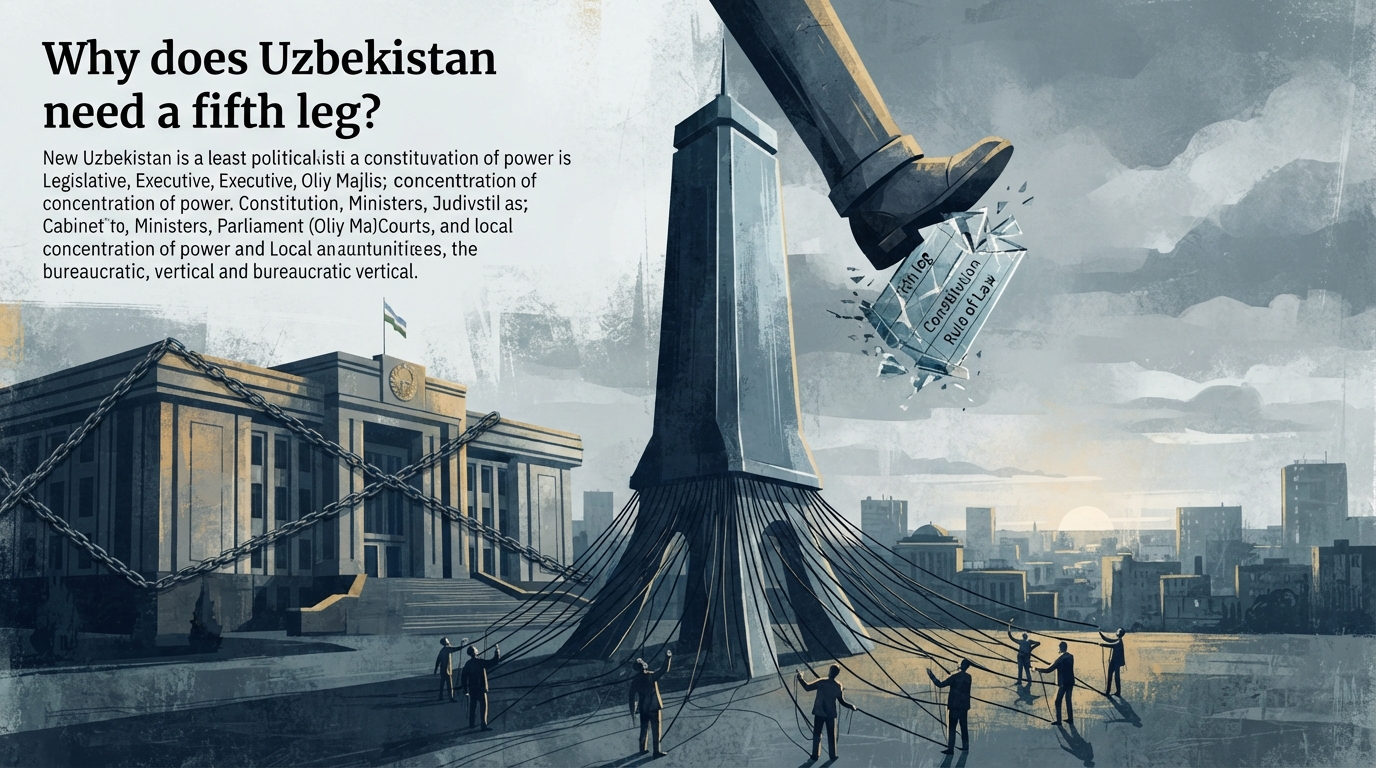
Why does Uzbekistan need a fifth leg?
The new Constitutional Law "On the Administration of the President of the Republic of Uzbekistan" was adopted at a time when Tashkent continues to talk about building a "New Uzbekistan," democratizing public administration, making government more open, and placing the state at the service of the people. Therefore, this document should be assessed not by its declarations, but by the extent to which it fulfills its stated goals. And this raises an unpleasant question: is the guise of improving the presidential apparatus a further concentration of power, characteristic of the authoritarian model of governance from which Uzbekistan officially intends to depart?
The mere existence of a strong presidential administration is not a problem. The problem begins when the apparatus ceases to be an apparatus and becomes an independent center of power.
This very danger is clearly evident in the new law.
It is particularly difficult to reconcile its provisions with Articles 7 and 11 of the Constitution. Article 7 states: the people are the sole source of state authority, and state authority is exercised exclusively by bodies authorized by the Constitution and laws. Moreover, the Constitution explicitly declares the appropriation of powers and the creation of new and parallel structures of power to be unconstitutional. Article 11 enshrines the classic principle of separation of powers into legislative, executive, and judicial.
These are fundamentally important provisions. They were not included in the Constitution for decorative purposes. Their purpose is to ensure that power is not concentrated in the hands of a single structure or group of officials, but is distributed among institutions with different sources of legitimacy and different mechanisms of accountability.
Furthermore, the Constitution of Uzbekistan specifically addresses the question of who has the right to speak on behalf of the people. Only the Oliy Majlis and the president, elected by the people, can do so. No specific group of individuals, no matter how high their position, is granted this right.
Against this background, the new law appears to be a step in the opposite direction.
The presidential administration reports directly to the president, which is natural in itself. But the law further transforms it from a service apparatus into a structure with very broad managerial powers. It coordinates the activities of government agencies, oversees the implementation of presidential decisions, manages personnel policy, interacts with law enforcement and security agencies, and oversees republican and local executive bodies. The Head of Administration is empowered to issue instructions to heads of government agencies, monitor their implementation, hear their reports, and initiate disciplinary action, including dismissal.
And this is no longer simply the presidential apparatus.
The provision regarding the orders of the Head of Administration is particularly controversial. The law effectively removes them from the scope of internal office work: they become binding on government agencies, enterprises, institutions, organizations, and officials. This very point is already being noted in public assessments of the adopted law as one of the most significant expansions of the Administration's powers.
However, the Constitution establishes its own system of acts of state authority. The President issues decrees, resolutions, and orders; the Cabinet of Ministers issues decrees and orders within its competence. In other words, the state has constitutionally defined centers for making binding decisions. The emergence of another center capable of issuing orders binding on the entire state system is nonsense in the current situation.
The position of the Administration in relation to the Cabinet of Ministers is even more difficult to explain. The constitutional model envisages the Cabinet as an executive body. But the new law grants the Administration the right to coordinate government activities, monitor them, participate in assessing the Cabinet's effectiveness, and the Head of the Administration or his representative to participate in meetings of the government and other state bodies, stating their position.
A subtle but fundamental substitution is taking place here.
The President has the right to direct the executive branch within the limits of his constitutional authority. But an official of the Presidential Administration is not the president. He was not elected by the people, was not approved by parliament as head of the executive branch, and is not a member of the Cabinet of Ministers solely by virtue of his position as Head of the Administration.
Nevertheless, he has the opportunity to control those who are formally part of the constitutional government.
This creates a strange structure: the government exists, but an administrative controller, not a government, emerges above it.
An even more sensitive area is parliament. The administration participates in the exercise of the president's right of legislative initiative, coordinates the preparation of bills, and, through its representatives, participates in their consideration by the chambers of the Oliy Majlis.
The participation of the presidential administration in parliamentary work is normal in itself. But when the same apparatus oversees the implementation of executive decisions, personnel policy, and the work of government bodies, the question arises about the actual relationship between parliament and the presidential bureaucracy.
Deputies are representatives of the people. Senators are representatives of the territories. The Head of the Administration is an appointed official. And if the latter is given instruments of administrative influence over the work of parliament, an obvious contradiction with the very idea of popular sovereignty arises.
The people do not elect representatives in order to then transfer the real power to govern them to appointed officials.
This is precisely why the problem with the new law is much broader than a legal conflict over a few powers. It concerns the very philosophy of public administration.
Uzbekistan has long been a state with a pronounced presidential vertical and limited political pluralism. The authoritarian features of this system are well known and are linked not only to the formal powers of the president but also to the fact that state institutions have historically lacked sufficient independence to effectively oversee each other. Following the arrival of Shavkat Mirziyoyev, reforms were announced aimed at openness, strengthening the role of parliament, increasing the accountability of officials, protecting human rights, and building a democratic state governed by the rule of law.
The new Constitution explicitly proclaims Uzbekistan a democratic and rule-of-law state, and that state bodies and officials are accountable to society and citizens.
And this is precisely why the strengthening of yet another center of bureaucratic control is alarming.
Authoritarianism does not necessarily begin with the abolition of elections or the dissolution of parliament. Far more often, it persists and develops within formally existing democratic institutions—by gradually stripping them of their real content. Parliament continues to function, but key decisions are made outside of it. The government continues to exist, but actual leadership is exercised by another structure. The court is formally independent, but the administrative system gains the ability to influence its organization. Elections are held, but the vertical power structure of appointed officials becomes stronger than elected representatives.
This mechanism is dangerous precisely because of its apparent legitimacy.
The new law creates the conditions for such a concentration of powers. It does not abolish parliament or liquidate the government. But it creates a powerful apparatus alongside them, which gains the ability to coordinate, monitor, and evaluate their work to a degree that significantly exceeds the usual technical support for the president's activities.
Now about the judiciary. The law allows the Administration to coordinate judicial and legal reforms and prepare proposals for reforming the judicial system. But the Constitution provides for the independence of the judiciary, and interference in the judges' administration of justice is unacceptable.
One could, of course, argue that this is merely a matter of organizational coordination of reforms. But in an authoritarian system, precisely such vague concepts often become a tool for expanding powers. "Coordination" gradually turns into control, control into leadership, and leadership into de facto subordination.
There's another problem that can hardly be considered minor. The law establishes a special immunity regime for Administration employees. Officials are subject to significant restrictions on criminal prosecution and investigative actions, and immunity remains for life after dismissal. For management employees, special guarantees are valid for five years.
At the same time, Administration officials are granted special guarantees of employment after dismissal, including a position no lower than their previous one, as well as social benefits.
For an ordinary civil servant, such a system seems unattainable. It's not envisaged for a member of parliament. The same goes for a minister. An administrative layer emerges that is simultaneously granted more power and greater protection from the state than other officials.
This is no longer a question of efficiency. It's a question of equality before the law.
A democratic state should not create a caste of officials who have the ability to control other civil servants, influence their career paths, and yet remain beyond the reach of the law.
And here arises the main contradiction between the law and the idea of democracy. Popular sovereignty is more than just the right to vote in elections. It is the ongoing participation of citizens in governing the state through elected institutions, the ability to control power, and the existence of mechanisms that prevent appointed bureaucrats from usurping powers they were never granted.
The Constitution of Uzbekistan explicitly enshrines the right of citizens to participate in government directly or through representatives. Therefore, state reform should lead to the strengthening of representative institutions, not the strengthening of a closed administrative vertical.
From the perspective of classical state theory, everything here is quite simple. The legislative branch should enact laws and oversee the government. The executive branch should govern the state and be accountable for its results. The judiciary should administer justice independently. The president should fulfill the constitutionally mandated functions of head of state and guarantor of the smooth functioning of the system.
The administration should assist the president.
Nothing more.
If the Administration receives its own binding orders, controls the government and khokimiyats, influences personnel decisions, participates in legislative work, interacts with the judicial system, and enjoys special immunity, it ceases to be simply an apparatus. It becomes an additional political and administrative center.
This is precisely the main risk of the new law.
For an authoritarian political tradition, this is a natural progression: to strengthen the vertical power structure, reduce the autonomy of institutions, and transfer as much control as possible to the center. But for the proclaimed "New Uzbekistan," this movement appears contradictory.
The main question, therefore, should be formulated as bluntly as possible: why does a country that declares the development of democracy need an agency capable of proving stronger than the state institutions through which this democracy is supposed to be exercised?
The answer to this question will determine more than just the fate of the Presidential Administration. It will reveal whether Uzbekistan is truly moving from an authoritarian model to a democratic state or is modernizing the old vertical power structure, giving it a more modern legal form.
Alexander Ivanov