

Why do some people learn foreign languages easily? Scientists have identified an important trait in distinguishing sounds
People who hear fine differences between sounds well may be able to distinguish foreign language sounds more accurately. Research conducted by scientists from University College London and Tohoku University in Japan showed that this trait plays an important role in mastering unfamiliar pronunciation.
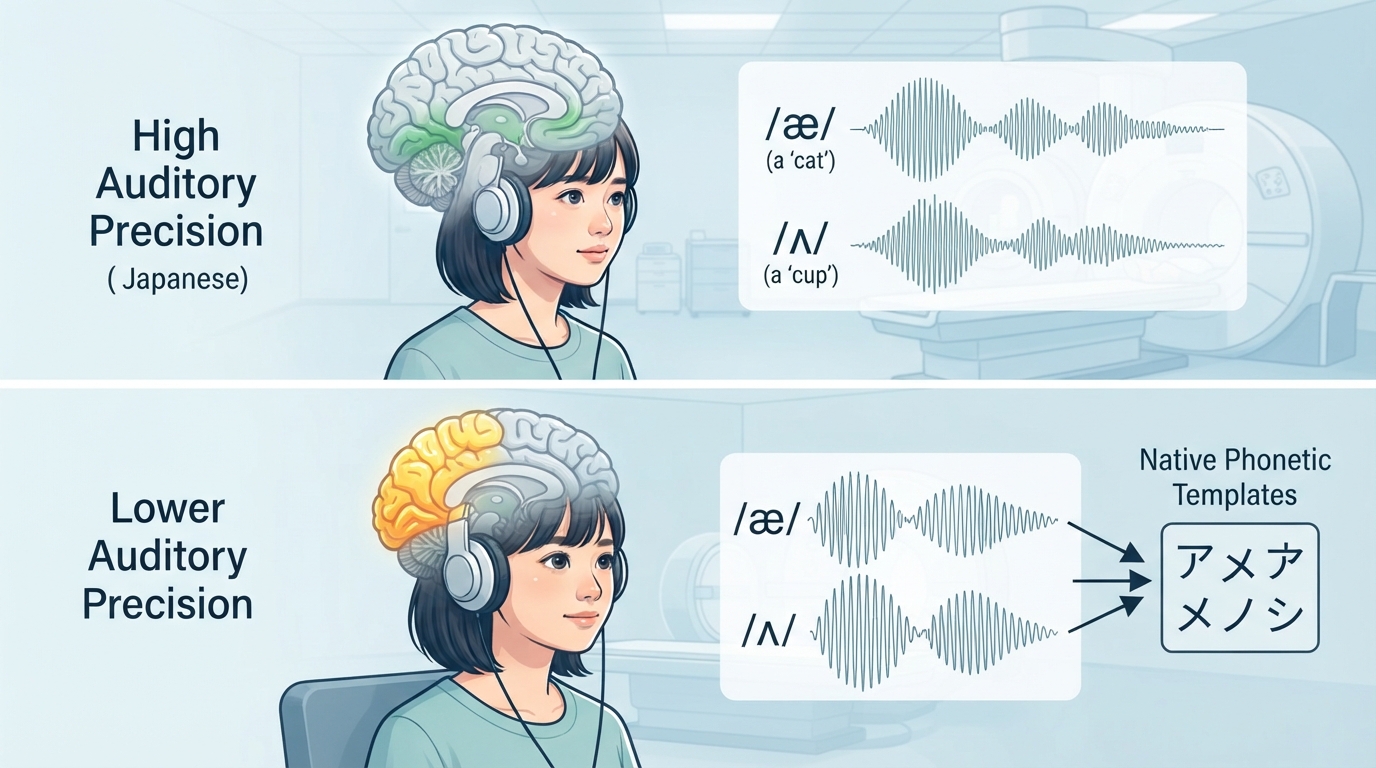
Why do some people learn foreign languages easily? Scientists have identified an important factor in distinguishing sounds
The study involved 67 Japanese participants learning English. First, scientists tested how well they could perceive pitch, duration, and other subtle differences in non-speech sounds.
After that, the participants were given the task of distinguishing the vowels /æ/ and /ʌ/, which occur in the English words cat and cup. In Japanese, there are no direct equivalents for these sounds. Brain activity was monitored using functional magnetic resonance imaging while the task was being performed.
According to the results, participants with higher auditory acuity showed less activation in the left sensimotor area of the brain, which is responsible for speech processing, when listening to foreign sounds. Their brain activity resembled the state observed during the analysis of non-speech sounds.
According to the scientists' explanation, such people do not immediately try to adapt unfamiliar sounds to familiar ones in their native language. They focus more on the characteristics of the sound itself. This, in turn, can reduce the influence of pronunciation habits formed in the native language.
Participants with lower auditory acuity, on the other hand, relied more on the phonetic patterns of their native language when distinguishing unfamiliar sounds.
The authors noted that in learning a foreign language, alongside vocabulary and grammar, it can also be useful to develop the ability to hear subtle differences between sounds.
However, the study was mainly focused on distinguishing foreign speech sounds. It does not prove that all language learning abilities are innate, nor that listening exercises can replace learning vocabulary and grammar.