

Why are more roofs not made of solar tiles?
Solar tiles were touted as an attractive alternative to solar panels - why have they not taken off?
Why are more roofs not made of solar tiles?
Some people in the US "still hate the look of solar", Kate Collardson admits.
She would know. Collardson oversees operations for Solar Service of Colorado, a company that maintains and inspects solar systems. She has also worked in nearly every other role in the sector, from installer to instructor.
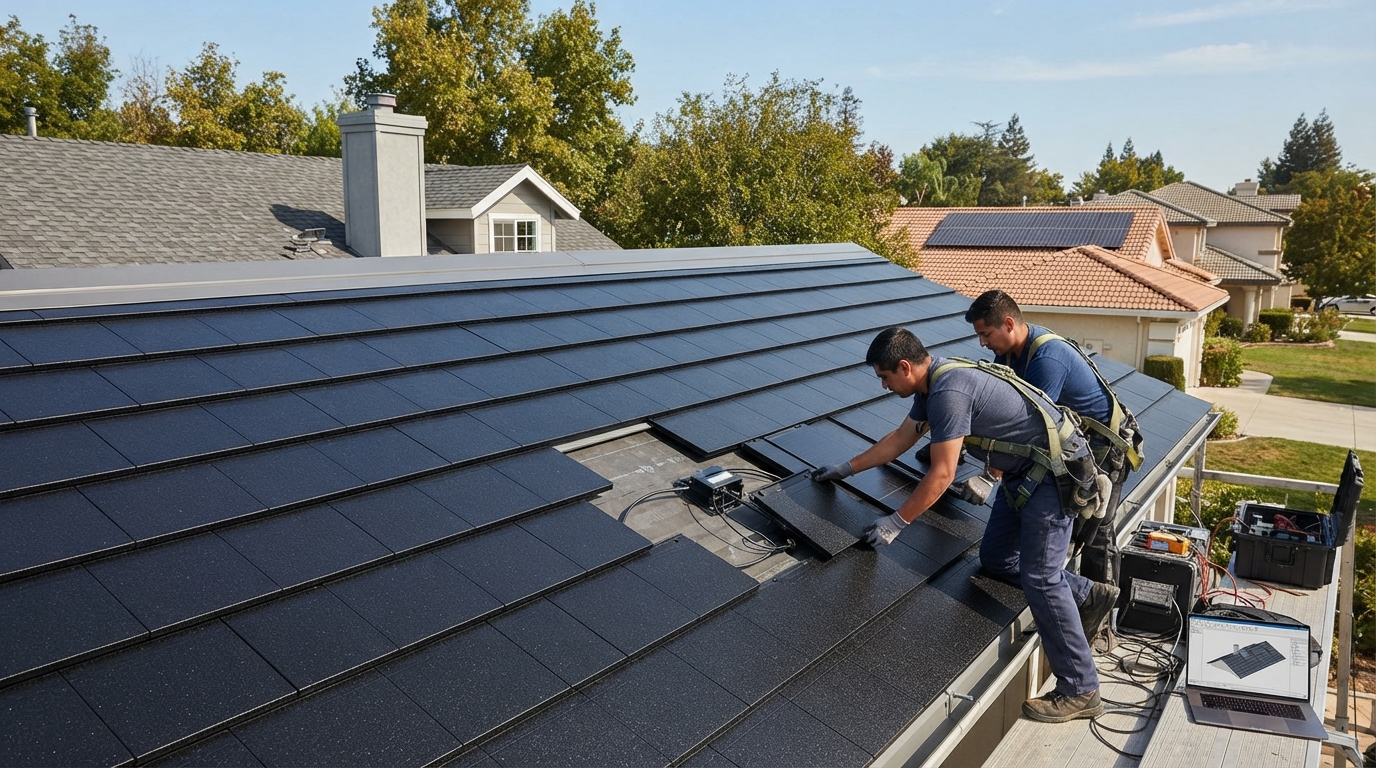
For people who dislike the appearance of solar panels, one option is a solar roof, in which the tiles, or shingles, contain solar cells while looking much like ordinary tiles.
That matters especially for historic buildings, where heritage rules restrict changes to their appearance.
For many people, the first time they had heard of this product category was in August, when
Other companies have also withdrawn, but Tesla's decision in particular sent shockwaves through the solar roof industry.
Some view that as a death knell for solar tiles; others see it as an opening.
For example, the small Swiss company Freesuns is thinking about expanding into the US.
Deborah Learoyd, Freesuns' CEO and managing director, says the company's sales have increased 20–30% since it was founded in 2019.
In general, solar roof parts are still produced in smaller runs. That reduces economies of scale and standardisation, although flexible manufacturing could help somewhat.
Learoyd says that while the unit costs of Freesuns' products are gradually falling, "a lot of the cost is actually the fact that every roof is a little bit different. And so it has to be engineered a little bit differently, installed a little bit differently".
Solar roofs usually require cooperation between roofers, solar installers and electricians. Building regulations also tend to be more complicated than for solar panels.
The extra time and paperwork can hurt a roofing business, Collardson says. "You try to put a roofer into the equation and they're going, 'This is taking forever. I'm losing money. I could have sold 10 roofing jobs in the time that it takes me to sell this one'."
Collardson has to charge more to repair solar shingles than a standard photovoltaic (PV) system.
She says, "With traditional solar, we generally have electronics on the panel and a map that shows us exactly how much each panel is producing." That makes it easy to identify where something has gone wrong.
"With solar shingles, we don't really have the benefit of that mapping; there's no room underneath the shingle for the electronics." Thermal cameras can, however, pinpoint the problem areas.
Then there is the issue of reaching them. "You can remove the one in the middle of the array, but you have to walk on the others, and you really shouldn't walk on them because you're going to create micro-fractures and that's going to cause issues down the road."
Before repair costs are included, a solar roof can cost twice as much as a roof-mounted solar panel system.
Solar roofs are also less efficient — partly because the tiles are simply smaller.
Another reason is heat loss. Because the tiles sit close to the roof, there is less airflow than with standard solar panels mounted on a roof. Heat reduces solar performance.
Coloured tiles are even less efficient, says Ben Graves, co-founder of UK solar company Sunsave. "The reason why all solar cells are black, and increasingly the whole panel is now black, is because black is the best absorbing colour."
Overall, far more space would have to be devoted to solar roof tiles to generate the same amount of energy.
Sunsave does not offer solar roofs. "Most people in the UK just don't have enough money to pay for it," Graves believes.
Although appearance mattered more five years ago, now "the vast majority of consumers are most interested in how much they can save".
Still, supporters of solar roofs say they should not be compared directly with standard solar modules on roofs.
"Let's not compare PV roof tiles to a standard PV system, but look at PV roof tiles as generating additional electricity from our roofs instead of just having the roof sit there," urges Martin Heinrich, who heads a research group at the Fraunhofer Institute for Solar Energy Systems in Germany.
While standard solar panels have continued to advance strongly, solar roofs have not progressed to the same degree.
One development that could particularly benefit solar roofs is matrix shingling technology.
This is a different method of connecting solar cells. The cells are cut into narrow strips, layered like overlapping shingles, and linked to each other with electrically conductive adhesive instead of metal wires.
That allows electrical current to move around shaded areas, unlike with standard modules. "If you get like a bird pooping on a part of the cell, the current can go around it," Learoyd explains.
Besides boosting energy output, this also improves appearance because the silver wires are not visible.
Another benefit, Heinrich says, is that "since we cut the cells into smaller areas, we can fill out special sizes more easily. You don't have to adhere to the regular pattern size."
Freesuns is an early adopter of matrix shingling technology in building-integrated PV. "We see it as a big opportunity for the future in terms of how we would make our tiles," Learoyd says.
The company would also benefit from better software for automated design. That would speed up the design process, since every roofing job is unique.
Learoyd believes this would reduce costs and give "the whole construction industry much more confidence in using the product".
Ten years after her own solar roof was installed, and despite the sector's setbacks, Learoyd remains optimistic.
She believes that for people who can afford it, it will eventually become standard to install a new roof with some kind of embedded solar. "It's just a no-brainer."