

While the world is watching us….
Many welcomed him as a person who changed the lives of millions of people, and he deserves this recognition. But
At a moment when the world is watching us….
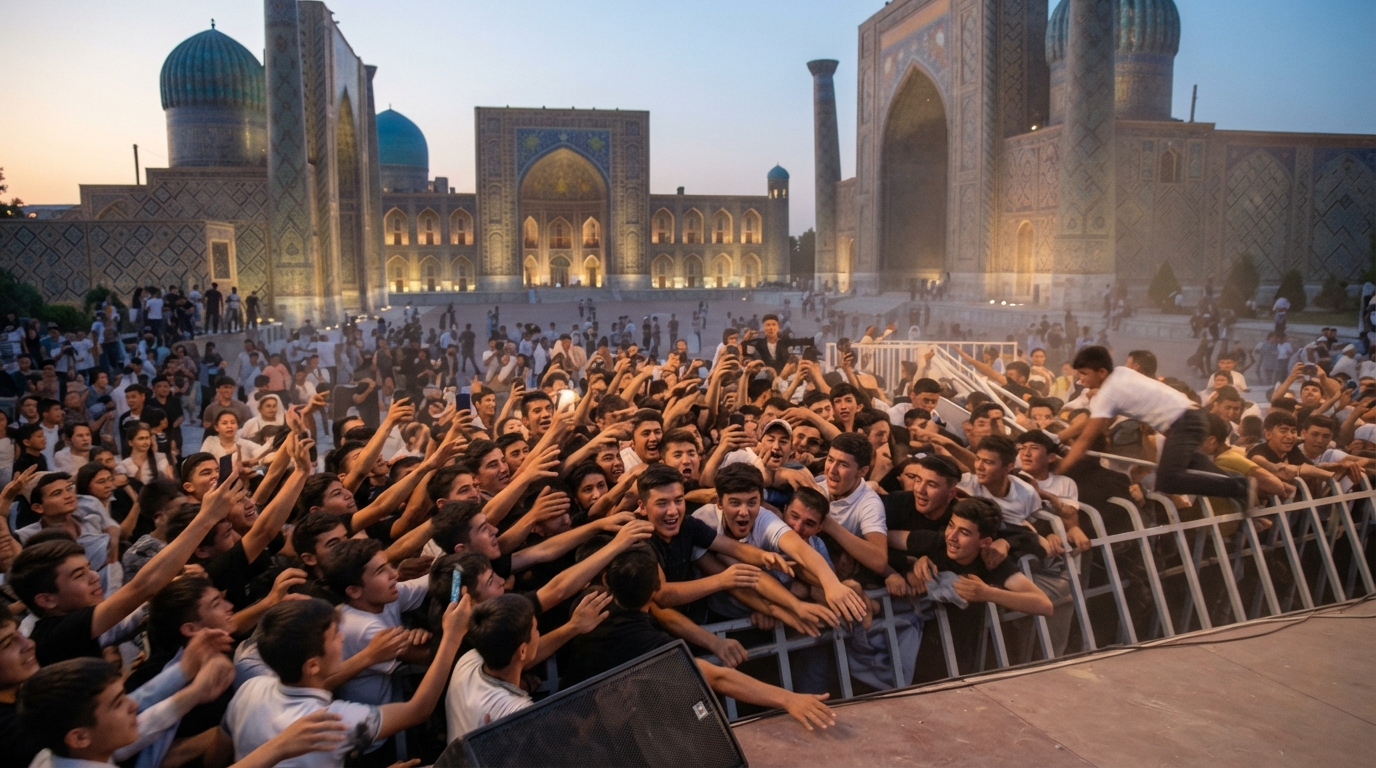
Recently, on the initiative of representatives of the culture and tourism sector, one of the most subscribed bloggers in the world — Jimmy Donaldson, known by the name MrBeast — visited our country. The goal was to demonstrate the culture, tourism potential, and rich history of Uzbekistan to millions of foreign viewers. Such an initiative can be evaluated as one of the modern methods of making the country known to the world.
However, images spread on social networks revealed another scene as well. An chaotically gathered crowd, people pushing each other to move forward, youth who forgot themselves in the hope of a gift or a prize. The main question is this: at a time when the world was watching us, how did we present ourselves to the world?
Virtues such as hospitality, modesty, decency, and holding oneself composed in front of others have never been foreign to our people. That being so, why did a few minutes of video clips leave precisely these virtues in the shade? This situation cannot be bypassed simply as an "unfortunate incident"; it is necessary to analyze its socio-psychological roots more deeply.
Why did so many people welcome him?
As I observed social networks over the weekend, it caught my attention that the majority of the content was dedicated precisely to this event, and I searched for information about this blogger on the internet. To be honest, until then I did not know him. In fairness, it must be said that he is not only an author of entertainment content. According to the information published by himself, through his initiative 23 million tree saplings were planted, more than 15 thousand tons of waste were cleaned from oceans and rivers, 500 thousand people in Africa gained access to clean drinking water, and more than 10 million people in need were provided with food.
Many welcomed him as a person who changed the lives of millions of people, and he is worthy of this recognition. But do we lack benefactors in our own country who, through *hashar* (community self-help), build roads, bridges, mosques, and schools, embrace orphans, and soothe the pain of the sick? We know the noble deeds of a foreign blogger, yet we do not know the benefactors in our own neighborhood. One root of the problem lies precisely in this.
The law of the crowd, or where is the individual lost?
The French scholar Gustave Le Bon, in his work "Psychology of the Crowds" published in 1895, showed that an individual who is cultured and rational on their own loses the ability for critical thinking after falling into a crowd, becoming prone to emotions and inclined toward imitation, and described this condition as a human's "descending several steps down the ladder of civilization."
In social psychology, this phenomenon is called deindividuation. Studies by L. Festinger and P. Zimbardo showed that within a crowd, a person feels anonymous and free from responsibility, their inner control weakens, and the influence of social norms decreases. In the state of "herd mentality," however, the thought that "everyone is doing it" drowns out the voice of conscience and modesty. These states are evident from such situations.
Hybrid crowd and virtual *manqurtism*
While in Le Bon's time a square and an orator were needed to gather the masses, today a single post or an announcement saying "gift to those who arrive first" is enough to gather thousands of people in one place. In this way, a hybrid crowd is forming whose roots are in the virtual world and whose actions manifest in the real arena.
We saw the bitterest example of this in September 2025 in Nepal. Following a decision to restrict social networks, the protest that began on the internet moved to the streets within a few days, the parliament building was set on fire, more than seventy people died, the government resigned, and the head of the interim government was selected through voting on the Discord platform. Therefore, today consciousness and thinking have transformed into a real battlefield.
The *manqurt* described by the writer Chingiz Aitmatov was unable to recognize his own mother because he was deprived of his memory. A virtual *manqurt*, however, is deprived of the ability to think independently. They consider themselves free, but in reality, they move in the direction shown by algorithms and the stream.
Big money and ethics — the trap of the "one-time opportunity"
The prize of one hundred million soums announced by the blogger is an amount that could fundamentally change living conditions for an ordinary person. The consciousness that sees big money with the thought "I was given an opportunity once" as if "switches off" morality and culture. A person attempts not to miss this opportunity even at the cost of pushing others, cutting in line, and debasing their own dignity. Considering that the majority of the blogger's audience is youth, this is not about a one-day event, but about the values being formed in the minds of the younger generation. The replacement of achievement attained through work and patience by "random luck" is a dangerous signal for society.
From grey propaganda to black propaganda
As a professional in the field, we know that white, grey, and black propaganda are distinguished in propaganda theory. Black propaganda strikes a blow at a specific reputation through false or distorted imagery. Scenes of disorder in a project aimed at making the country known can become ready material in someone's hands for a generalizing conclusion that "this is what Uzbekistan's youth is like." The difference is that this time we prepared its "raw material" ourselves.
Yet, just a few weeks ago, the world saw the youth of Uzbekistan in an entirely different light. At the 46th World Chess Olympiad in Samarkand, Uzbek chess players became the expression of our intellectual potential, or through yesterday's legendary victory achieved by the youth at the international robotics competition held in Incheon (Republic of Korea), our youth won gold medals in 3 categories among representatives of 190 countries. Here is the Uzbekistan we need to show to the world!
"Where are our heroes of the era?" Who are we setting as an example?
The Roman poet Juvenal wrote with bitter irony in his "Satires" that a people that once determined power and the legions themselves now dreamed only of bread and circuses. In a society where circuses have replaced thinking, both the future and sovereignty remain under threat.
Why are the names of Chess Olympiad participants or our young engineers not mentioned on social networks as much as the names of entertainment bloggers? The reason is that we are not promoting them enough. Creating heroes of the era for the growing generation must become a priority task in the spiritual-educational activities of state organizations and agencies operating in all sectors. Otherwise, we will surrender the minds of our children to the disposal of entertainment bloggers and vainers.
The experience of other countries in this regard is instructive. In Germany, television glorifies the work of scientists, engineers, teachers, and doctors. In the USA, the Pentagon has assisted in more than 2,500 films and television shows over a century, spreading the "American Dream" to the world through Hollywood. China promotes the concept of the "Chinese Dream" through Confucius Institutes. In South Korea, the 2025 budget of the Creative Content Agency (KOCCA) exceeded 600 billion won. Pay attention: the "Korean Wave" (Hallyu) is a product of state policy. In the media products of these countries, ideas that demean representatives of their own nation are not promoted.
And what about us? According to our personal observations, more than 140 films, series, and telenovelas on the subject of "daughter-in-law and mother-in-law" are being shown on our screens. The time has come to think seriously about what kind of perception these contents, which have turned family conflicts into entertainment, are evoking about the Uzbek family, man, and woman.
Who owns free time?
In today's information struggle, the most valuable resource is human attention and free time. If we do not fill it with meaningful content, others will fill it with their own content. That is, sports, books, science, crafts, and creativity are sources of spiritual immunity that protect youth from crowd mentality.
Proceeding from this, the following tasks can be defined: it is advisable to thoroughly plan public events involving foreign guests in advance, establish clear rules of conduct for participants, and consistently promote young scientists, athletes, engineers, and inventors who have achieved success in the international arena, as well as benefactors in our country, as "heroes of the era." It is necessary to develop media literacy and critical thinking among youth, and to support artistic and documentary shows and broadcasts that raise the prestige of professions such as teacher, doctor, engineer, and scientist.
In this context, strengthening the cooperation of the family, neighborhood, and educational institutions in organizing the free time of youth meaningfully is very important.
In lieu of a conclusion, it is worth emphasizing that the world evaluates us not only by our architectural monuments and our table, but also by how we conduct ourselves. A single video clip certainly cannot negate a thousand-year-old culture, but it can leave it in the shade. As our President Shavkat Mirziyoyev emphasized at the meeting on January 19, 2021, "If the body of society's life is the economy, its soul and spirit are spirituality." The head of our state also gave a clear definition of ideology: "When we say ideology, we understand, first of all, the education of thought, the education of national and universal human values." It is precisely this education of thought that shapes a generation that will not get lost in a crowd and will not forget its dignity even in the face of the promise of big money. The youth who are turning into a crowd today will tomorrow turn into elderly people who can offer the next generation neither experience nor spiritual support. Preventing this, however, begins in the family of each and every one of us.