

Which products became more expensive and which became cheaper in August — official statistics
According to official data, in the last month of summer, prices for goods and services in the consumer sector increased by an average of 0.2 percent
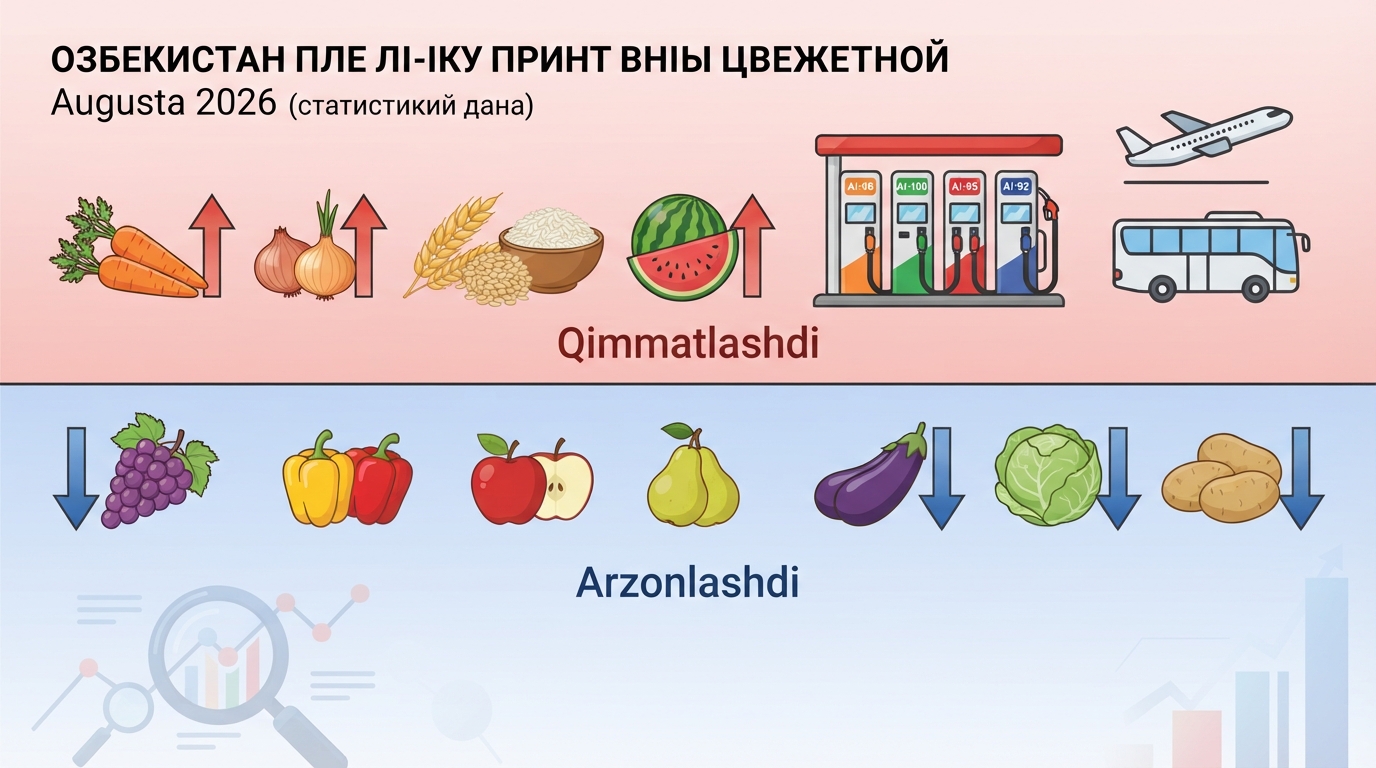
Which products became more expensive and which became cheaper in August — official statistics
In August 2026, prices for goods and services in the consumer sector in Uzbekistan rose by an average of 0.2 percent.
The annual consumer price index (CPI) stood at 6.2 percent, which is 2.6 percentage points lower compared to the same month last year (August 2025 — 8.8 percent).
In August, it was recorded that food products became more expensive by an average of 0.4 percent, non-food goods by 0.2 percent, and paid services provided to the population by 0.1 percent.
Among the main food products, price increases for carrots (9.2 percent), onions (6.2 percent), long-grain rice (2.4 percent), round-grain rice (2.3 percent), and watermelon (7.5 percent) had an impact on inflation.
As a factor reducing inflation, a significant contribution was made by the decrease in prices of key food products such as grapes (-10.9 percent), bell peppers (-9.2 percent), apples (-7.2 percent), pears (-6.0 percent), eggplant (-5.5 percent), cabbage (-4.9 percent), and potatoes (-3.3 percent).
Among non-food products, price increases were observed for AI-98 and AI-100 octane gasoline (6.7 percent), AI-95 octane gasoline (4.9 percent), and AI-92 octane gasoline (1.1 percent).
Additionally, in terms of service prices and tariffs, increases were recorded for international flights (1.7 percent), intercity road passenger transport (0.6 percent), and rent for leased housing (0.4 percent).
For the calculations, more than 2 million prices were recorded from over 10 thousand retail and service points. Prices of 419 types of food and non-food products and 98 types of services were monitored.