

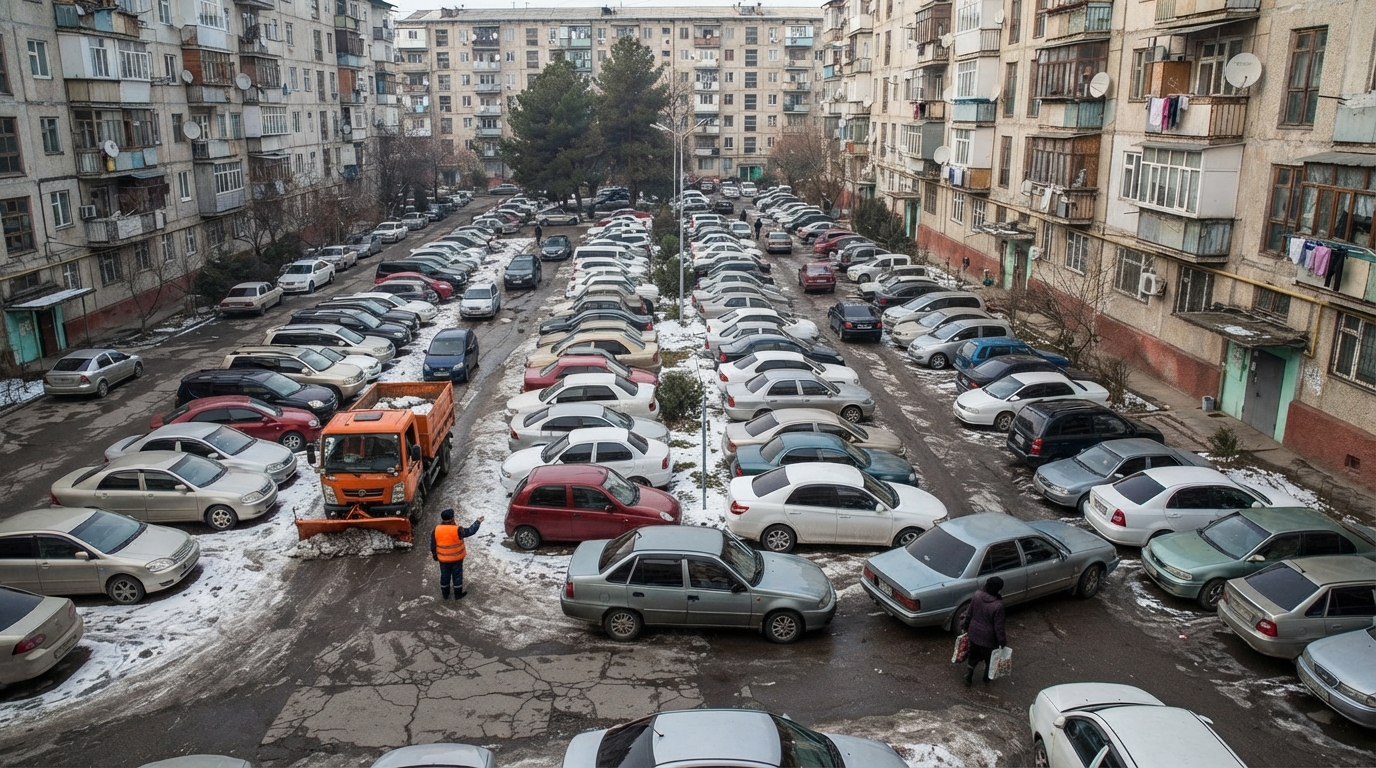
Where to park a car?
In Central Asia, a car was long perceived as personal property, requiring no dedicated space in the urban infrastructure. A person would buy a car, and the city would provide it with a space: near the house, on the sidewalk, in the yard, along the road, in a vacant lot, or among the trees. This model worked as long as the number of cars was relatively low, yards remained spacious, and most housing was built according to Soviet standards designed for a completely different level of motorization.
Now the situation has changed. Astana's population has exceeded 1.5 million, Almaty is approaching 2.3 million, Tashkent has over 3 million permanent residents, Bishkek has effectively become an agglomeration with a population well over 1 million, and Dushanbe is also rapidly expanding beyond its administrative boundaries. At the same time, the number of two-car families is growing, as is the fleet of taxis, company vehicles, delivery vehicles, and small commercial vehicles. New residential neighborhoods accommodate tens of thousands of people, but the space around them is not expanding. On the contrary, development is becoming denser, land is becoming more expensive, the ground floors are occupied by shops and services, and the vacant space between buildings is becoming too valuable to be used for free parking. The Central Asian city is entering a period where an apartment no longer guarantees access to a car near the entrance. This is not a temporary shortcoming of new neighborhoods, but a structural change in urban life.
One car takes up significantly more land than its owner realizes. A standard parking space is approximately 2.5 meters wide and 5 meters long, meaning its net area is 12.5 square meters. But a car requires access, room to maneuver, passage between rows, lighting, drainage, and safe egress for passengers. Therefore, in a real-world project, one surface parking space requires approximately 25-30 square meters of land. For 1,000 cars, 2.5-3 hectares are required—the area of several football fields. For a neighborhood with 10,000 apartments, even the standard of one space for every two apartments requires approximately 12.5-15 hectares just for parking. If we assume one car per apartment, the parking area could occupy 25-30 hectares. This is comparable to the area of a large residential complex, including its courtyards, school, kindergarten, and public spaces. A car is stationary for most of the day: typically, a personal vehicle is used for about an hour a day, and stored for the remaining 23 hours. As a result, one of the most expensive urban resources—land—serves a facility that 95% of the time serves no transportation function. In older neighborhoods, this cost is hidden, as courtyards, roadsides, and vacant lots were created or abandoned decades ago. In newer neighborhoods, it becomes visible: every square meter must be paid for during the land purchase, design, construction, and subsequent maintenance.
The problem is particularly acute in high-rise developments. On a 1-hectare plot, several buildings and 700-1000 apartments can be built. If the average family owns at least 0.7 cars, the neighborhood will require 490-700 parking spaces. Physically accommodating them above ground is impossible without destroying the courtyard. Then the developer chooses one of three options. The first is to reduce the number of parking spaces and hand over the future conflict to residents. The second is to build a multi-level parking garage that occupies a separate plot and requires constant occupancy. The third is to move the cars underground, dramatically increasing the cost of the project. An underground parking space is not a rectangle painted on a concrete floor. It requires an excavation pit, a reinforced foundation, waterproofing, ventilation, fire suppression, lighting, pumps, entrance ramps, security, and utility systems. Depending on the soil, depth, and technical conditions, constructing a single space can cost between $15,000 and $35,000, and even more in complex projects. If a mass-market apartment costs $70,000–$100,000, parking can add another 15–30% to the price. This is why a developer can't simply "gift" an underground garage to every buyer. Residents bear the cost of this, either separately, through the price of their apartment, or through the reduction of courtyard space and social facilities.
In Astana, the conflict is exacerbated by the climate. In winter, a car can't be seen solely as a means of transportation: for many families, it replaces a protected space between a warm home, school, office, and shopping center. Temperatures below -30°C (-32°F) increase the value of indoor parking, as cold starts accelerate wear and tear, require warming, and increase fuel consumption. However, new districts in the capital are growing faster than the supply of heated parking. As a result, courtyards become filled with cars, driveways narrow after snowfalls, and municipal vehicles are unable to properly clear the area. A single improperly parked vehicle blocks a tractor from operating on the entire lot. Almaty faces a different combination of factors: land shortage, dense development, traffic jams, mountainous terrain, and environmental stress. Here, surface parking competes not only with playgrounds but also with trees, which the city needs for shade and some heat reduction. Thousands of additional cars in new residential complexes are entering a road network with limited capacity. Even if each building built its own parking lot, it wouldn't solve the street problem. A parking space allows for the storage of a car, but doesn't create a new road for it.
Tashkent is facing the effects of mass motorization amid rapid housing construction and urban expansion. The car remains an important symbol of prosperity and simultaneously a practical response to long distances, hot summers, and uneven public transportation access. However, development along major highways creates a paradox: apartments are sold due to their convenient location for driving, but then thousands of new residents make these highways less convenient. Yards are converted into parking lots, street frontages into parking rows, and the driveways to commercial premises are constantly occupied. In Bishkek, the situation is complicated by a small street network, the active import of used cars, and weak land use regulations. A significant portion of parking demand is absorbed by sidewalks, irrigation ditches, green belts, and driveways. While a car technically occupies a few square meters, it actually interrupts pedestrian traffic, forcing people onto the roadway. In Dushanbe, car ownership is still less evenly distributed, but the intensive construction of high-rise buildings is already creating a future shortage. A tower with several hundred apartments can be built in two or three years, while the street network around it may still be designed for a mid-20th-century low-rise neighborhood. Correcting this imbalance several years after occupancy is much more expensive than considering it at the design stage.
Parking is gradually becoming an independent real estate asset. It has a limited supply, a specific location, construction costs, monthly expenses, and the possibility of leasing. In dense areas, a parking space near a building can appreciate faster than the car parked there. A mid-range car loses some value each year, while a well-located parking space maintains its value due to scarcity. This is changing the structure of home purchases. Previously, families chose an apartment based on its size, floor, renovation status, and distance to work. Now, a fourth major asset is added to the mix: parking. An apartment without a guaranteed parking space may be cheaper to purchase, but it creates ongoing time costs. If a driver spends 15 minutes each morning and evening searching for, exiting, or releasing a blocked car, that adds up to 180 hours a year. That's more than seven full days. Add to this the risk of damage, conflicts with neighbors, towing, fines, and the need to clean the car in winter. Free off-street parking has a high hidden cost; it's simply not paid for with a single payment, but in time, stress, and the deterioration of the urban environment.
The main mistake in urban planning is trying to provide parking for every possible demand. The more spaces created, the more convenient it is to own a car, which means more cars are bought. After a few years, the new capacity once again proves insufficient. If 5,000 free spaces are built in a neighborhood, they will almost certainly be filled. Moreover, each space creates an additional trip: a car leaves in the morning and returns in the evening, congesting intersections and driveways. International practice is gradually abandoning minimum parking standards that mandate a certain number of spaces per apartment, moving toward maximum restrictions, especially near metro stations and major transportation hubs. For Central Asia, fully emulating this model is premature: public transportation isn't always able to replace private cars. However, continuing the old approach is also impossible. Requiring one or one and a half spaces per apartment makes housing more expensive, even for families without cars. A buyer who commutes by bus effectively contributes to the cost of their neighbor's garage.
A rational model should separate the cost of an apartment from the cost of storing a car. Residents purchase housing and purchase or rent a parking space separately. This makes the price of a car more fair: the owner pays not only for gas, repairs, and insurance, but also for the city land they occupy. Guest parking should be short-term, not turn into permanent garages. On-street parking in the most congested areas should be paid, with the rate set at a level that keeps at least 10-15% of spaces vacant at all times. If all 100 spaces out of 100 are occupied, the price is too low or there's no enforcement. If 60 spaces are occupied, the rate is too high or the parking lot is poorly located. Payments are needed here not to collect money, but to manage limited space. It's logical to direct the funds collected to sidewalks, lighting, landscaping, and public transportation in the area where they were collected. Residents then see that paid parking doesn't simply extort money, but rather restores street functionality.
New neighborhoods will require a network of block-level multi-level parking garages located 300-500 meters from homes. This distance takes 4-7 minutes to cover, but it frees up courtyards and reduces the cost of building each building. The lower floors of such facilities can be occupied by shops, workshops, drop-off points, and car washes, while the rooftops can be used for sports fields or solar panels. Some spaces should be pre-wired for electricity: even if electric vehicles currently make up a small portion of the fleet, installing cables after construction is completed is significantly more expensive. Potential changes in demand must also be considered. A parking lot with low ceilings, narrow aisles, and sloping slabs cannot be adapted for any other purpose. A more flexible building could be converted into a warehouse, office, service center, or housing in the future if public transportation development reduces the number of private cars. Urban infrastructure is built to last 40-60 years, while the automobile market can change significantly in a decade.
The most valuable resource that Central Asian cities can preserve is a car-free courtyard. This is not a matter of aesthetics, but of economics and safety. A 1.5-2-ton vehicle driving between the entrance and the playground poses a constant risk. A parked driveway obstructs fire trucks, ambulances, and waste removal. Asphalt increases summer heat, and the lack of trees raises surface temperatures to 50-60 degrees Celsius. A courtyard occupied by cars serves no purpose as a public space, even though its cost is already included in the price of apartments. A family gains a few rooms inside the house but loses a safe space outside. At the neighborhood level, this impacts health, children's mobility, neighbors' interactions, and the attractiveness of real estate. In 10-15 years, residential complexes with enclosed green courtyards and guaranteed parking will be valued higher than houses surrounded by unregulated parking, even if the difference seems insignificant today.
The future of millions of cars in Astana, Almaty, Tashkent, Bishkek, and Dushanbe is not determined by the number of available vacant lots. Vacant lots will run out, shoulders will fill up, and road widening will collide with existing buildings. The main question is who should pay for parking a private car in the city and how much. While this cost is hidden, everyone bears it: homebuyers, bus passengers, pedestrians, children, utility companies, and business owners. When parking is recognized as real estate, not a free accessory to a car, a more rational distribution of space will begin. Some families will buy a space, some will rent it, some will give up a second car, and some will choose housing near high-quality public transportation. Cars will not disappear from Central Asia. But a city that tries to provide each of them with a free plot of land near every destination will gradually turn the most expensive land into a huge garage. The choice of the coming years is not between a car and a car-free life, but between organized vehicle storage and the chaotic privatization of streets.