

Where to find a partner, raw materials, and manufacturing: why does business need the SCO Industrial Cooperation Map?
One of the most practical initiatives presented by the President of Uzbekistan at the Bishkek SCO Summit was the proposal to create an SCO Industrial Cooperation Map. If the mechanism is populated with up-to-date and verifiable information, it could become a tool for businesses to find partners, production sites, raw materials, and new markets — and help the organization's member states transition from simple trade to the creation of cross-border production chains. […]
Where to find a partner, raw materials, and production: why does business need the SCO Industrial Cooperation Map?
One of the most practical initiatives voiced by the President of Uzbekistan at the Bishkek SCO Summit was the proposal to form the SCO Industrial Cooperation Map. If this mechanism is filled with up-to-date and verifiable data, it has the potential to become a tool for businesses to find partners, production sites, raw materials, and new markets — as well as to help the organization's countries transition from ordinary trade to creating cross-border production chains.
Bakhtiyor Mustafaev, Deputy Director of the Institute for Strategic and Regional Studies under the President of the Republic of Uzbekistan, spoke about how this initiative could work in practice.
According to his assessment, the problem today is not so much a lack of joint projects, but rather that the information needed to launch them remains fragmented, and business conditions differ significantly from country to country.
In Uzbekistan alone, more than 1.5 thousand joint projects with SCO countries are being implemented. However, an entrepreneur intending to enter the markets of other states of the organization still has to independently gather information on production sites, raw material bases, potential suppliers and partners, government support measures, logistics, and sales markets.
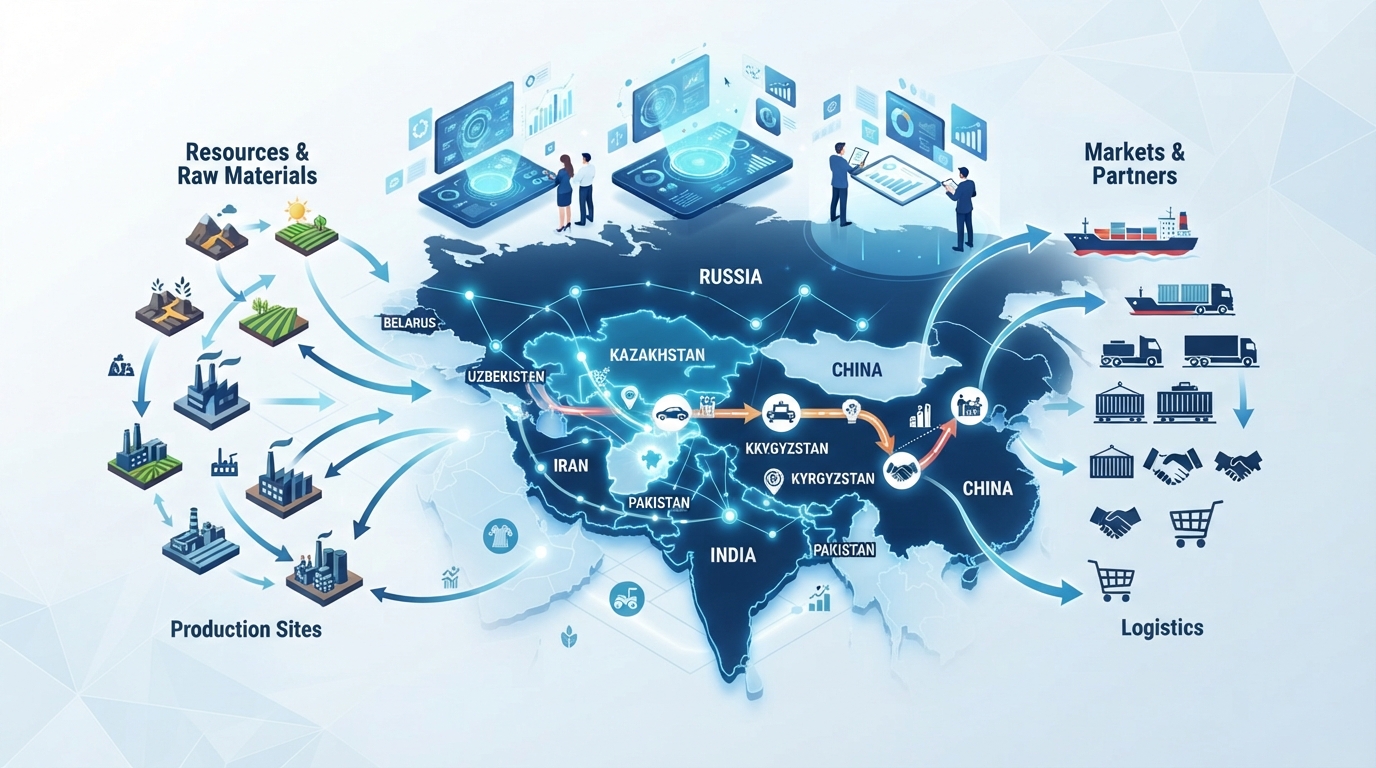
The SCO Industrial Cooperation Map could gather this data in a single digital space. For business, this would mean a more convenient search for partners and projects, as well as a reduction in time and transaction costs for their preparation.
The practical value of the initiative will directly depend on what exactly is included in the map.
If the digital platform includes up-to-date information on special economic zones, free production capacities, raw material resources, localization requirements, potential suppliers, transport routes and tariffs, tax and investment preferences, it can become not just a directory, but a fully-fledged tool for industrial cooperation.
For example, a company from one country will be able to find a suitable production site, a supplier of necessary raw materials or components in another country, and evaluate logistics costs and localization conditions. As a result, a chain could be formed in which raw materials are extracted in one SCO country, processed in another, components are produced in a third, and the finished product is sold in several markets at once.
It is this approach that makes it possible to transition from exporting raw materials and finished goods to manufacturing products with higher added value.
Such a system could become especially significant for small and medium-sized businesses. Large corporations have their own analytical, legal, and investment departments capable of independently studying the legislation and markets of different states.
Small companies, as a rule, do not have such capabilities.
A unified industrial map could lower the barrier to entering the markets of the SCO countries: it will be easier for an entrepreneur to understand where to produce, with whom to cooperate, what conditions a specific country offers, and where the products can be sold.
In this case, the initiative can become not only an instrument of interstate industrial policy, but also a practical service for entrepreneurs.
The scale of the SCO creates serious potential for such a platform. Today, the organization unites 10 states — Belarus, India, Iran, Kazakhstan, China, Kyrgyzstan, Pakistan, Russia, Tajikistan, and Uzbekistan.