

When and why did girls start wearing pink clothes and boys wearing blue?
When and why did the custom of dressing girls in pink and boys in blue arise?
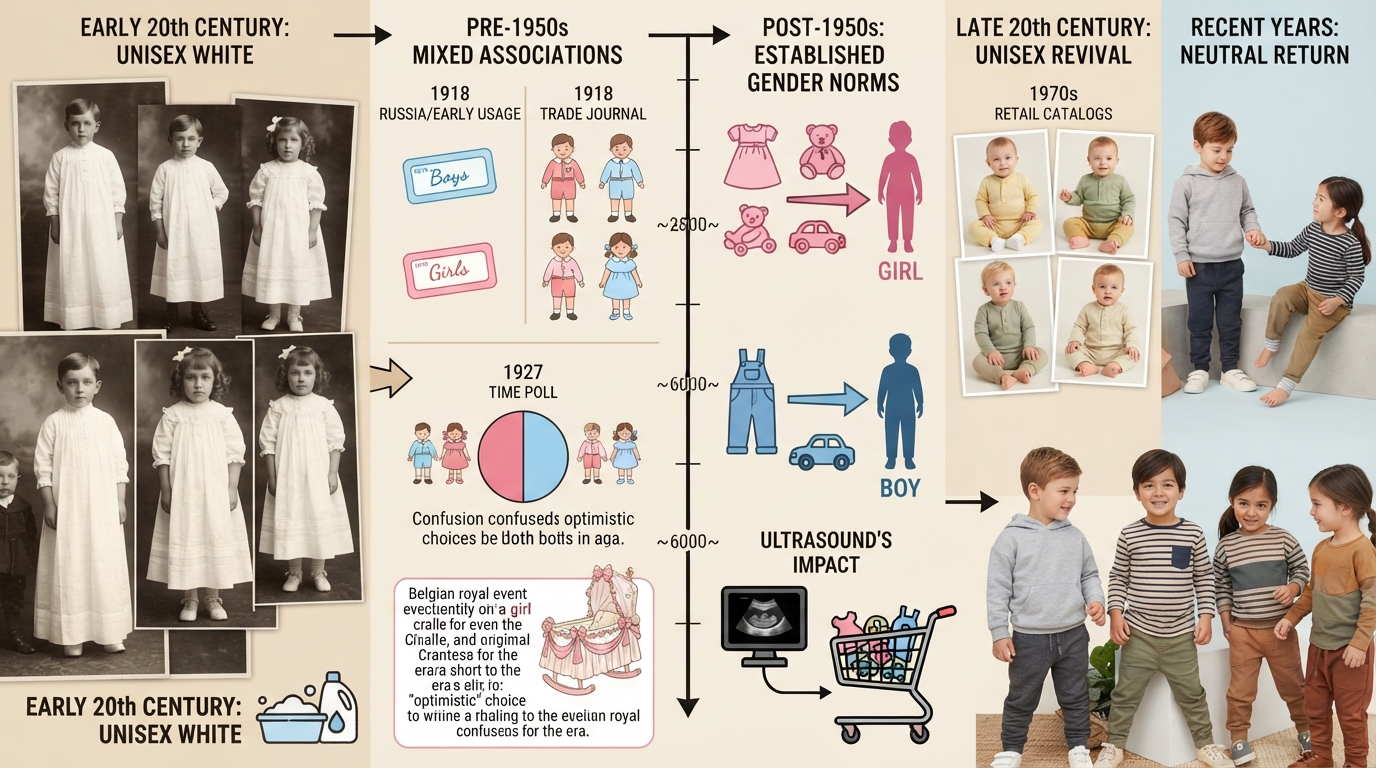
Until the beginning of the 20th century, it was common for all children under the age of 6-7 to wear white dresses, regardless of gender. This was convenient for practical reasons: white fabric could be easily bleached, and wide-hemmed clothes made it easier to change diapers.
The process of dividing clothes into colors according to the child's gender developed gradually, but not consistently. Although pink and light blue clothes began to appear in the 19th century, it took time for a certain color to become associated with a specific gender.
For example, in 1898, an article was published in the American Medical Journal about the care of orphans in Russia. It noted that cards with the names of boys in orphanages were light blue, and those of girls were pink.
At the same time, a 1918 salesman's magazine noted that pink was more suitable for boys, because it was more pronounced and saturated, while blue was more delicate and elegant, because it was more suitable for girls. Other articles from that time also recommend that blue be suitable for blond children, pink for dark-haired ones; blue for blue-eyed children, and pink for brown-eyed ones.
Even ten years later, there was no single opinion about who was more suitable for pink and blue. In 1927, Time magazine published the results of a survey of salespeople from leading American stores. Opinions were divided: about half of those surveyed believed that pink was suitable for girls and blue for boys, while the other half thought the opposite.
The birth of a baby girl in the family of the Belgian crown prince was the reason for the Time article. The news about this incident said that the swing was decorated in an "optimistic" pink color intended for boys. In fact, in Catholic countries of Europe, blue is considered the color of the Virgin Mary and is used for girls.
According to experts from the Pantone Institute, pink is historically associated with its "mother" color - red. At different times, it was depicted as more passionate, active and aggressive. Even when red was diluted, that is, practically turned into pink, it was still associated with boys.
Today, many researchers, especially those in the field of sociology or gender theory, do not doubt that the strong association of pink with girls and blue with boys was established only in the middle of the 20th century. Before that, the gender relationship of colors was either reversed or unstable.
In the second half of the 20th century, the women's liberation movement in the West took off, and unisex styles came to the fore. In the 1970s, the catalogs of the largest US retailer did not have a single pink baby item for at least two years.
Even in Soviet publications until the 1980s, there was no strict division of colors into "boys" and "girls." Blue and pink were mainly mentioned in sections dedicated to clothes for babies under one year old.
Neutral children's clothing remained popular until about 1985, when the world was again divided into pink and blue. The next change came with the widespread use of prenatal ultrasound. Having learned the sex of their unborn child, parents began to buy products for a girl or a boy. Retailers were happy to offer separate clothing for each gender, as this method created the opportunity to sell more goods.
Another factor that connects the return of gender-based clothing is the choice of children themselves. Most of them become aware of their gender at about the age of two and by the age of four have a stable idea of their gender identity. At the same time, they are constantly exposed to influential advertising that reinforces social stereotypes. As a result, children may think that women should have long hair and wear pink dresses.
In recent years, neutral colors have become popular again. This is partly due to the constant redefinition of gender and gender concepts. Fashion reflects the cultural and political views of a generation, which are often determined by young people.