

What you need to know about breast health. WHO recommendations
What changes in a woman's breast require medical attention, how does early diagnosis differ from screening, and how can the risk of cancer be reduced? In October, Breast Cancer Awareness Month, Gazeta presents WHO recommendations on self-examination and seeking medical care.
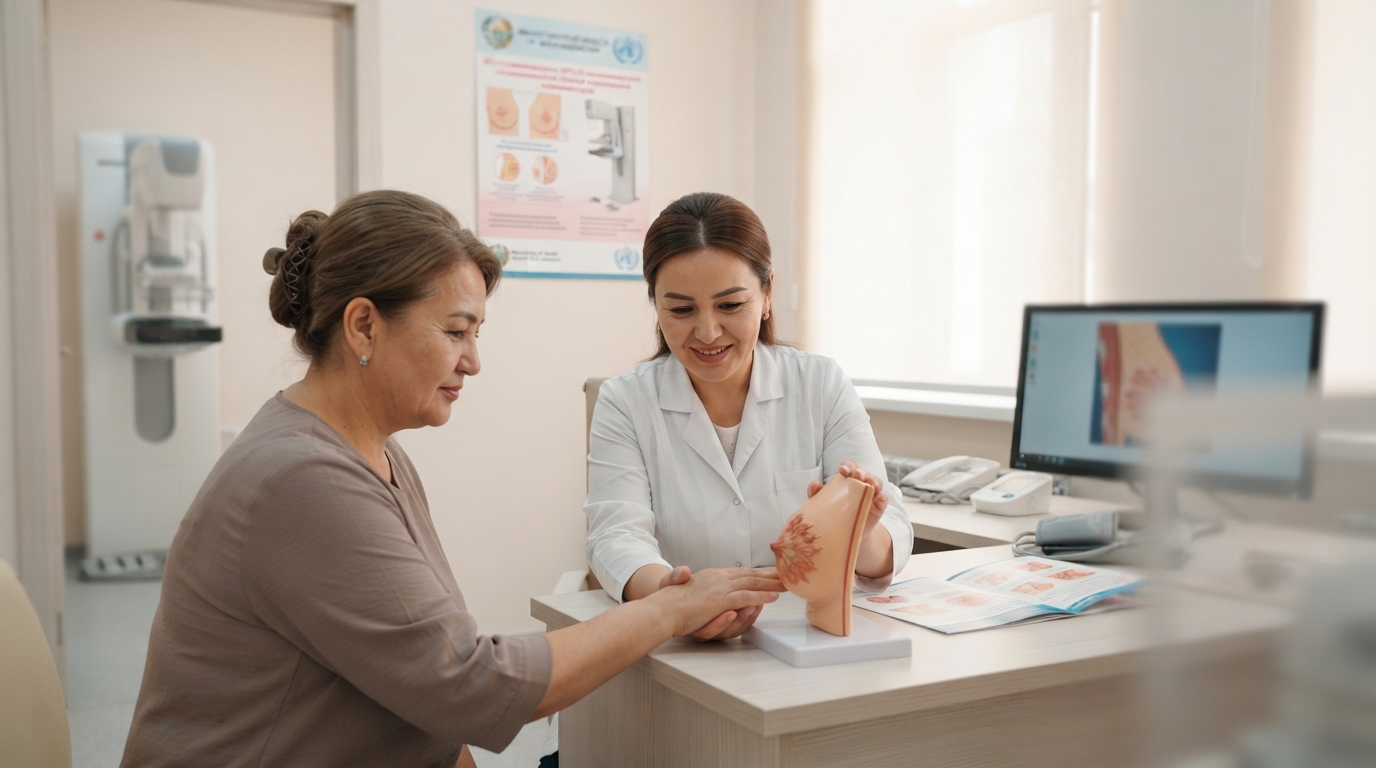
What is important to know about breast health: WHO recommendations
Breast cancer is the most common type of cancer among women worldwide. In Uzbekistan, it also ranks first among the causes of cancer deaths in women. According to estimates by the International Agency for Research on Cancer, there were 4,793 new cases of the disease in the country in 2024, and 2,085 women died from it.
At the same time, in most cases, breast cancer is treatable, especially if the disease is detected at an early stage and therapy is started on time.
Breast cancer occurs when altered breast cells begin to divide abnormally fast. They can form lumps or cause other changes. As the tumor develops, it can spread to surrounding tissues, lymph nodes in the armpit and supraclavicular area, and then to other organs.
"It is important to remember: a lump in the breast is not necessarily cancer. However, it is impossible to determine its nature by touch alone. Any new lump, thickening of tissue, or other unusual change in one of the breasts should be examined by a healthcare professional, even if it does not cause pain," the WHO emphasized.
"Most breast lumps are not cancer. But if a lump is related to cancer, the chances of successful treatment are much higher when the tumor is small and has not yet spread to the lymph nodes," the WHO noted.
Most cases of breast cancer are detected by women themselves — including in countries with organized mammography screening programs.
"Therefore, it is important for every woman to know the characteristics of her body, understand how her breasts usually look and feel, notice any changes, and react to them as early as possible," the WHO stressed.
As noted, in breast self-examination, the main thing is not the technique, but regularity. It is recommended to choose a specific day of each month and conduct the examination every time on this day. Women with a menstrual cycle are advised to perform self-examination about seven days after the end of menstruation; postmenopausal women should choose an easily remembered date each month.
During the examination, it is necessary to carefully look at and feel both breasts, comparing them with each other.
"If you notice anything unusual, different from the same area on the other breast, or if you are concerned about something, consult a doctor, even if the changes are not accompanied by pain," the WHO noted.
Self-examination helps to notice changes, but it does not allow for a diagnosis and does not replace a medical examination.
The main risk factors are female gender and age. Reproductive factors also play a significant role: a small number of pregnancies, late first pregnancy, early onset of menstruation, and late menopause.
Heredity plays a smaller role than is commonly believed. According to experts, only 3% to 6% of breast cancer cases are associated with genetic predisposition.
The WHO pays special attention to alcohol. Even a small amount of it increases the risk of breast cancer: the less a person drinks, the lower the alcohol-related risk.
According to the WHO Regional Office for Europe, in 2022, about 180,000 cancer cases and 92,000 cancer deaths in the region, which includes Central Asian countries, were associated with alcohol consumption.
"However, the responsibility for reducing risk cannot be placed entirely on the individual," the organization noted. "The promotion of alcohol, tobacco, and unhealthy food, including among vulnerable populations, makes it difficult to make healthy choices. The conditions in which a person lives are also important: access to reliable information, opportunities to lead a healthy lifestyle, and receive quality medical care."
Early diagnosis is the detection of cancer shortly after symptoms appear. It depends on whether women are aware of the warning signs, how quickly healthcare professionals respond, and whether it is possible to undergo an examination without a long wait.
Screening is the examination of people who do not have symptoms to detect the disease before noticeable signs appear. Mammography and clinical breast examination are used for breast cancer screening. The age of participants, intervals, and order of examinations are determined by the national program.
A well-organized screening program can indeed save lives. However, screening is beneficial only when, after detecting suspicious changes, a woman can quickly undergo additional examination, receive a diagnosis, and, if necessary, treatment.
At the same time, screening also carries certain risks: false-positive results (the examination may show a problem where there is none); false-negative results (sometimes, on the contrary, the disease may go unnoticed), anxiety, and stress. There are situations when a woman is prescribed additional examinations and procedures, including invasive ones, which ultimately turn out to be unnecessary.
"Therefore, screening programs require strict quality control at all stages: from conducting examinations to evaluating results. If there is no such control system, mammography screening can do more harm than good," the WHO emphasized.
For this reason, the WHO does not recommend mammography screening for women under 50.
"If you have been invited to participate in an organized screening program, consider this opportunity and discuss all questions with a medical specialist. If you develop symptoms, do not wait for an invitation to screening. Seek medical help as soon as possible," the organization urged.
The first step can be contacting a family doctor who will conduct an examination.
You should ask for a referral for a mammogram and an ultrasound scan, which should be performed by a breast disease specialist.
The results of the examination may show that there is no cause for concern. However, in some cases, a biopsy will be required — taking a small tissue sample for laboratory testing. Only a biopsy allows to accurately determine whether there is cancer or not.
Early treatment is usually tolerated more easily and yields better results. The earlier breast cancer treatment begins, the higher the chances of recovery.
Treatment may include surgery, radiation therapy, chemotherapy, hormone therapy, or a combination of these methods.
To achieve the best results, close work of the entire team of specialists is necessary: surgeons, oncologists, radiotherapists, pathologists, and other medical workers.
A diagnosis of "breast cancer" affects more than just the physical state. Women often face fear, anxiety, stress, and uncertainty.
"No one should go through this journey alone. Psychological and psychosocial support from healthcare professionals, family, friends, patient organizations, and mutual support groups is an important part of comprehensive breast cancer care," the WHO emphasized.
"If you are experiencing difficulties, talk to your care team about available types of support or contact cancer community organizations," the organization urged.
To fight breast cancer, it is not enough to urge women to undergo examinations: it is important that after seeking help, they receive all necessary assistance in a timely manner, the organization noted.
Primary care specialists must recognize suspicious changes and refer patients for examination, and radiology specialists must correctly interpret the results of the studies. The healthcare system must ensure that women transition from diagnosis to treatment without delay and do not get lost along the way.
The WHO noted that, together with the Ministry of Health, they support this work in Uzbekistan.
For primary healthcare specialists from all regions of the country, training was conducted on identifying risk factors and warning signs, clinical breast examination, communication with patients, and timely referral for further research.
The training involved experts from the NHS Breast Screening Programme, Oxford University Hospitals, and St George's National Breast Education Centre.
Radiology specialists underwent practical training in mammography.
It included correct positioning of the patient during the examination, ensuring image quality, and their interpretation according to international standards. Complex clinical cases and the use of tomosynthesis were also considered. Additional training sessions were dedicated to the evaluation of mammographic studies and the improvement of screening programs.
A significant part of the work is carried out within the framework of the second phase of the project "Support to the Development of Oncology Services in Uzbekistan." It is funded by the Islamic Development Bank and the government of the country, and implemented in cooperation with the Ministry of Health and the WHO.
The goal of the project is to assist in creating a coherent system in which primary healthcare specialists timely identify suspicious cases and refer patients for examination, radiology services provide accurate diagnosis, information systems support further follow-up, and women receive the necessary treatment without unnecessary delays.