

What will the weather be like in Uzbekistan on September 7−13? Newspaper review
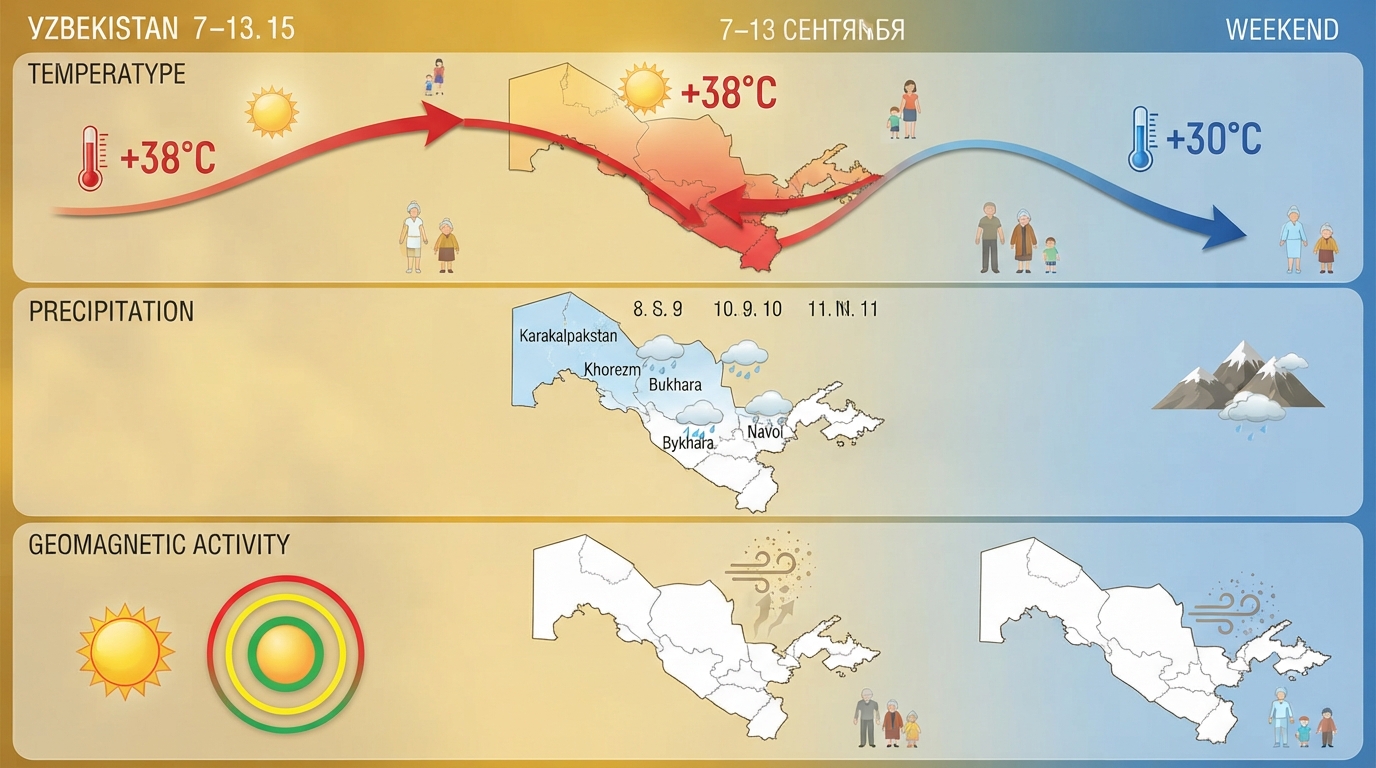
Temperatures will rise again in Uzbekistan. By the middle of the week, the heat will intensify, with daytime temperatures warming up to +36…+39 degrees in other regions, except for northern and mountainous areas. However, this heat will not last long: temperatures will drop significantly starting Thursday in the north, and from the weekend across the rest of the republic.
What will the weather be like in Uzbekistan on September 7−13? Gazeta review
The cold air that entered from the north and provided a noticeable coolness in Uzbekistan last week will retreat, causing temperatures to rise significantly across the republic during the working days of this week, except for the northern regions.
Starting from Thursday, another wave of cool air will first affect the north, and it is becoming clear that there will be days with light precipitation for the north and the Kyzylkum deserts. Over the weekend, most of the republic will again fall under the influence of cool air, with the maximum daytime temperature reaching at most +30 degrees in some places.
According to foreign weather bureaus, due to the influence of a warm air current in the vast majority of Uzbekistan on September 7−11, the average temperature for these 5 days will be 2−4 degrees higher than the long-term climatic norm.
According to Uzhydromet's forecasts for the days of the week, light precipitation is expected in some districts of Karakalpakstan on September 8, and in the Khorezm region and the Republic of Karakalpakstan on September 9 and 11, while light rainy days will also be observed in the Bukhara and Navoiy regions on September 10 and 11.
No precipitation is expected in other regions. It is added that short-term downpours may occur in the mountains by the weekend. The forecast map below shows the total amount of precipitation that may be observed in places during the week.
In the Khorezm region, Karakalpakstan, and the mountains, almost the same cool temperature will persist at night during the working days of the week, with minimum air temperatures in these areas varying between +10…+15 degrees. In other regions, this indicator is expected to be between +13…+18 degrees, and on September 9−10 between +15…+20 degrees. However, during the day, the air temperature in many regions, except for the valley provinces, will not have the same stability as during the night and morning periods.
For example, in the northern regions, the daytime heat of +34 degrees at the beginning of the week will be replaced by +28 degrees of heat by the middle of the week. Excluding the valley and southern regions, in most of the republic, the heat of up to +35 degrees at the beginning of the week will change to up to +38 degrees by mid-week, and will drop to +32 degrees on Friday. While heat of +30…+35 degrees is expected in the valley during the week, in the southern regions, the temperature will reach up to +39 degrees in the middle of the week. Strong winds may blow and dust storms may rise in the north and desert areas in the middle of the week, and in many other regions of the republic on Friday and Saturday.
According to other information from Uzhydromet and forecasts of the European Centre for Medium-Range Weather Forecasts (ECMWF), it is understood that this week the average air temperature in most of the republic will be around the norm, and in some areas 1−3 degrees above the norm, while the amount of precipitation may be observed more in the north and the Kyzylkum deserts.
Thus, it has become clear that during the working days of the week, significant heat will be observed during the day across the republic, and autumn coolness at night and in the morning. This means it will be much warmer compared to last week.
The rise and fall of temperature during the week can affect human physiology. This will have a significant impact especially on children, the elderly, and people with chronic diseases. Such a sharp change places an additional load on the body's thermoregulation system: at night the body retains heat, and during the day, blood vessels dilate and sweating increases to cool the body. Studies have shown that a large difference in daily temperature has a negative effect on the cardiovascular and respiratory systems.
To reduce the load on the body during sharp temperature differences in September, it is recommended not to stay out long during the hot daytime hours, to perform heavy physical labor in the morning or evening, and to drink a sufficient amount of water. It is important to wear light and breathable clothing during the day, protect oneself from the sun, and dress appropriately for the cool air at night. When using an air conditioner, very cold modes should be avoided.
In the middle of the week, the population in most of the republic may experience different levels of heat within a single day. Such temperature contrasts also affect the style of dress during the day. Nevertheless, the temperature during the working days of this week will mostly encourage wearing light clothing in many regions. Except for the northern regions, Wednesday and Thursday across the republic, and Friday in the south, are considered the hottest days of the week, during which temperatures will remain significantly high during the daytime, presenting warm bioclimatic conditions.
Current forecasts on solar activity show a high probability of a "red" danger level geomagnetic storm at the beginning of this week.
In particular, there is also a risk of a "yellow" danger level magnetic storm on Tuesday. For other days of the work week, mostly "green" level magnetic storms are forecast.
The Uzhydromet agency reports that in the middle of the week and on Friday and Saturday, short-term strong winds in many areas may increase dust rising from dry soil, and during some periods when the wind weakens and the atmosphere stabilizes, the accumulation of fine particulate matter in the air may intensify.
It would not hurt to get acquainted with the recommendations prepared by the Sanitary-Epidemiological Committee for various age groups of the population and patients on how to act if air pollution increases or pollution related to fine particles occurs.
Thus, on September 7−13, the weather in Uzbekistan will not be stable: at the beginning of the week the heat will intensify, reaching its peak in the middle of the week, and then the cool air current starting from the north will lower the temperature across the republic by the weekend. Therefore, the main feature of this week is not only the heat, but also its rapid changeability.