

What will change in Uzbekistan from October 1?
From October 1, public transport fares will increase in Tashkent, and tariffs for drinking water and sewerage services will rise in the Tashkent region. Markets and shopping complexes will begin connecting to the E-bozor system in test mode. Entrepreneurs will be able to pay fines in installments.
What will change in Uzbekistan from October 1?
From October 1, 2026, several legislative changes and other innovations will come into effect in Uzbekistan at once.
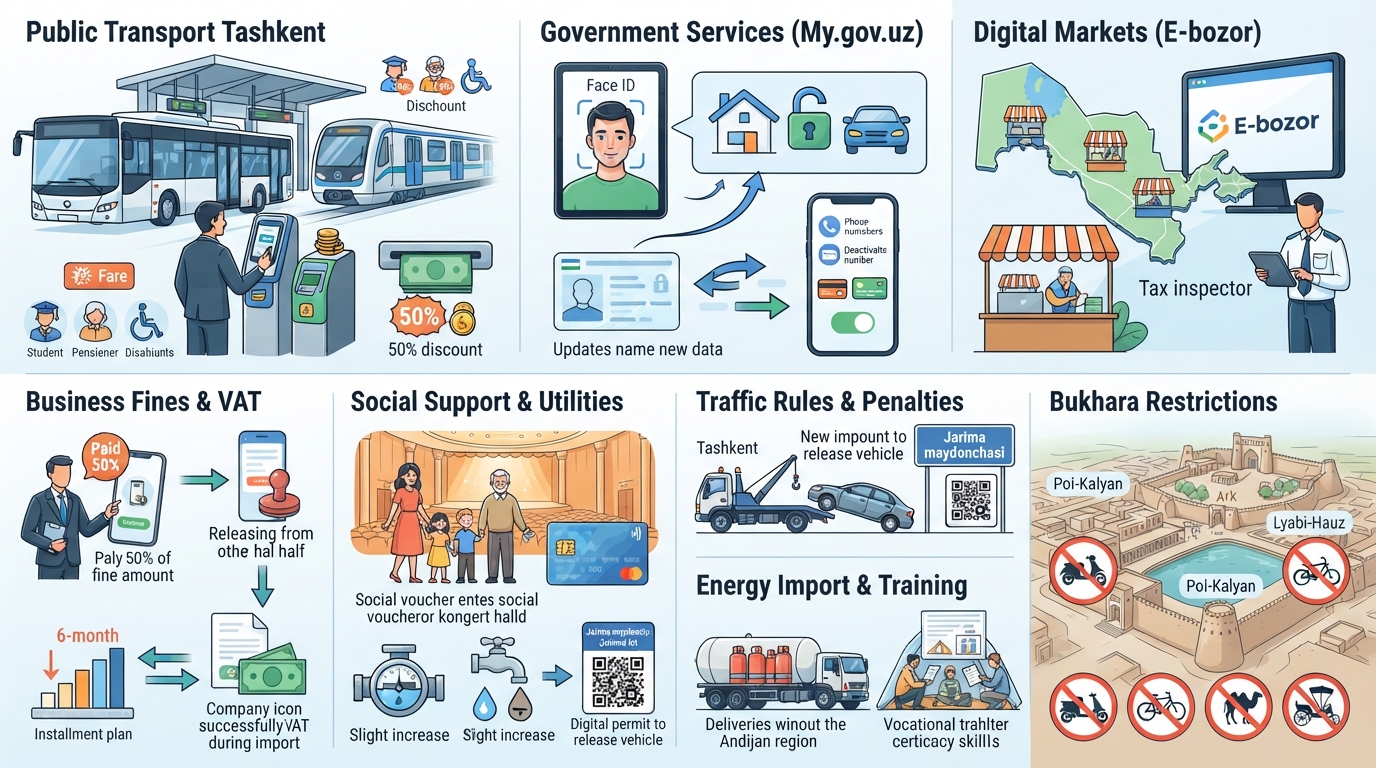
In Tashkent, from October 1, fares for buses and the metro will increase — when paying electronically, the tariff will rise from 1,700 to 2,500 soums. When paying in cash, the price will remain the same — 3,000 soums.
A system of discounts depending on the number of trips will also be introduced for passengers. Pupils, students, pensioners, and people with disabilities will be able to save 50% on tariff packages.
Legal entities and individuals will have the opportunity to independently set and lift bans on pledges, mortgages, and alienation of real estate and vehicles belonging to them through the Single Portal of Interactive Public Services (my.gov.uz).
For individuals, such a ban will be established after identification using Face ID. Legal entities will need a decision of the general meeting of founders, participants, or shareholders, signed with an electronic digital signature.
State bodies of Uzbekistan will automatically update information on the Single Portal about citizens after they change their surname, first name, patronymic, date of birth, and other personal data.
Based on the certificate of data change, which can be obtained on the portal, identity documents will be reissued.
A new service will appear on the Single Portal, through which citizens will be able to obtain information about all telephone numbers and bank cards registered in their name.
Through the portal, it will also be possible to temporarily deactivate a telephone number with the possibility of subsequent restoration. If the number is no longer used, a citizen will be able to apply for the termination of its service.
In addition, information about paid services connected to each telephone number will be displayed on the Single Portal.
From October 1, in test mode, more than 300 markets and shopping complexes in Uzbekistan will be connected to the unified digital platform E-bozor. The full launch of the platform is scheduled for March 1.
It is planned to place passports of markets and shopping complexes, their addresses, and data on vacant retail outlets and spaces on the platform. Also, through E-bozor, residents will be able to receive information about the operation of markets and send electronic appeals to administrations.
The operator of the platform will be the Tax Committee, which will assign tax employees to retail outlets and analyze the efficiency of their work daily.
Entrepreneurs will be able to voluntarily pay financial fines on more convenient terms. If, within one month after receiving the decision, a businessman pays 50% of the fine amount, they will be exempted from paying the remaining half.
An installment plan for six months in equal installments will also be available. To do this, the entrepreneur must make an initial payment of at least 1/6 of the fine amount during the first month. After that, the installment plan will start automatically.
From October 1, participants in foreign economic activity who simultaneously meet two conditions will be able to offset VAT paid on the import of goods.
The first condition is that the company must have a low tax risk level. The second is that it must have a valid VAT payer certificate.
For exporters, the rates of certain fees and payments related to the export of goods will be reduced by 30%.
The reduction will affect four types of expenses: customs clearance; obtaining a phytosanitary certificate; fumigation; and obtaining a certificate of origin of goods.
Social categories of the population will be able to receive free vouchers for theater, cinema, and concert events from October 1. Funds will be allocated from the state budget.
This category includes 500,000 teachers, doctors, civil servants, active pupils and students, as well as one child from 100,000 families included in the "Social Register", and children with disabilities.
Funds in the amount of the voucher's value will be transferred through a social card issued to the respective person.
From October 1, a new procedure for evacuation, placement, and storage of vehicles detained for violations is being introduced in Tashkent. The "Jarima maydonchasi" module has been launched in the Unified Automated Information System of the Road Safety Service.
The system will maintain a unified electronic record of vehicles that are detained, placed in an impound lot, or have received permission for release. Through it, it will be possible to pay fines for offenses, storage costs, and other mandatory payments. An electronic permission for the release of a vehicle with a QR code will also be generated through the Single Portal.
The experiment is scheduled to run until the end of 2034.
From October 3, tariffs for drinking water and sewerage services will increase in the Tashkent region. For the main part of the population, a cubic meter of water, including VAT, will rise by 19.2% to 3,472 soums, and wastewater disposal by 15.4% to 1,680 soums. For budgetary organizations and other legal entities, the increase will range from 6.7% to 33.3%.
From October 1, an experiment will begin in the Andijan region, under which private companies will be able to directly import liquefied gas and sell it to the population in household cylinders at free prices. The experiment will run in parallel with the LPG-Trade system.
At least two private operators must participate in the project. They must have their own or leased facilities for transportation, reception, storage, and distribution of gas, the necessary licenses and permits, as well as trained personnel.
Companies must also launch mobile applications through which consumers can receive services online.
Residents of Temporary Shelter and Social Rehabilitation Centers will be able to officially obtain unemployed status and apply for vouchers for free vocational training.
This will make it possible to master professions that can be acquired in a short time, including in the fields of delivery, construction, repair, and household services.
From October 1, the movement of electric scooters, electric kick scooters, rickshaws, mopeds, four-wheeled bicycles, go-karts, and a number of other means of transportation will be restricted in the historical part of Bukhara.
The restrictions also apply to movement on horses and camels. They will be in effect in the area from the Ark Fortress through the Poi-Kalyan ensemble and Hakikat Street to the Lyabi-Khauz ensemble.