

What Tokayev will speak about
New challenges or old problems: what will the Address of the President of Kazakhstan be about?
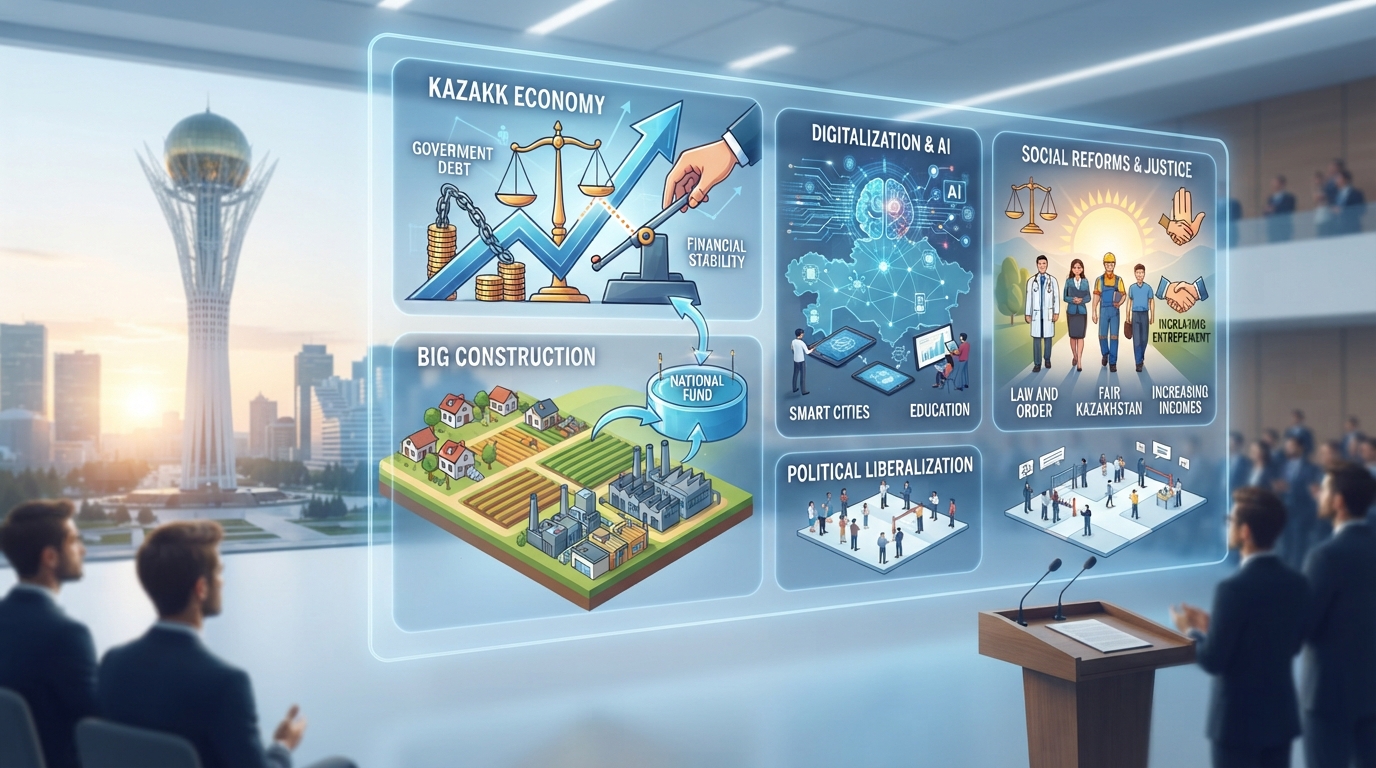
**What Tokayev Will Talk About**
30 years ago, the first Address to the people of Kazakhstan was delivered. Over this time, tasks and priorities have changed, but the format itself has remained, although over time it has lost its former intrigue and aura of special significance. Nevertheless, it is still interesting to see what fundamentally new things the president will say, which areas of the state apparatus's work he will criticize, and on which tasks he will focus public attention. Economists and political scientists of Kazakhstan shared their forecasts and expectations for the upcoming Address of the Kazakh leader.
**Vyacheslav Dodonov, economist: "Not enough attention is paid to government debt"**
— The economic part of all addresses is roughly the same. Sometimes some non-standard initiatives and decisions are voiced in it — for example, on distributing half of the National Fund's investment income to children. But in general, it is always a kind of review of the situation in key sectors of the economy, including the agro-industrial complex, industry, construction, the financial sector, as well as state economic policy — tax, budget, monetary. Traditionally, attention is also paid to the problems of entrepreneurship, the development of small businesses, the reduction of administrative barriers, and the attraction of investments, including foreign ones.
In these areas, both achievements and shortcomings are noted, which become the basis for certain decisions. Apparently, this Address will be no exception: it will also touch upon the most pressing problems of the main sectors of the economy.
In addition, addresses often feature some trendy topic of the global agenda — climate, digitalization, artificial intelligence, etc. Therefore, we can expect that this time the topic of AI, its integration into the economy and social sphere (for example, into the education system), as well as the threats associated with it and ways to neutralize them, will be raised. Especially since one of the actively discussed topics in the world right now is control over the development of AI...
What new things will we hear? It can be assumed that the Address will expand on the recently voiced thesis about the active use of the National Fund during the "grand construction" announced after the Kurultai elections. As the president said then: "Why do we keep money in foreign securities when we can use it for the benefit of the people?".
This thesis can be considered new, as it is opposite to the task set in December 2022 — to increase the National Fund to 100 billion dollars in seven years. That is, we are talking about a change of course — from accumulating the fund's assets (which were always kept in those very securities) to their active use within the framework of the "grand construction". Apparently, the Address may provide some explanation of this position and where the money should go and in what form.
If we talk about current topics that would be advisable to raise in the Address, based on the realities of the economic situation, then first of all it is the stabilization of the public finance system, primarily government debt and the budget process. These problems are constantly and rapidly worsening, but they are not given enough attention in program documents and speeches. Especially regarding the debt, the size of which has exceeded 75 billion dollars, while the cost of servicing it in the budget has reached 3.5 trillion tenge and exceeded 13% of its expenditures.
**Marat Kairlenov, Director of Ulagat Consulting Group LLP: "Measures aimed at increasing citizens' incomes are needed"**
— I think that in the new Address, the president will focus on anti-crisis measures and, perhaps, even instruct the government to develop a special program. After all, one of the key problems today is that in Russia, which is Kazakhstan's largest trading partner, serious crisis phenomena are developing, and this is hitting our economy harder and harder.
The inflationary wave coming from the Russian Federation was initially countered by the National Bank's attempt to restrain it by strengthening the tenge against the ruble (from about six to five tenge per ruble). On the one hand, this had a positive effect, as it contributed to a reduction in overall inflation. But, on the other hand, there are also negative consequences: competition from Russian producers has intensified. And this has created additional pressure on our manufacturing industry. Food producers, in particular of milk, as well as other goods, primarily construction materials, were the first to suffer.
In this regard, the president will certainly speak about the need to develop and strengthen alternative logistical routes in order to reduce dependence on a single direction and support domestic producers.
And, of course, he must pay attention to the rapid fall in real wages and the overall standard of living of the population. Therefore, the Address will likely also cover measures aimed at increasing citizens' incomes.
**Rustem Mustafin, political scientist, head of the Center for Digital Social Sciences of the IFPR: "One of the most important topics of the Address is bringing order"**
— Since 2019, a consistent logic of Kazakhstan's development has been visible. First, the central place was occupied by the concept of the "Listening State", public dialogue, and the formula "Strong President, influential Parliament, accountable Government". Then they were expanded with the target of "Just Kazakhstan". This was followed by constitutional transformations, the renewal of government institutions, the strengthening of the "Law and Order" principle, and economic reforms. Later, the "Adal Azamat" (Honest Citizen) program with an emphasis on civic responsibility and the "Taza Qazaqstan" (Clean Kazakhstan) environmental initiative were added. And last year, this complex was supplemented by digital transformation and artificial intelligence.
Thus, Kazakhstan's own language of modernization is gradually being formed. And, in my opinion, the October Address will be a continuation of this course, or rather, a transition to a new stage of its implementation.
In addition, a serious institutional and regulatory framework has been formed in the country — the constitutional structure has changed, new political mechanisms have appeared, and legislation is developing. At the same time, the framework continues to be built, and the nature of the tasks is expanding. The ability of the entire structure to work consistently, predictably, and equally effectively at every level comes to the fore. Hence, one of the most important topics of the upcoming Address suggests itself — bringing order. And I understand this order in a broad state sense, where it covers management, economy, finance, construction, housing and communal services, land relations, education, healthcare, social policy, and digital processes.
At the same time, another important pillar of statehood is being formed — the intellectual and value-based one. After all, it is values that give content to the material and legal framework, filling it. Therefore, I also expect the continuation of work on the semantic consolidation of society. The question "what should be done?" must gradually be supplemented by more fundamental questions: "what are we doing this for?", "what kind of country do we want to build?", "what rules should become common to everyone?", and "what responsibility does a citizen accept?". In other words, it is important for society to understand the meaning of the ongoing transformations and to have a clear idea of the direction of movement, the image of the future, the principles of living together, and the criteria of justice.
A special place in the Address will certainly be taken by the topic of digitalization and artificial intelligence. Just a few years ago, it was mainly about electronic government services. Today, data, algorithms, and AI are becoming part of economic policy, public administration, education, healthcare, industry, energy, and infrastructure, and at the international level — an important factor of competition. In the previous Address, the president set the task of turning Kazakhstan into a fully-fledged digital country within three years. The next logical stage is related to assessing the practical effect and orienting the digital market toward production.
What would I personally like to hear from the head of state? Ideas on forming an institutional environment in which honest, professional, and law-abiding behavior would become a natural and rational choice. A person who works conscientiously, pays taxes, obeys the law, fulfills obligations, and benefits society should receive support, encouragement, and opportunities for development. While corruption, negligence, abuse of power, destructive behavior, and causing harm to society, the country, and nature should lead to clear and inevitable consequences, as well as appropriate punishment.
**Madi Omarov, analyst at the "Strategy" Center for Social and Political Research, associate professor at Narxoz University and visiting researcher at Heidelberg University: "Reforms to liberalize the political space are important"**
— The Address is considered one of the main events in the Kazakh political space, within which future changes and new reforms are usually announced. But, it seems to me, this format itself is no longer entirely relevant. I would even say that it is highly outdated and it is time to move away from it.
Of course, one can try to come up with fresh ideas and spectacular statements specifically for this event every time to attract attention to it. But consistent and coordinated work is much more important. New tasks and changes can be announced throughout the year — as they arise, rather than bearing a ritualistic and symbolic character. Ordinary citizens, officials, and experts should not sit and guess what interesting things the president will say in September-October.
What would I personally like to hear in the new Address? That a new stage of political reforms aimed at liberalizing the political space is beginning. But, given recent events related to the detention of journalists, pressure on non-governmental organizations, and so on, this is unlikely to happen. Moreover, I do not rule out that it might be the opposite — some measures may be announced that will further narrow the opportunities for independent actors — media, NGOs, bloggers, etc.