

What the medals speak of
In diplomacy, there are few accidental things, and there is especially little that is accidental in the highest state awards with which national leaders decorate one another…
**What Orders Speak Of**
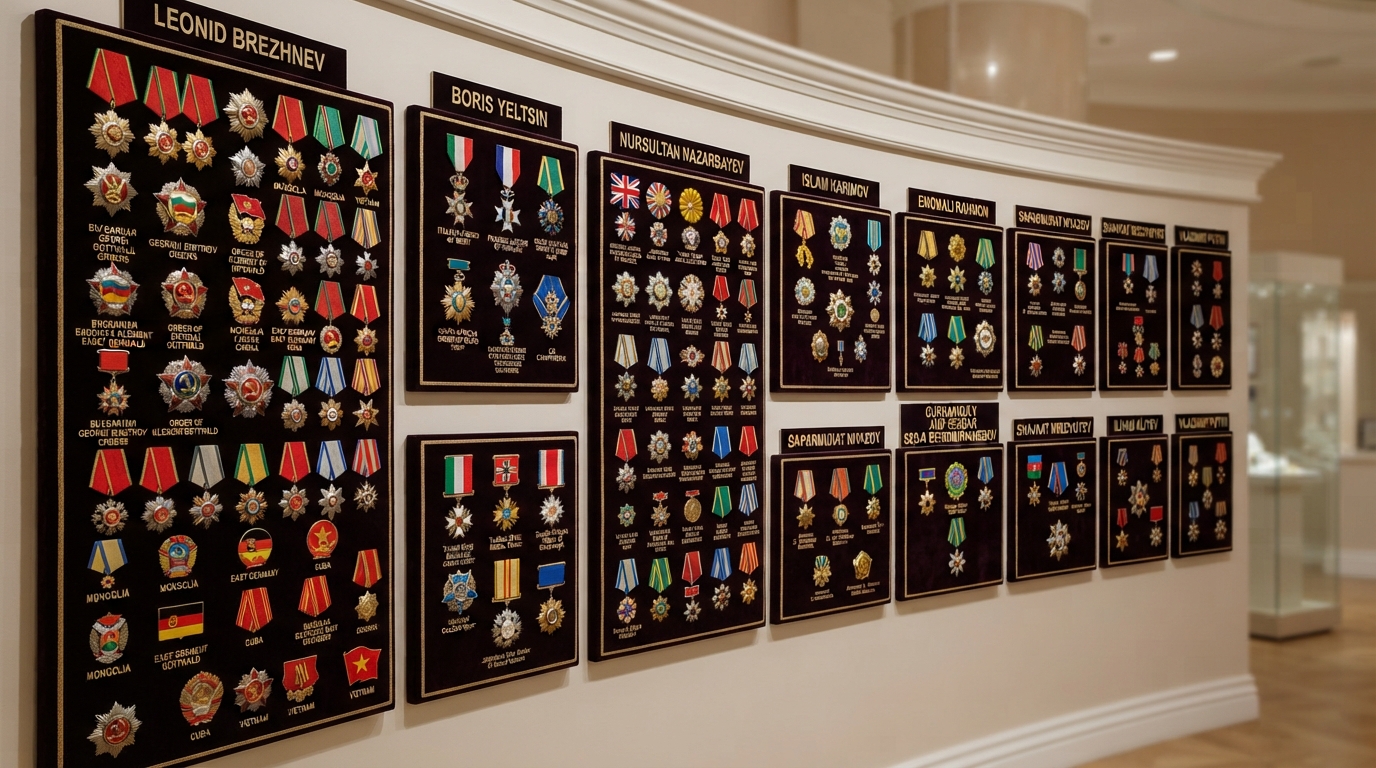
There is a curious way of looking at post-Soviet history that is rarely recalled for some reason, even though it allows one to see a great deal without long speeches, official statements, and diplomatic ceremonial. It is enough to take the presidents of the states that emerged after the collapse of the Soviet Union and look at which foreign orders they were awarded. At first glance, this is an almost secular activity, from the realm of state protocol and court heraldry. But if you gather all these awards together, highly remarkable political biographies emerge, because behind each order there is usually a specific country, a specific stage of relations, and a very definite political interest.
Of course, an order is not a geopolitical treaty and proves nothing by itself. A president may receive the highest award of another country for participation in some specific process, for a personal contribution to the development of relations, or simply as a sign of special state respect. But in diplomacy in general, there are few accidents, and in the highest state awards with which heads of state honor each other, there are especially few accidents. Such orders do not appear daily: their presentation is carefully prepared, accompanied by official formulations, and usually becomes part of bilateral diplomacy. Therefore, if we look at them not as a set of spectacular badges, but as a kind of foreign policy map, very characteristic patterns can be noticed.
Every era, as they say, has its own buttons. Leonid Brezhnev had particularly many of them, with a significant portion of his foreign orders coming from the countries of the socialist camp and states oriented toward the Soviet Union. He received the Bulgarian Order of Georgi Dimitrov three times, the Czechoslovak Order of Klement Gottwald repeatedly, was several times awarded the highest honors of Mongolia and the GDR, and received orders from Cuba, Poland, Hungary, Romania, Vietnam, Yugoslavia, and other states of the socialist camp. There were also orders of countries outside the Soviet bloc among his awards, but the overall pattern remains completely obvious: Brezhnev's award map practically coincided with the map of the Soviet foreign policy system.
In this sense, the Brezhnev collection is very indicative. The Soviet Union did not just maintain diplomatic relations with its allies—it built an entire system of political, military, and ideological ties, and state awards were one of its external symbols. Brezhnev turned out to be the person on whom this system literally materialized. His chest gradually turned into a kind of map of the socialist world, where each order marked another point of Soviet influence. Today, such a number of awards looks almost grotesque, but for that era, it was a completely natural continuation of official diplomacy.
The picture looks completely different if we move from Brezhnev to Boris Yeltsin. The former had a large-scale and fairly homogeneous system of awards, while the latter had a much more heterogeneous set of tokens of attention, reflecting a completely different era. Yeltsin received the highest foreign awards of Italy, Kazakhstan, South Africa, Belarus, Ukraine, Latvia, and France. Moreover, the very geography of these awards is highly eloquent: former Soviet republics, European states, and a country that symbolized a completely different political world.
Yeltsin's award diplomacy corresponds well with Russian foreign policy of the 1990s, when Moscow itself did not yet fully understand what kind of state it wanted to be and in what kind of world it was going to live. Russia was simultaneously trying to maintain special relations with former Soviet republics, building new ties with the West, and searching for its own place in the international system. In the orders, this lack of final geopolitical certainty looks almost visual.
The collection of Nursultan Nazarbayev has a completely different character. Here it is already difficult to speak simply of a large number of awards. Rather, we are talking about a systemic and very broad diplomacy, which was later called multi-vector. Nazarbayev received the highest state awards of Italy, Ukraine, Russia, Uzbekistan, Romania, Austria, Lithuania, Tajikistan, the United Kingdom, Greece, Croatia, the Vatican, Slovenia, Poland, Saudi Arabia, Qatar, Slovakia, Hungary, Egypt, France, Luxembourg, Japan, Mongolia, Latvia, the UAE, Finland, South Korea, Turkey, Estonia, Serbia, and Monaco.
Such a collection is difficult to explain by the president's personal popularity alone. Behind it, a very definite state strategy can be discerned. Kazakhstan under Nazarbayev sought not to choose a single external center of attraction, but to maintain relations simultaneously with Russia, China, the West, the Islamic world, Turkic states, and European countries. And if you look at Nazarbayev's awards, one gets the impression that he was collecting not so much orders as confirmations that Kazakhstan was needed by everyone.
It is particularly curious that among his awards were even the British Order of St Michael and St George, the French Legion of Honour, the Japanese Order of the Chrysanthemum, the Italian Grand Cross of the Order of Merit of the Italian Republic, the Vatican Golden Collar, and many other awards of states located far beyond the traditional post-Soviet space. Experts believe that this is no longer just diplomatic protocol, but a kind of visual biography of multi-vectorism.
With Islam Karimov, the picture was noticeably more restrained. He received the highest awards of South Korea, Italy, Kazakhstan, Ukraine, Lithuania, Spain, Poland, Georgia, Bulgaria, Greece, Turkmenistan, and Latvia. At first glance, the list also looks impressive, but it differs noticeably from the Kazakh one. There is less demonstrative globality in it, and the cautious diplomacy of sovereign Uzbekistan in the first decades of independence is much more clearly visible.
It is no secret that Karimov generally did not like foreign policy dependence too much, even if it was a partnership. Uzbekistan under him consistently defended the right to independently determine its foreign policy course, now drawing closer to some centers of power, now distancing itself from them. Therefore, Karimov's award geography looks not like a collection of alliances, but rather like a set of evidence that Tashkent spoke with many, but ultimately did not want to belong to anyone.
It is also interesting what exact formulations accompanied some of the awards. Karimov received the Ukrainian Order of Prince Yaroslav the Wise for outstanding state and political activity and personal contribution to the development of the Ukrainian-Uzbek strategic partnership. The Georgian "Golden Fleece" was associated with a contribution to strengthening independent Georgia, developing the Eurasian transport corridor, and Uzbek-Georgian relations. That is, behind the orders stood very specific directions of foreign policy, and not just a ceremonial gesture.
Emomali Rahmon has a different award map. For the president of a relatively small country in a complex geopolitical environment, foreign orders become another way to expand the space of foreign policy opportunities. Rahmon received the highest awards of Afghanistan, Ukraine, Latvia, Pakistan, Azerbaijan, Turkmenistan, Kuwait, Bahrain, Russia, Uzbekistan, Kazakhstan, and China. Here, states of the post-Soviet space, the Islamic world, Russia, and China appeared side by side.
Particularly indicative are the orders presented for the development of bilateral relations. The Order of Heydar Aliyev of Azerbaijan, the Order of Alexander Nevsky of Russia, the Uzbek "El-Yurt Hurmati," the Kazakh "Altyn Qyran," the Chinese Order of Friendship—all of them show how actively Dushanbe sought to maintain relations with several external centers at once. Political scientists believe that for a small state, such diplomacy is not a luxury, but a way of survival in a rather complex international environment.
A completely special case is Saparmurat Niyazov. Within Turkmenistan, his personality cult was elevated to scales that are difficult to imagine today without a sense of historical grotesqueness. "Turkmenbashi," the golden statue, books, renamings, special state symbolism—all of this was significantly more abundant than foreign orders. Among Niyazov's most famous foreign state awards are the Order of Prince Yaroslav the Wise, 1st Class, of Ukraine and the Armenian Order of Saint Mesrop Mashtots.
And here a curious paradox arises: inside the country, the cult was almost limitless, whereas in foreign award diplomacy, no particular desire to create an international pantheon of orders was observed. Perhaps because Niyazov did not need external confirmation of his own exceptionalism at all. In Turkmenistan, he himself was the source of all possible marks of honor.
Under Gurbanguly Berdimuhamedov, the situation changed. Turkmenistan retained the concept of permanent neutrality, but Berdimuhamedov himself turned out to be much more active in international diplomacy. He received orders from Saudi Arabia, the UAE, Uzbekistan, Tajikistan, Bahrain, Turkey, Serbia, Moldova, Kazakhstan, and Russia. Among them were the orders of Ismoili Somoni, Alexander Nevsky, "Dostyk," "Altyn Qyran," as well as the highest Turkish and Arab awards.
It is here that one can clearly see that neutrality does not mean diplomatic isolation at all. On the contrary, Ashgabat turned neutrality into a kind of foreign policy brand that allowed it to simultaneously maintain relations with Russia, Turkey, Arab monarchies, Central Asian countries, and other states. Berdimuhamedov's foreign orders in this sense look like small metal confirmations of the Turkmen formula: to be friends with everyone, but formally not to enter into any military-political blocs.
Serdar Berdimuhamedov is still at the beginning of his own award journey, and therefore his collection is much more modest. Among his foreign state awards are the highest order of Bahrain, the Order of Sheikh Isa bin Salman Al Khalifa, the Uzbek Order of "Oliy Darajali Do'stlik," and the Kazakh "Altyn Qyran." It is premature to compare his award list with the collections of his father or Nazarbayev. But it is already noticeable that Turkmenistan is continuing its previous line, in which relations with neighbors in Central Asia and the Arab world occupy a special place.
Against this background, Shavkat Mirziyoyev looks particularly interesting. Over the years of his presidency, Uzbekistan's foreign policy has changed noticeably, and award diplomacy records this change quite well. In 2017, he received the Kyrgyz "Danaker," in 2018—the Kazakh "Dostyk," in 2021—the Tajik Order of "Zarrintoch," 1st Class. This was followed by the Russian Order of Alexander Nevsky, the highest awards of Turkey and Kazakhstan, the French Legion of Honour, the Turkmen Order "For Contribution to the Development of Cooperation," the highest order of Jordan, "Al-Nahda," the Serbian Order of the Republic on a Grand Collar, and, in 2026, the Azerbaijani Order of "Heydar Aliyev."
While under Karimov, award diplomacy demonstrated primarily caution and maintaining distance, under Mirziyoyev, it testifies to a desire to be actively present in the outside world. The list includes practically all the main directions of modern Uzbek diplomacy: Central Asia, Russia, Turkey, Europe, the Arab world, the Caucasus, and the Balkans. And this fully corresponds to the foreign policy that Tashkent has been pursuing in recent years, trying to simultaneously improve relations with neighbors and expand ties with the widest possible range of states.
Particularly symbolic is the receipt of the "Heydar Aliyev" Order from Azerbaijan in August 2026. Formally, this is an award for special merits in the development of friendly, brotherly, and allied relations between the two countries. But behind the ceremonial formulation lies a much broader trend: Uzbekistan is increasingly moving beyond the boundaries of its former Central Asian geography and strengthening relations with the states of the South Caucasus and the Turkic world.
Ilham Aliyev's own order map is also quite expressive. It includes the highest awards of Romania, Saudi Arabia, France, Poland, Ukraine, Kuwait, Latvia, Bulgaria, Tajikistan, Belarus, Serbia, Turkey, Italy, and Kazakhstan, and in 2026, the Kyrgyz Order of "Manas," 1st Class, and the highest Uzbek Order of "Oliy Darajali Do'stlik" were added to them. Azerbaijani diplomacy under Aliyev consistently connects several directions—Turkic, European, Islamic, and post-Soviet, and his award collection quite accurately reflects this construction.
Finally, Vladimir Putin. His foreign state awards also allow one to see the evolution of Russian foreign policy. In different years, he received orders from Vietnam, Kazakhstan, France, Saudi Arabia, the UAE, Tajikistan, Uzbekistan, Mongolia, Venezuela, Palestine, Belarus, Monaco, Cuba, Serbia, Turkmenistan, Guinea, Cyprus, Kyrgyzstan, China, Angola, North Korea, and other awards.
If you arrange them chronologically, it becomes noticeable how much Russia's international geography has changed. At the beginning of his presidency, European states—France, Monaco, Cyprus—are still noticeably present among Putin's awards. Later, the center gradually shifts toward Asia, the Middle East, Africa, and Latin America. In this sense, orders here also become a kind of diplomatic thermometer: as the political climate changes, the geography of awards changes too.
Of course, it would be naive to believe that any foreign order automatically means a political alliance. Diplomacy is much more complex than heraldry. States award each other for a variety of reasons, and sometimes an award becomes part of a protocol exchange that does not mean a complete coincidence of interests at all. Moreover, relations between countries can change drastically after the order has already ended up on a president's chest.
But that is precisely why what is of interest is not an individual award, but the totality of awards, their geography, the time of presentation, and the official formulations. One order may be an accident of protocol, two—a coincidence, but dozens of awards distributed among the same regions and appearing in certain periods already form a kind of pattern.
In this sense, "order diplomacy" turns out to be a fairly accurate way to look at the post-Soviet space. Brezhnev shows the Soviet system of alliances, Yeltsin—a period of geopolitical uncertainty, Nazarbayev—multi-vectorism, Karimov—cautious sovereignty, Rahmon—the search for room to maneuver, Niyazov—the gap between an internal cult and external restraint, Gurbanguly Berdimuhamedov—the transformation of neutrality into a diplomatic tool, Mirziyoyev—the opening of Uzbekistan to the outside world, Aliyev—the multi-layered Azerbaijani balancing, and Putin—the gradual shift of Russian diplomacy from the European direction to a broader non-Western circle.
One can argue endlessly about how accurately an order reflects real politics. But it has one undeniable advantage: it does not make speeches. An order does not promise friendship, does not speak of strategic partnership, and does not discourse on a new world order. It simply remains on the chest of a statesman as a material trace of what once happened between two countries.
And therefore, sometimes it is enough to look not at what a president says about foreign policy, but at what orders he receives and from whom exactly. Behind the gleam of metal, the political geography of an entire era suddenly emerges. And if we consider these awards together, they turn no longer into personal decorations of presidents, but into a kind of chronicle of international relations, where every ribbon, every star, and every chain reminds us of whom the state wanted to be close to at one moment or another.