

What should you not say on a plane, and what are the consequences of "joking" on board?
What shouldn't you say on a plane, and what do "jokes" on board lead to?
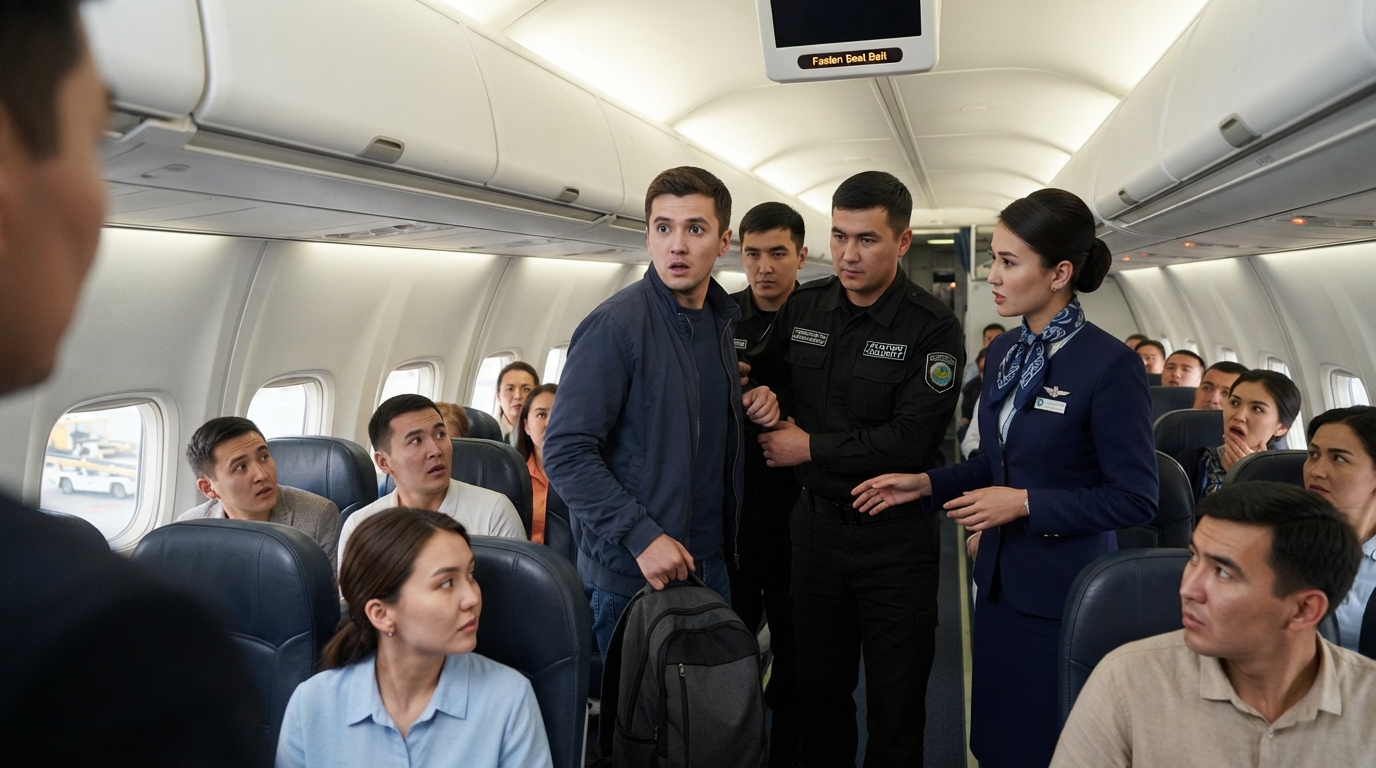
In early September, a passenger on an Almaty-Aktau flight was removed from the aircraft right before departure after claiming there was a bomb in his bag. No explosive devices were found during the search, but the careless remark led to a flight delay, a re-screening of passengers, and the intervention of the transport police.
A Podrobno.uz correspondent found out what awaits a passenger who decides to joke about a bomb in Uzbekistan, what liability they might face, and whether they will have to compensate for multi-million losses due to the flight delay.
### No room for humor in the sky
In civil aviation, a threat is not assessed based on whether the passenger actually turned out to have a dangerous object. Any statement or action that can be perceived as a threat to security requires verification. Therefore, even a phrase said in jest can lead to flight delays and additional checks. For airport staff, the passenger's intentions become clear only after the potential threat has been ruled out.
Uzbekistan Airways emphasized that in such situations, safety always comes first:
"Any statement or action by a passenger that could potentially be interpreted as a threat to security cannot be ignored, even if it later turns out to be a joke and no real threat existed."
But for a passenger who decides to joke about a bomb, the matter may not end with just a check. If their words cause the flight to be delayed and emergency checks to be launched, all expenses fall on the culprit. As Uzbekistan Airways told Podrobno.uz, the carrier has the right to file a recourse claim against the "joker" and recover the full amount of damages through court, provided the costs are documented.
### Where did this security system come from?
Such a harsh reaction did not arise by chance. Modern aviation security rules were shaped after major incidents that forced states to review their approaches to passenger and baggage screening. One of the key turning points was the terrorist attacks of September 11, 2001, in the United States, which killed nearly three thousand people.
Before that, the security system already included passenger and baggage screening, metal detectors, and X-ray machines. However, after the attacks, investigations revealed a number of serious vulnerabilities, and control requirements at airports and on board were significantly tightened.
Today, security is built on the principle of multiple layers of defense. Passengers and baggage are screened, access to different areas of the airport is controlled, and the crew is obliged to respond to a potential threat directly on board.
### What are the consequences for such a "joke" in Uzbekistan?
In Uzbekistan, administrative liability is provided for violating the rules of conduct on an aircraft. Uzbekistan Airways referred to Article 117 of the Code of Administrative Responsibility — "Violation of the rules of conduct on an aircraft."
At the same time, the rules of passenger conduct themselves are enshrined in Article 92-1 of the Aviation Code. A passenger is obliged to comply with the orders of the aircraft commander and crew members related to ensuring the safety of the flight, people, and property.
However, liability for actions on board is not limited to a single administrative article. As the airline explained, depending on the nature and consequences of the incident, it can be administrative, and in cases provided for by law, criminal.
If the incident shows signs of another offense or crime, or if a threat to the aircraft or people arises, the final legal qualification is given by the competent state authorities, taking into account the specific circumstances.
In addition to the already mentioned reimbursement of the airline's expenses, the passenger may lose the opportunity to continue their flight.
Uzbekistan Airports added that the consequences of such incidents can affect not only the violator themselves but also all passengers on the flight.
"The scale of further actions depends on the results of the threat assessment. If the passenger is already on board the aircraft, as was the case in Almaty, not only the culprit, their cabin baggage, and luggage are checked, but, as a rule, all passengers undergo additional screening. The entire aircraft and the baggage of the remaining passengers are fully searched. That is, it is a flight delay for the entire duration of the check. These are the instructions. Therefore, in such a 'joking' situation, not only the joker themselves suffers in the end, but also all the other passengers," Uzbekistan Airports commented.
### Blacklist of words on board
And the main question, for the sake of which many open such articles: what words can cause problems for a passenger?
As Uzbekistan Airports reported, there is no formal list of words in Uzbekistan for which a passenger will be automatically punished. Therefore, it is impossible to compile a list like "say this word — get punished": the meaning of the statement and the specific circumstances matter.
At the same time, specific recommendations can be found in international practice. For example, the Turkish airline Pegasus Airlines explicitly advises passengers on international flights not to use the words "terrorist," "bomb," "missile," and "weapon." The airline explains this by saying that such words can cause panic among passengers and crew, and separately notes that the set of sensitive expressions may vary depending on the country.
In addition, Uzbekistan Airports noted that an airport employee cannot independently decide that a passenger was "just joking" and ignore such a phrase. If a person speaks of a bomb, explosives, weapons, an impending explosion, a terrorist attack, or a plane hijacking, employees are obliged to assume that the potential threat could be real until proven otherwise.
In other words, problems can be created not by a specific "forbidden word," but by a statement that, in a specific situation, can be interpreted as a threat. Only after that do specialists and law enforcement agencies assess the circumstances of the incident and decide whether there are grounds for further action.
"Therefore, the best advice for passengers is very simple: do not joke about topics related to bombs, weapons, explosions, and terrorist threats. Neither at check-in, nor at security screening, nor on the plane," Uzbekistan Airports emphasized.