

What independence could mean for oil-rich Alberta's economy
Albertans vote this month on staying in Canada or moving ahead to a binding independence referendum.
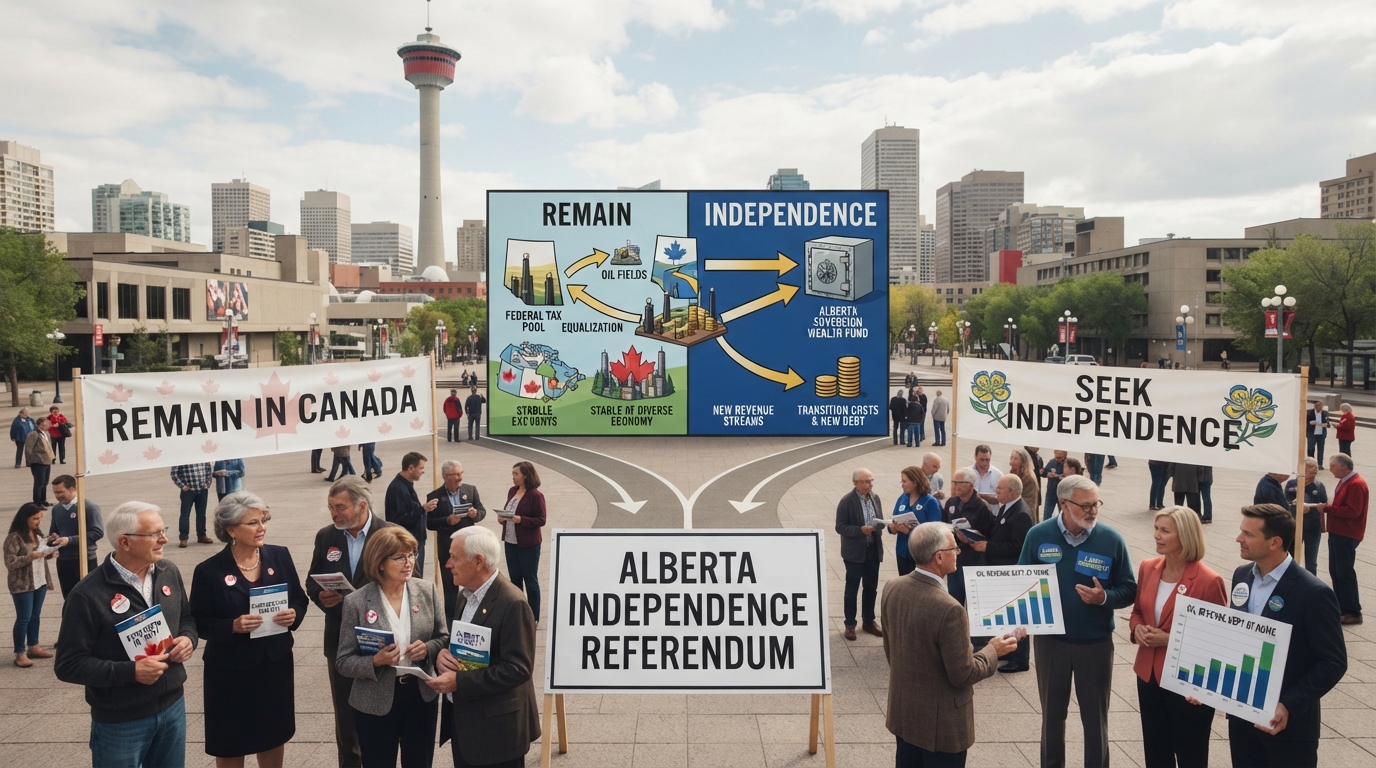
What Alberta’s oil wealth could mean for its economy if it became independent
Albertans are set to vote on 19 October on whether to hold an independence referendum in the future.
For Keith Wilson, an Alberta independence advocate, the western Canadian province stands apart from the rest.
He says Alberta’s abundant oil and gas reserves, major agricultural industry, and young, highly skilled workforce make its economy formidable.
On 19 October, the province will hold a referendum that gives voters two choices: support remaining in Canada, or back moving toward a formal binding referendum on independence at a later stage.
Although the ballot is not a simple “stay or leave” question, it is still expected to rank among the most significant votes in recent Canadian history and a major test of national unity.
At the centre of the debate is one crucial question: would Alberta be wealthier as an independent country?
Wilson says the answer is yes.
“Alberta's economy is unique. is fundamentally different than the rest of Canada's - we have the people, the institutions, the infrastructure to excel,” he says.
Separatists in Alberta have long maintained that the province has been short-changed by remaining in Canada, arguing that more oil and gas revenue would stay inside Alberta rather than being shared with Ottawa, saving tens of billions of dollars.
But many dispute those calculations.
Alberta Premier Danielle Smith, who is against independence, forecasts a far less optimistic result. She says the province could face C$400bn ($283bn; £213bn) in transition costs alone, while also losing billions more through reduced investment and trade caused by political turmoil.
A report commissioned
, external by her government and published earlier this month estimated the cost of separation at between C$50bn and C$170bn over five years, along with a highly uncertain long-term outlook.
The report warns that the task list for a newly independent Alberta would be extensive and expensive.
It would need to create agencies for taxation and national security, build its own constitution, legal and court systems, and pension plans, and negotiate how federal assets such as national parks and military bases would be divided.
Lennie Kaplan, a former Alberta finance official, says the province would also be expected to assume part of Canada’s national debt, among many other fiscal duties and challenges.
, a non-profit Alberta-based think tank, estimates Alberta could be left with extra debt of between C$258bn and C$333bn.
With the projected blow to Alberta’s GDP and the added costs, the report says separation could hurt Albertans’ finances and cut their disposable income by an average of 5.8%.
“Why do we have to create all this uncertainty that might impact and impair the province's fiscal position going forward? Why wouldn't we just work within Canada to address these issues?” Kaplan asks.
Polling suggests about 20% to 25% of Albertans intend to vote in favour of proceeding to a binding separation referendum, with stronger support among younger, rural and conservative voters.
The separatist movement is driven by the view that Alberta is misunderstood and ignored by decision-makers in Ottawa. For decades, that feeling has fed a sense of “western alienation” in the prairie province.
What was once a fringe cause has moved to the centre of Alberta politics for several reasons.
There has been anger over environmental and political resistance that blocked proposed pipelines from landlocked Alberta to coastal waters.
A decade of Liberal rule in Ottawa has also frustrated reliably conservative Alberta. On top of that, some Albertans still distrust the federal government over what they saw as excessive lockdowns during the Covid-19 pandemic.
Over the past year, separatist organisers held town halls across the province to measure public interest. They then launched a citizen-led petition for separation earlier this year, which gathered more than 300,000 signatures.
Smith, the premier, decided earlier this year to authorise a vote.
Alberta is the centre of Canada’s oil and gas industry, with oil reserves estimated to be the fourth-largest in the world. Crude oil is by far Canada’s most lucrative commodity, worth C$142bn in exports in 2025 alone.
Most of it is sold to refineries in the US.
The province has the highest GDP per capita in the country, and its strong economy means it contributes billions each year to the federal tax pool.
It has not received any “equalisation” payments - funds that poorer, so-called “have not” provinces receive from the federal government - since 1965.
Calculations by Tegan Hill and Nathaniel Li, economists at the Fraser Institute think tank, show that Alberta’s total net contribution to Ottawa since 2007 has been C$322bn, or about $17bn a year on average.
“That’s nearly four times that of British Columbia, more than four times Ontario,” Hill tells the BBC. “The other seven provinces were net recipients, meaning Ottawa spent or transferred more money to those provinces than it collected.”
Hill says the amount Alberta sends to the rest of Canada is one of the main grievances among supporters of separation.
The feeling, she says, is: “We're paying to support these other provinces, and if we just went our own way, we could keep all that wealth for ourselves.”
That belief underpins the economic forecasts from the Alberta Prosperity Project, one of the main groups campaigning for independence.
In its fiscal plan, released last year
, external
, the group estimates Alberta could save as much as C$47bn a year if it stopped paying federal taxes.
The plan also acknowledges that an independent Alberta would face higher costs because it would need to fund national defence and international diplomacy, putting those expenses at up to C$31.6bn annually.
That would come on top of the roughly C$75bn Alberta already spends as a province on areas such as healthcare and education.
After covering all essential and new costs, the Alberta Prosperity Project says the province could still have a surplus of C$24bn to C$46bn a year.
Supporters argue that with this extra money, Alberta could cut individual taxes by more than C$10,000 a year, expand infrastructure, or put the surplus into the province’s wealth fund.
But several economists say the projections are unclear and probably overstate the gains.
Hill of the Fraser Institute says one of the biggest threats to economic performance is prolonged uncertainty, especially if the referendum does not settle the issue or if separation turns into a long break from Canada.
“If someone doesn't know if Alberta is going to be a part of Canada or if it's going to go on its own way in the next couple years, in what world are they going to be putting their money in the province?” she asks.
Prime Minister Mark Carney often cites Brexit - Britain’s vote to leave the European Union - as a warning for Alberta.
One report published earlier this year says the UK economy has taken a 6% hit from Brexit. If Alberta experienced a similar outcome after independence, its economy could shrink by C$62bn a year, according to one estimate by Calgary-based economist Trevor Tombe.
He also projected that the workforce would shrink by 175,000.
Wilson rejects that comparison, saying the “fundamental dynamics are completely different”.
He says some of the stay-side forecasts are pure “doom and gloom”, joking that the only possible downside they left out is “a large asteroid hitting Canada”.
“We're a resource economy. We have leverage. We have products the world wants. That's why investment comes here, despite the constraints imposed by Ottawa,” he says.