

Carney hopes an oil pipeline can help Canada fight a trade war
A west coast pipeline project is the first to be fast-tracked and will be a major test of Carney's promise to global investors.
Carney says oil pipeline could help Canada withstand trade war
Mark Carney seeks to position Canada as a major energy exporter
Prime Minister Mark Carney said Canada will speed up approval for a 1,250km (775 mile) oil pipeline to the Pacific coast.
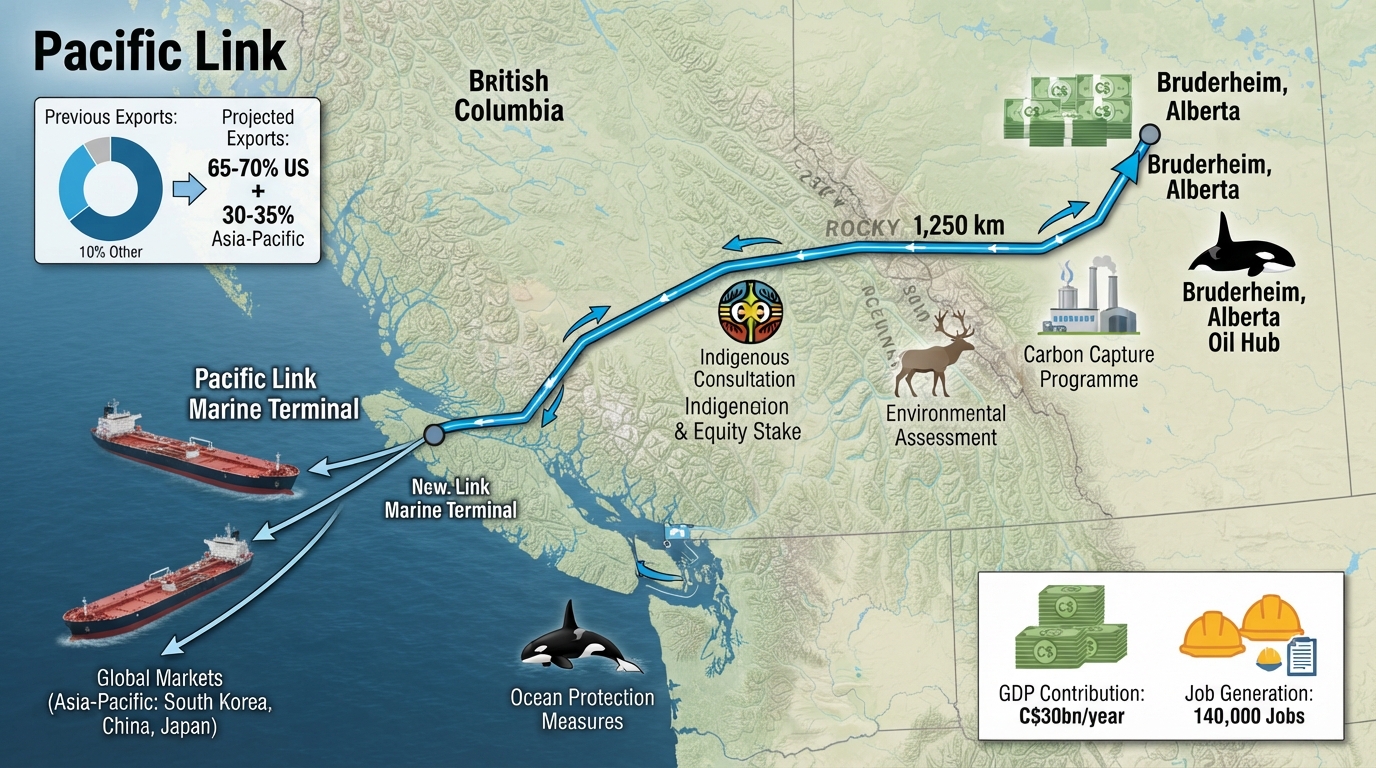
Carney says the Pacific Link project is vital to the national interest because it would help Canada broaden its oil sales beyond the US.
“A pipeline to the west coast is part of our mission to transform our economy, to double our non-US exports over the next decade,” he said on Thursday.
The plan will also serve as a test of his pledge to global investors that Ottawa can rapidly advance major projects as he tries to make Canada a global energy “superpower”.
The prime minister said the project is expected to add as much as C$30bn ($21bn; £16bn) a year to Canada’s GDP and generate 140,000 jobs.
Carney says Canada’s economic dependence on the US has become a weakness amid protectionist tariffs imposed by US President Donald Trump.
Last year, Canada sent 90% of its crude oil exports south of the border.
Pacific Link would be able to transport about one million barrels per day of crude oil from Bruderheim, Alberta, to a deep-water port near Delta, British Columbia.
The project also includes marine berths designed to handle vessels capable of carrying up to two million barrels-worth of oil.
From there, the oil would be shipped by sea to global markets.
Ottawa says the project will cut Canada’s overall reliance on the US to roughly 65-70% by opening access to the Asia-Pacific region, including major markets such as South Korea, China, and Japan.
Pacific Link will be the first project to have federal approvals and regulatory reviews accelerated under a new law introduced last year by the Liberal government.
The aim is to give investors a final yes or no on a proposed project within a year.
Strong opposition and Canada’s lengthy, complicated project review process have previously contributed to the cancellation of some pipeline projects.
“People are watching very closely how Canada is handling this process,” a government official said in a media briefing on Thursday.
They said that if everything proceeds as planned, they expect more private investment to show interest in the project, which is projected to cost between C$35.2bn and C$43.7bn.
The second hope is that the pipeline, which would run from Alberta’s landlocked oil patch to the coast, will help satisfy the western province, which says it has long been held back from developing its resources.
Albertans will vote later this month in a referendum on independence.
Pacific Link is “a demonstration of the power of Canada”, Carney said in Fort McMurray, Alberta, when asked whether he had a message for the province.
The pipeline is likely to face opposition from environmental groups, especially over concerns about its impact on coastal marine health, as well as from some indigenous communities along the route.
Carney says talks with many indigenous communities have already taken place, with “intensive” consultations still to come.
Construction is planned to begin by 2032 if final approval is granted.
At present, the governments of Canada and Alberta support the project, along with one private investor, the Pembina Pipeline Corporation, which has a non-binding agreement for a 10% stake during construction and the option for another 10% once the pipeline is operating.
A minimum 10% ownership stake will also be offered for purchase to indigenous groups.
As part of the deal, Alberta has agreed to build the world’s largest carbon capture programme in an effort to reduce its overall emissions.
Ottawa has also moved to strengthen ocean protection funding and rules to safeguard marine life that could be affected by increased coastal tanker traffic, including the endangered Southern Resident killer whales.