

What happened in failed execution of Christa Pike - and what next?
The convicted killer is in hospital in Tennessee after surviving two lethal injections, in a case that has raised many questions.
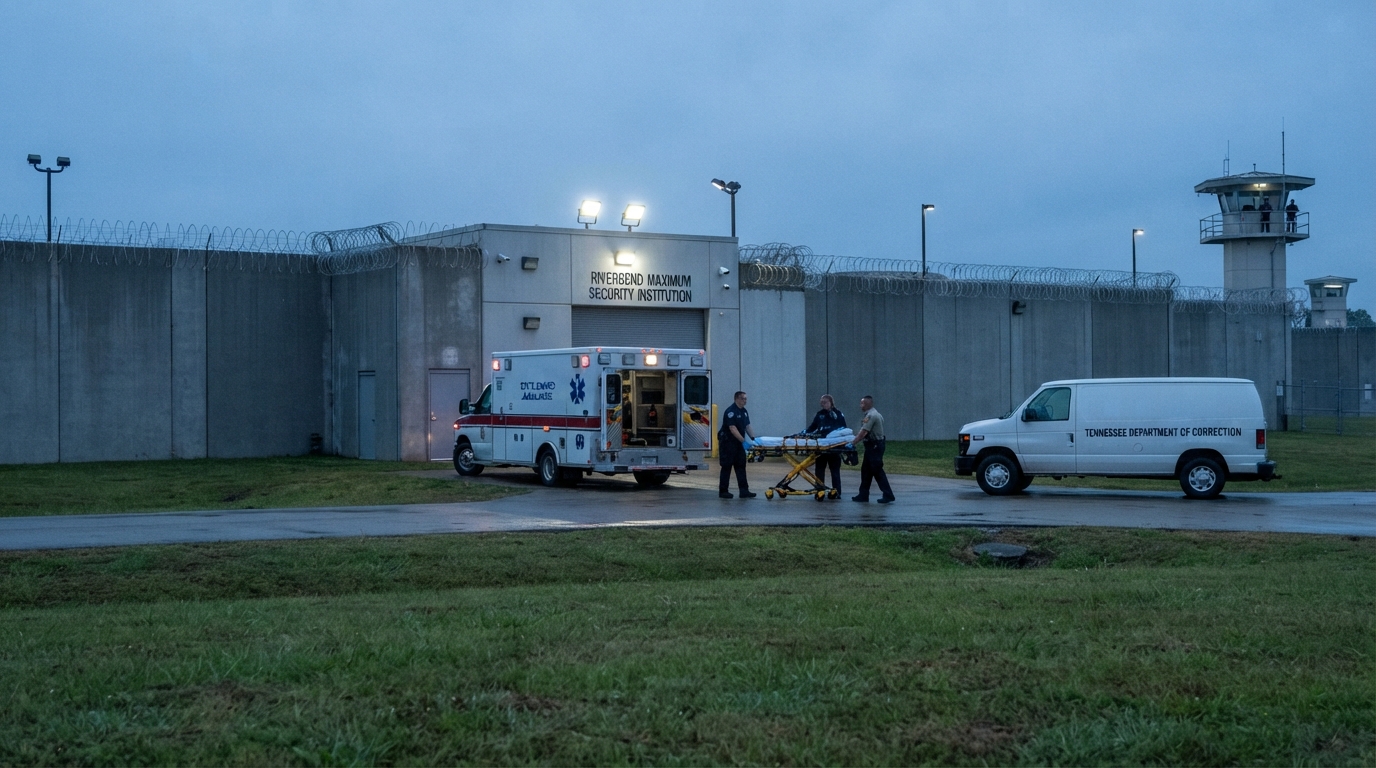
What happened in the failed execution of Christa Pike — and what comes next?
US convicted murderer Christa Pike is in hospital and receiving "life-saving measures" after Tennessee authorities failed in their attempt to execute her by lethal injection.
Pike’s case, which had already been the focus of a high-profile legal fight, has prompted several questions.
Among them are what went wrong, what happens now, and — for death penalty opponents — renewed concerns about the suffering of an inmate when an execution does not go as planned.
Pike, 50, was sentenced to death in 1996 for the murder of 19-year-old Colleen Slemmer, an attack carried out with her then-boyfriend Tadaryl Shipp.
She was due to be executed on Wednesday evening, local time. The injections were permitted by the US Supreme Court at the last minute after the legal battle.
Pike was given two syringes of the drug pentobarbital, but her legal team said these did not stop her heartbeat and that she could still be heard snoring.
The Tennessee Department of Correction defended the procedure it used, saying "the protocol does not allow for additional procedures beyond what was carried out this evening".
According to the AP news agency, the state protocol does not clearly say what should happen if an inmate is still alive after a second dose.
Authorities have not yet explained why the dose given to Pike was not fatal, although medical experts have offered their own theories.
Dr Joel Zivot, a professor at the Emory University School of Medicine who told the BBC he had been retained by Pike’s legal team as a medical expert, said she likely never reached a high enough blood level of pentobarbital to cause apnoea and cardiovascular failure.
The state correction department said Pike had been taken to an off-site medical facility.
One of her lawyers said she was "being provided life-saving measures" in hospital.
Her condition was unclear as of Thursday morning.
In emailed comments to the BBC, Zivot said: "It's very possible that as a consequence of the delay of the beginning of resuscitation she will have a brain injury."
State governor Bill Lee has ordered a third-party review and also said the year’s final scheduled execution will not proceed as planned.
May Martinez, the mother of Colleen Slemmer, who had pushed for Pike’s execution, told NBC News the events had been "a mess".
Death penalty opponents also reacted quickly.
Maya Foa, chief executive of the international legal organisation Reprieve, said: "We cannot know exactly what went wrong, because so much happened behind a curtain – lethal injection relies on secrecy at every stage, to hide the violence of the state taking a human life."
Authorities have not said whether they will try again to execute Pike. There is historical precedent for officials making a second attempt to execute people on death row.
Pentobarbital is a powerful sedative that slows the body, including the nervous system, to the point of death.
Its use in lethal injections came under renewed scrutiny last year after a US federal government review — carried out under President Joe Biden — raised concerns about the drug’s potential for "unnecessary pain and suffering".
His administration banned its use in federal executions, but that did not apply to individual states such as Tennessee, which can choose their own methods.
In recent years, states have found it harder to obtain the drugs needed for lethal injections because pharmaceutical companies have opposed their products being used in this way.
The Tennessee Department of Correction has not directly addressed Pike’s legal team’s allegation that the pentobarbital used was "degraded". Drugs can degrade for several reasons, including age.
However, the department gave a broader defence of its method, saying in a statement: "The lethal injection chemical in the protocol has consistently been effective."
Pike’s attempted execution was not the first in Tennessee in 2026 to go wrong.
The execution of Tony Carruthers, who was convicted of kidnapping and murdering three people in 1994, was postponed in May after staff could not find a vein to administer a lethal injection. He was granted a one-year reprieve by Governor Bill Lee.
More broadly across the US, botched executions continue to raise alarm.
In 2022, more than a third of executions in the US were botched or highly problematic, according to the Death Penalty Information Center (DPI) — an organisation that provides statistics and research on the death penalty but does not take a moral position on it.
The DPI says lethal injection has the highest rate of botched executions.
A 2014 case in Oklahoma drew particular attention. The execution of Clayton Lockett was halted after 20 minutes because the lethal injection of three drugs did not work properly when one of his veins ruptured, and he went on to writhe and shake uncontrollably.
In the US, 27 of the 50 states have the death penalty under state law. The federal government can also carry out executions after President Donald Trump, a supporter of capital punishment, ended a moratorium last year, although it has not yet carried out any executions since then.