

“We need to be calm in order to get out without conflict.” What rights do you have when interacting with law enforcement officers?
According to lawyer Jahongir Mutalibov, conversations with law enforcement officials should be recorded on audio or video. He considers this an effective way for citizens to demand their rights and avoid potential misunderstandings. How is evidence collected? Gazeta discussed the topic with the expert.
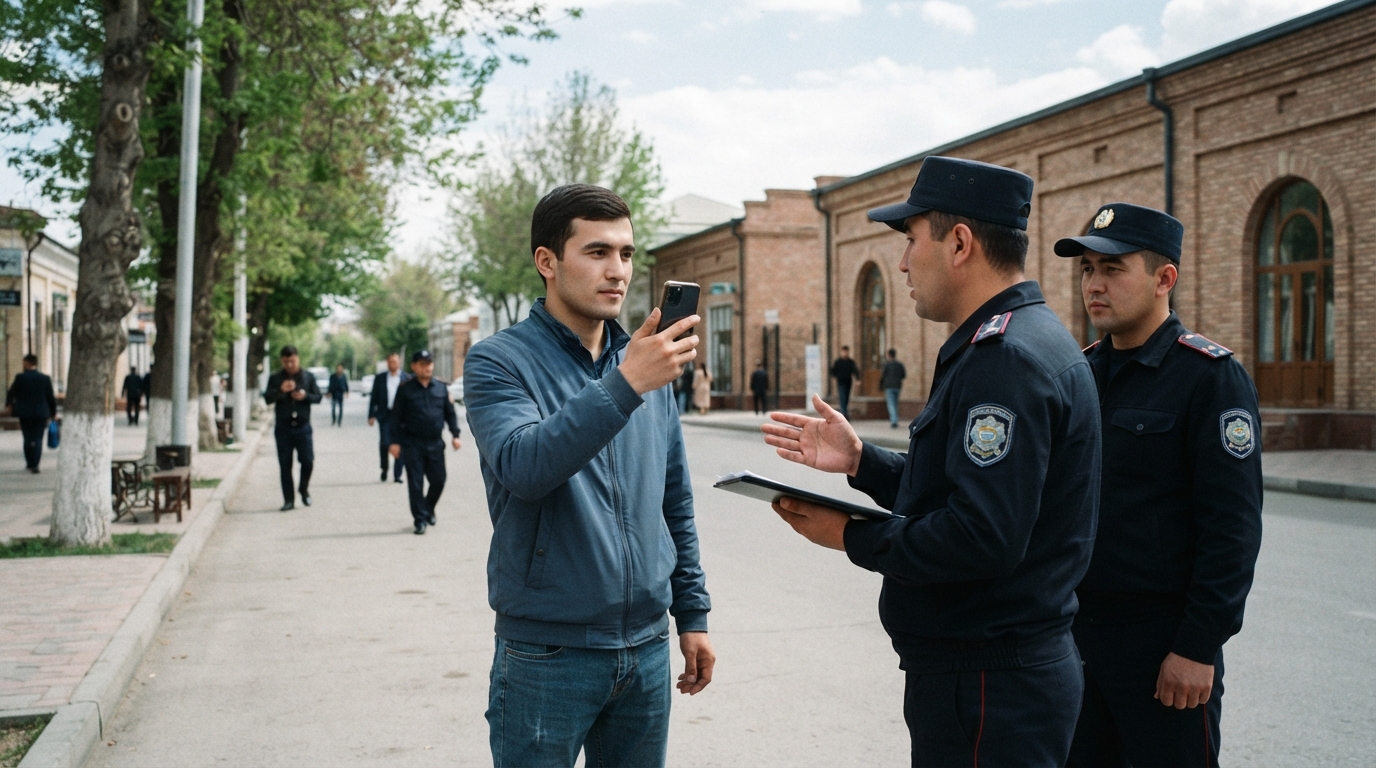
“We must be calm to get out without conflict.” What rights do you have when communicating with law enforcement officers?
Imagine an internal affairs officer suddenly stops you and asks for your ID, or wants to see the data on your phone, or wants to search your car—what would you do in such a situation?
Lawyer Jahongir Mutalibov shared his recommendations on how citizens can behave in such situations.
— Jahongir aka, first of all, thank you for agreeing to the podcast. We refer to them as law enforcement or internal affairs bodies. First, could you tell us which organizations are included in these bodies and what their duties are?
— When we say law enforcement bodies, several organizations are meant. Generally, in legal literature, they are referred to as law enforcement bodies. That is, they protect rights in various fields.
We know that the state does not consist only of citizens; first comes the individual, then society, and then the state. Based on this, law enforcement bodies protect, first of all, the rights of citizens, various institutions, organizations, and enterprises, and then the rights of the state. There are several such bodies. In popular parlance, examples include the militia, i.e., the Ministry of Internal Affairs (MVD), the Prosecutor General's Office, the State Security Service (SGB), the Customs Committee, the National Guard, the Tax Committee, the Bureau of Compulsory Enforcement (MIB), and the Ministry of Justice.
In Uzbekistan, the organization that conducts legal policy is primarily the Ministry of Justice, while other agencies are law regulators. Not all of them can perform the same task; each has its designated duties. Otherwise, information would not be properly structured in the state. For this reason, responsibilities are distributed among different bodies.
— Today, which of the organizations you listed do citizens encounter most often? And what problems arise during communication, in your opinion?
— Currently, one of the organizations citizens interact with the most is the Ministry of Internal Affairs. This is because representatives of the Ministry of Internal Affairs are distributed across every territory. We call them prevention inspectors, or in simple language, the "uchastkovoy" (district inspector). Next, they encounter the prosecution bodies more often, because they are the ones who supervise the execution of laws. Following that, representatives of the Customs Committee can be mentioned. That is, our people travel abroad or enter Uzbekistan, and customs officers deal precisely with this. In addition, one can face YPX (road patrol service) officers in road traffic.
In general, people may still encounter representatives of law enforcement bodies in one place or another. Of course, it is difficult to say 100 percent, but in daily life, it is natural to have to talk to them in 10–20 percent of cases. Usually, patrols are also frequently carried out on the roads by PPX (patrol-post service) officers. A person seeing these actions may refrain from certain activities in the future or approach them with their problem. This is also one of the important reasons why patrols are conducted.
— You said that while walking on the street, an internal affairs officer can stop and question you. Does an internal affairs officer have the right to do this? Can you explain from a legal point of view why this is done?
— In any state, a certain guard is placed to ensure the safety and peace of the community in a specific area. In our case, this could be a district inspector, i.e., a prevention inspector, or other special officers. These officers are authorized to check and talk to citizens who look suspicious on the street. There may be individuals in society who are wanted, and officers must find and detain them. They have the right to stop a citizen walking on the street when they resemble a wanted person or when suspicion arises. We cannot tell them, "What right do you have to stop me, I am just walking straight on my way."
— Can you explain the procedure of this process? Let's say an internal affairs officer approaches a citizen, what should they do first? Should they introduce themselves and show their ID? What can the citizen say to this?
— Not only internal affairs officers, but in general, the National Guard, PPX—all bodies involved in maintaining public order can stop and talk to citizens. If you ask what the reason for this is, everyone is aware of the geopolitical situation in today's world. For this reason, the government frequently instructs officers to increase vigilance. And increasing vigilance, of course, comes with observation and questioning. Now, regarding the procedure for officers to address citizens, every officer of any body has internal regulations and professional ethical standards. They define how to talk to citizens, how to address them, and there is politeness in all of them.
On top of that, law enforcement officers also have their own dignity and seriousness; they will not approach a citizen with a smile. At least, we do not have this in our practice. For example, in European countries: Great Britain or American states, they may speak with a smile. This is probably specified in their internal rules. But, in my opinion, there is no such rule in our country. Perhaps this should also be understood correctly. Not every officer will come, smile, and say, "Excuse me, let's get acquainted." If they said that, we ourselves might misunderstand it. We might feel as if they are harassing us.
Therefore, they may greet you in a serious tone and first ask for your documents. At this time, the citizen themselves must ask the officer to introduce themselves and show their ID. Let's say the person who came is in a special uniform, with badges attached, and in 99 percent of cases, it is clear that they are an officer, even then the citizen has the right to ask for their ID and who they are. If they stop you and ask for your first and last name, you can also make such a demand before answering. However, there are also those who do not state who they are when speaking over the phone. This happens in the internal affairs bodies, in the prosecutor's office, and in court. I have personally observed this.
— In such a situation, does the citizen also have the right not to answer?
— If you do not know who is asking for your personal data, and it is unknown who you are talking to on the phone, you have the right to say, "I do not know who you are, please understand, I will not give my data." But as a suggestion to our citizens, I would say that it is better to be patient and polite in communication.
— But what if the public servant themselves behaves rudely?
— Law enforcement officers are still officials of the state in a specific field. It is nothing for them to draw up a protocol against a citizen, claiming "they are resisting me." Then to whom will they complain?
— Do you mean that even then the citizen must be patient?
— I think it is better to be more patient than to have a rude relationship arise due to the citizen's impatience, and the officer evaluates these actions as disobedience, writes a protocol, and takes a certain measure. It is also possible to be a little patient and politely tell the officer, "Tell me your first and last name, otherwise, I will complain about you." At this point, citizens must back up the officer's rude behavior with evidence. Because if a complaint is made to some organization tomorrow, that evidence in the form of video or audio can be useful. The law does not prevent citizens from gathering evidence.
We can call this a life hack. Almost everyone has smartphones now, and their capabilities are wide. The situation can be recorded in audio or video. Let the citizen freely state that the conversation is being recorded, and if the officer asks why they are doing this, they should say, "If you treat me rudely, let this be evidence for me to complain tomorrow." Then the officer who stopped them will become alert. If they say, "I won't do that, turn it off," it is good to say, "Don't be offended, comrade inspector, I have encountered such aggression many times, this is my right." Even if any officer is not afraid of the citizen, they are afraid of audio or video recording. Now smart glasses are coming out, because the times demand it. Increasingly, people are demanding caution.
— Okay, in what cases can law enforcement officers check a phone or a citizen's personal belongings?
— Generally, according to our Constitution, a person and their property are inviolable. Therefore, without a legal basis, no one has the right to check anything of yours. Not all uniformed officials are given the same authority. But among those given, they have the right to inspect whether citizens have items related to an administrative offense. Today, along with sharp-edged objects, knives are also included in the items of administrative offenses. To find out whether you have a knife on you or not, an officer may ask you to take everything out of your pockets. Now, there may also be a suspicion that the citizen has hidden it. Then the issue of a search is raised. How is it done? There are clear boundaries here.
In practice, when a specific person arouses suspicion, an internal affairs officer can bring two independent witnesses, tell the citizen what they suspect and why they are suspected, and search them along with their pockets. Only with two independent witnesses. According to the law, this process must be recorded in a protocol. But someone might be too lazy to do this. In order to avoid slander and misunderstandings on both sides tomorrow, it is actually better if this situation is formalized. Today, in practice, even if there is no decision of an investigator or a higher official, cars are being searched, and drugs are being found. The detected consequence covers up the illegality of the search. Actually, it should not be like this. I am against this, but since you are asking based on practice, I am speaking based on practice. In this situation, we must also know how to demand documents.
That is, if officers ask to search a citizen or their property, it is important that the process is formalized and takes place in the presence of independent witnesses. You can ask politely, saying, "I will show you everything fully. I will open and show my bag or car like this, just let two independent witnesses watch, and you will give me a copy of the protocol. Then I will go to the relevant body and complain about this. I will apply to find out whether these actions were correct or not." There are also those who say, "Let them go, let them write, I am right." Therefore, one should not be afraid of a little paperwork.
If they say, "Come, let's go to our office together," according to the Code of Administrative Responsibility, an officer has no right to do this. This can only happen when the identity of the person is unknown. Let's say I do not have an identity document with me, and it cannot be found via the internet, or my face cannot be fixed either. In this situation, the right arises to hold me in the prevention inspector's room or the mahalla office for about 2 hours to clarify information about me.
But if you have an identity document, at least a driver's license or a student ID, or if you can show it electronically, you are not obliged to go. No one has the right to take you away without reason. If even then there is no other choice but to go with the officer, even if you are taken by force, you can call your lawyer by phone and inform your family. That is, the citizen has the right to report where they are. No one can take you away without a trace.
— What if the citizen does not agree to go? Can they stand their ground and say, "I will not go to your office"?
— If they take you away without paying attention to your request to make a phone call and without creating conditions, the violation of the law begins. But even if the citizen does not want to go, they are forced to comply with the instruction. What else will they do besides complying, run away? Let them cry out, ask for help, scream "they are taking me away illegally," but let them secure that situation with evidence.
In this situation, it is difficult not to go even if they do not want to. Because the citizen can still be taken away, finding that they did not comply. There are many delicate aspects to this. When a citizen and an official are weighed on the same scale, it must be admitted, the official's side weighs heavier. They believe their word more. This is a fact. There is no hiding it. The citizen has to prove that they are right.
— Let's say, if one is summoned to the internal affairs office not on the street, but by phone, how does it work? According to current legislation, shouldn't a written summons be sent?
— A citizen is summoned to a state body only if they have a specific status. In this situation, they are summoned to the internal affairs office when they need to give explanations as a witness or a suspect, or about a situation. Or else, whether they are summoned to court as a defendant, or to the investigation as an accused—in this case, the status of the citizen plays an important role.
Let's say you are being summoned to the body as a suspect, you have the right to remain silent, and you have the right to bring a lawyer with you. You may not even know what you are suspected of. You received a notification that you are being summoned as a suspect. If you ask, "What am I suspected of?" and they say, "Well, we won't tell you everything on the phone, you will find out when you come, that's why I told you openly," this is a mistake.
Any summons or request must indicate the status of the citizen. In this situation, you have the right to say, "Until you send the summons in paper form, I cannot go." According to the Criminal Procedure Code or other relevant laws, if a citizen is summoned to a specific body, a written summons must be sent.
If they say, "Come and give an explanation, a clarification," there is no obligation in our legislation to give an explanation. The person who wants to get an explanation should actually come to you. For example, in movies, an internal affairs officer goes to a certain place, asks someone for an explanation, and asks "what happened," similarly, in life, they should come.
— Understood. What about the issue of checking the phone?
— Today, the phone has become an object that knows many of people's secrets. Inside it, there may be information related to bank and family secrets, as well as information that degrades your honor and dignity. For this reason, the government amended the legislation, making it impossible to take a citizen's phone without a court decision.
That is, without a court decision, no one can ask for your phone password or inspect it. Even the court cannot order, "you will unlock the password." If it is important for a case, the court can only issue a decision to seize your phone. But it cannot impose any obligation to rummage through it or open it. You are not obliged to do this.
But there is also an important aspect here. That is, if some information inside the phone is needed, it can be opened precisely for that part. How does this happen? Let's say a witness testifies, "I know that this information is in so-and-so's Telegram, I saw it," the investigative body or a specific body will need to take your phone and inspect it. Of course, if they ask you, you won't give it. A court decision is still required for this.
After the decision is issued, the phone is opened, and only that part in Telegram where the aforementioned information is located is checked. It is not allowed to rummage through everywhere. There is no such thing. Today, because our people lack legal literacy, they open their phones themselves. And representatives of the bodies, taking advantage of this, take whatever information they want from inside it and use it against them. Whereas, the citizen has the right not to give their phone.
Only when an investigation decision is made, the prosecutor submits a petition to the court, and the court issues a decision, after that can the phone be taken. Until then, no one has the right to take your phone. As long as there is no legal literacy, there is not enough courage to demand this. That is, subconsciously, one must still feel the wrongness of such actions.
If they take your phone by force, go and complain immediately. One should say, "Officer so-and-so took my phone, it is currently in their hands." For that, there must be evidence. Do you see, if you do not gather evidence, you cannot prove that either. Therefore, we must learn to work with evidence and increase our legal literacy. We must learn to explain our rights to them beautifully.
You may say, "Now why should I speak to them beautifully if they speak to me rudely?" The situation demands it. If you speak harshly to an officer, they take measures. People become guilty without being guilty; instead of that, isn't it more important to get out of the situation more beautifully?! It is better to show the officer's rudeness with specific evidence to their organization or to the body dealing with internal security, and make demands.
It was not said in vain long ago that "rights are taken, not given." No one will just give you your rights on their own; you take them. You demand, you go to court, to the prosecutor, if necessary, you apply repeatedly, you fight for years, and then the matter is resolved. This is still achieved through legal literacy. Knowledge is also needed for this.
Or else, if we talk about preventive conversations or summonses to give testimony. It is better to ask the officer to record the conversation in audio or video form at the place you went. After that, the officer's questions should be answered. Because this is more beneficial for the citizen. Or it can also work to their detriment. That is, the opportunity to check every word spoken arises. It is easier to prove whether it is true or false.
Therefore, first of all, let us be correct ourselves, then we will not go wrong. If we are wrong, of course, we will try to lie. In conversations like the one above, a lawyer may not participate, so demanding that it be recorded and including it in the explanation letter is useful. That is, it should be entered that at the request of the person being questioned or giving an explanation, our conversation was recorded on audio tape or video. Let it be, whether the citizen is guilty or not, that is the next issue. But this practice is also important to prevent pressure applied during this process.
— At this point, let's talk about working with minors, how should they be communicated with?
— Minors, by their very name, have not yet reached maturity and cannot yet fully understand this or that relationship, so all legislation specifies that conversations with them must be conducted in the presence of their parents or a pedagogue. All officers know this. Even if officers do not know this, it is not allowed to talk to minors or take statements from them without the participation of their parents, guardian, or a pedagogue; even if taken, that evidence is found inadmissible in court.
— Understood. At the end of the podcast, can you share your main 3 recommendations?
— First of all, my first advice would be that one should not speak to a state body officer in anger. I understand, in reality, there are all kinds of situations, they cross the line, we see this in practice. But you cannot achieve a result by responding to their rudeness with rudeness. Let's admit this. Better, let's be calmer and document the process. On social networks, too, citizens who were calmer and took video recordings are winning; seeing the video uploaded to the network, people themselves know who is making a mistake and express their opinions. That is, not just attacking, but if rude relations begin, it must be fixed. It is necessary to fix it and gather evidence.
Secondly, do not sign the documents presented to you without reading and studying them. Thirdly, if an officer is demanding that you do something, and your saying no to them is being evaluated as resisting, then know that they will be considering the issue of drawing up a document about your disobedience. Everyone wants others to obey them; no one says, "it's okay if no one obeys me."
To avoid getting into this situation, being polite does no harm. Do you have business, stop, are they asking, first focus on their purpose and on what legal basis, and then answer. If they ask for a secret related to your person, we explained above how to act in this. I have not yet seen anyone prosper who responded to a state officer's anger with anger.
In our country, from of old, a person who demanded their rights is met with the view, "have you decided to demand your rights all of a sudden?" This is not news.
— Understood. Today we talked about another important topic. I think it will be useful for many. Jahongir aka, thank you once again for coming.
— Thank you for inviting me.