

'We lock shop doors during opening hours after theft'
Businesses reveal the impact of shoplifting with recorded offences still above pre-pandemic levels.
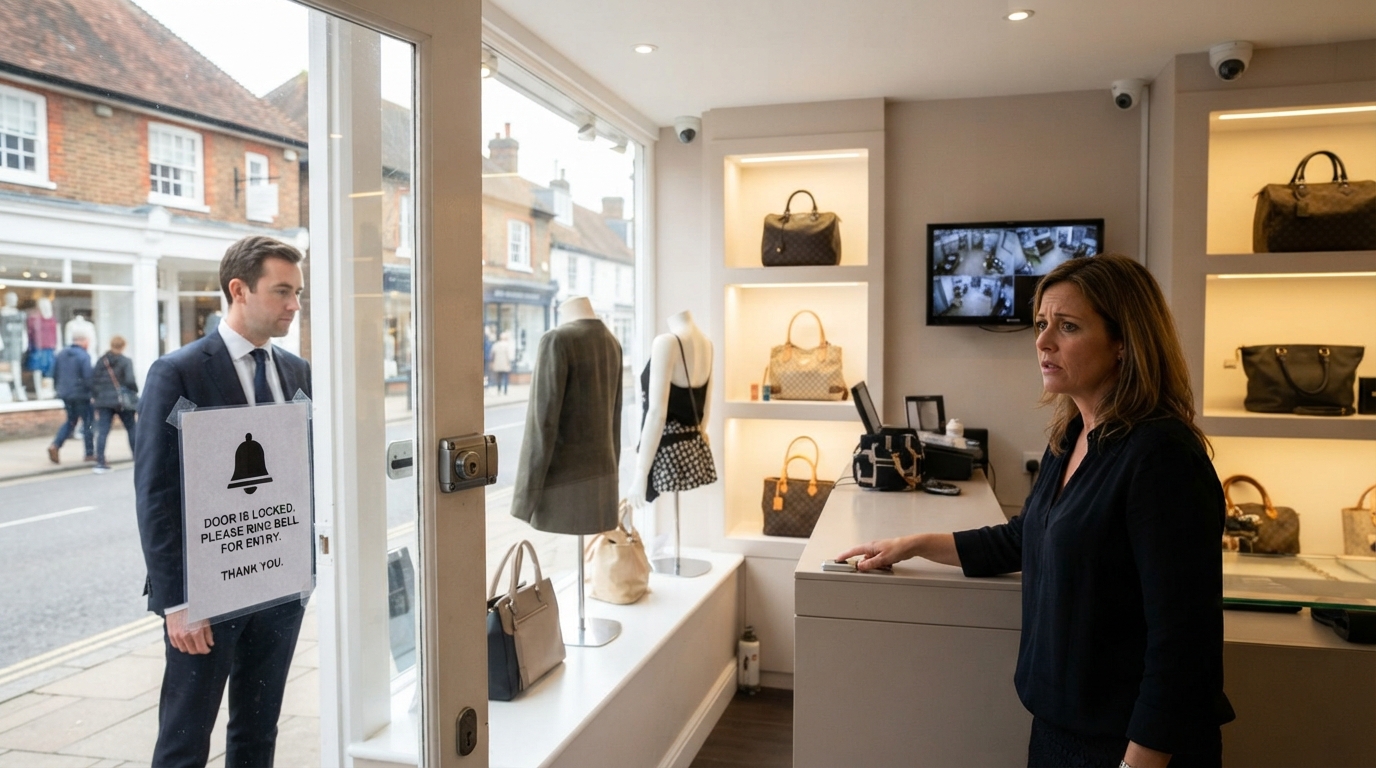
'We lock shop doors during opening hours after theft'
Shop owner Paige Mengers says shop theft has become very organised
A shop owner has explained that she now keeps her door locked while the store is open, with customers needing to ring the bell to enter, after thieves targeted her shop last year.
Paige Mengers, who owns a designer boutique in Surrey, has been discussing the effects of shoplifting, as recorded offences remain higher than they were before the pandemic.
Home Office figures indicate there were 42,674 shoplifting offences across Kent, Surrey and Sussex in 2025/26, up from 28,048 cases in 2019/20.
The government said total offences in England and Wales dropped by 4% last year, while more suspects were charged.
Mengers, who has shops in Cobham and south-west London, said she increased security after a raid in January 2025 involving men carrying wire cutters.
"One barricaded the door, the other came in and cut the wires on the bags and stole quite a lot of them," she said.
"It was absolutely awful, I lost two very good members of staff who were terrified after that.
"We were really shaken and for about six months I had security on the doors for our staff."
Elmbridge borough commander Chris Thoday told BBC South East that the methods used by these groups were "pretty sophisticated".
"They're very organised, they know exactly what they are doing," he said.
"Quite often they will recce the shops beforehand, then go in afterwards, steal the items they want to take, to make sure they're in and out as quickly as possible."
Insp Thoday said several stores had since trialled lone worker alarms for staff working alone at night in a number of shops in Cobham.
Businesses are describing their experiences of shop theft as a BBC investigation finds 270 people were linked to more than 28,000 offences across England.
Official figures show that 23 per cent of investigations across England and Wales resulted in a charge or summons in the 12 months to April this year.
High street shops are not the only ones being hit; rural areas are affected too.
Managers at a family-run farm shop in Wingham, near Canterbury in Kent, said they had lost thousands of pounds over the course of a year.
"We're getting small gangs come in or individuals to steal high value goods, either meat products, meat joints or alcohol," said Andrew Gibson, director at Gibson's Farm Shop.
"They seem to be more organised, out here you have to drive here, you can't be an opportunist thief."
Gibson recently used social media to publicly shame offenders online.
"We've had the situation where thieves have gone back into a police station with the money for the goods to pay back to us," he said.
Andrew Gibson has used social media to appeal for help in catching shoplifters
In Canterbury, Kent Police have created a dedicated retail crime team.
"People are going in, stealing to order, filling up trolleys and just running out of the stores," said James, a plain clothed police officer speaking to BBC South East during an operation to catch thieves.
He said crime groups would sometimes survey stores and film the items they wanted stolen before sending shoplifters in.
"We notice people coming in checking out where the CCTV cameras are," he said.
"Sometimes a shoplifter will use trolleys, they'll load up what they want to take and then they'll hover by the entrance or exit and when the opportunity comes they just take the whole trolley load of goods.
"We've also noticed people with prams loading up the bottom or the top, wandering around pretending they are getting something out for the young child in the pram and then load up the pram and take items out of the store."
Paul Stoner, district commander for police in the city, said the team was formed in response to a rise in crime over an 18-month period.
"It's a set few individuals who commit a disproportionate amount of that crime," he said.
"Our officers have a really good knowledge of the local offenders, we are able to identify them very quickly through the CCTV images," he said.
"What we also have is the ability to put those images through facial recognition, if the suspect is on a database, we're able to identify them."
Police also pass information to the local City Watch scheme, and details of known suspects can be sent to shops over a radio system.
The scheme is run by the Canterbury Business Improvement District (Bid) and connects retailers with police and the city council's CCTV control centre.
Lisa Carlson, chief executive of Canterbury Bid, said they had a street team that trained businesses and helped them collect and submit evidence.
"We have 137 radios in circulation, if there is an incident unfolding it can be reported in real time and hopefully we can avoid any crime happening," she said.
Nick Strickland from the Brighton and Hove Business Crime Reduction Partnership is patrolling the streets with police
In Sussex, the Brighton and Hove Business Crime Reduction Partnership (BCRP) also offers services aimed at tackling crime and anti-social behaviour.
According to manager Lisa Perretta, they are working with other BCRPs across Sussex to identify repeat offenders.
"When someone becomes quite well-known in one area, it will be flagged to our area, so we are forewarned and can identify them a lot earlier before they commit multiple crimes," she said.
Perretta said they had also become much better at encouraging businesses to report crime.
Temporary Ch Insp Olivia Carroll is from the Sussex Police business crime team
Recorded shoplifting offences across the South East reached their highest point in 2024/25.
Only Kent recorded a rise in cases over the past 12 months, while Surrey and Sussex saw reductions.
Olivia Carroll, temporary chief inspector at Sussex Police, said there was a "large number of reports" of retail crime in the county - including "organised criminality" by groups.
"Clearly we deal with repeat prolific offenders and our focus is on that as a priority," she said.
A Home Office spokesperson said retail crime had been "dismissed as low-level offending" but it harmed shopworkers and damaged businesses.
"Shop theft is down 4% on last year and charges are up 19%," the spokesperson added.