

From photo albums to apps: How the fight against shoplifting changed
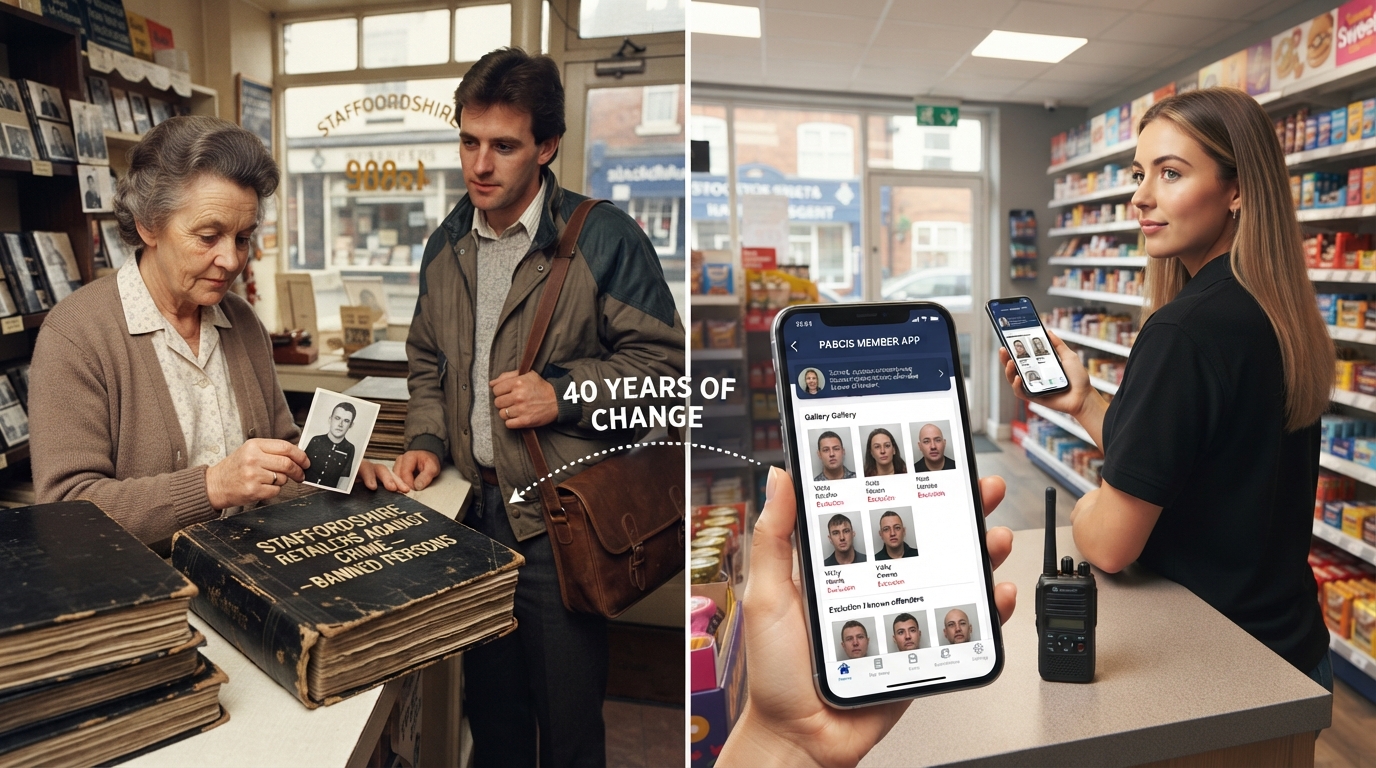
Technology has changed in Staffordshire to a secure app instead of a photo album of mugshots.
From photo albums to apps: How the fight against shoplifting changed
Members of the scheme can see and share information about shoplifters in their part of Staffordshire using the latest technology on smartphones
Before smartphones, secure apps and instant alerts, tackling shoplifting in Staffordshire depended on photo albums.
Filled with police custody images, they were handed from shop to shop to help staff identify banned shoplifters.
The yearly job of updating all 300 often landed on Paul Greenhough.
Nearly 40 years later, the county’s response to retail crime has changed hugely, but Greenhough says one thing has not.
"I think unfortunately it has become partly accepted that stores are going to lose things," he said.
"For us it's about saying 'no, that's not acceptable, we need to do something about it'."
Greenhough runs Partnerships Against Business Crime in Staffordshire (PABCIS), a scheme he said was the first of its kind in the country when an early version started in Stoke-on-Trent in 1988.
For retailers, the effects of shoplifting are often deeply personal.
Vicky Hoofe and her family have operated a sweet shop in Hanley for about 20 years. Although she said they had "done alright" lately, every theft still counts.
"I've been on the phone to my partner and my dad in the past like crying, because I take it personally, thinking why do these people hate me?" she said.
The shop has fitted cameras and barriers to prevent people taking sweet jars from the front window.
Even when staff witness theft, stepping in can be hard.
"I've been in the shop before, and there's been other customers in, and we're literally watching somebody taking something," she said.
"But it's scary because you don't know what that person is capable of."
Helping businesses handle situations like that has been central to Greenhough's work for decades.
In the early years, retailers were given copies of police custody photographs of shoplifters who had been barred from stores for 12 months.
The pictures were stored in albums and shown to staff at meetings.
Every January, they had to be replaced.
"You had to then go to every shop, and swap those albums, for the January of the year before, which when you've got 300 photo albums was a lot of work," he said.
Those heavy albums have now been replaced by technology.
PABCIS was created in 2007 after partnerships across Staffordshire were brought together under one umbrella organisation.
Today, alongside a radio link, members can use a secure app with photographs of excluded offenders, details of their exclusions and any relevant warnings.
The goal is to raise awareness before an offender enters a store.
"If business A has somebody in, they pass that information over, if they're heading toward business C, they can be at the door stopping them, where it's far easier to deal with that person," Greenhough said.
The partnership began in Stoke-on-Trent, and in Hanley, the city centre business improvement district pays the membership fee on behalf of retailers
The team also sends out alerts about incidents where offenders have not yet been identified.
"I might have been doing this a long time, but I don't know every shoplifter!" he joked.
Even after nearly 30 years dealing with business crime, some things still surprise him.
One of them is the number of thefts from charity shops.
"They are plagued by shoplifters, and you just think, they are trying to help people."
Measuring the scale of the problem is not always simple.
"There is a decline in the amount of shoplifting being reported, but that needs to be treated with caution," Greenhough said.
"If you look nationally, anyone will tell you that there's a lot that goes unreported. If stores reported every single incident, the police would be overrun by shoplifting."
Shopflifters convicted twice can be banned from member's stores for a year, two if there was violence involved
Patterns also vary across the county.
In Stoke-on-Trent, many offenders tend to live and steal locally, he said. In Lichfield and Tamworth, a bigger share come from outside the area, while some travelling shoplifting teams come from as far away as London and Scotland.
For Greenhough, the ways used to tackle shoplifting may have changed since the days of carrying photo albums from store to store.
For retailers such as Hoofe, though, the impact is still much the same.
"It's not coming out of some big corporate company, it is coming out of my pocket," she said.