

'We grew up around this historic Delhi mosque - now we have been forced out'
Authorities have razed hundreds of houses in a neighbourhood in central Delhi, saying they were built on government land.
**'We grew up around this historic Delhi mosque - now we have been forced out'**
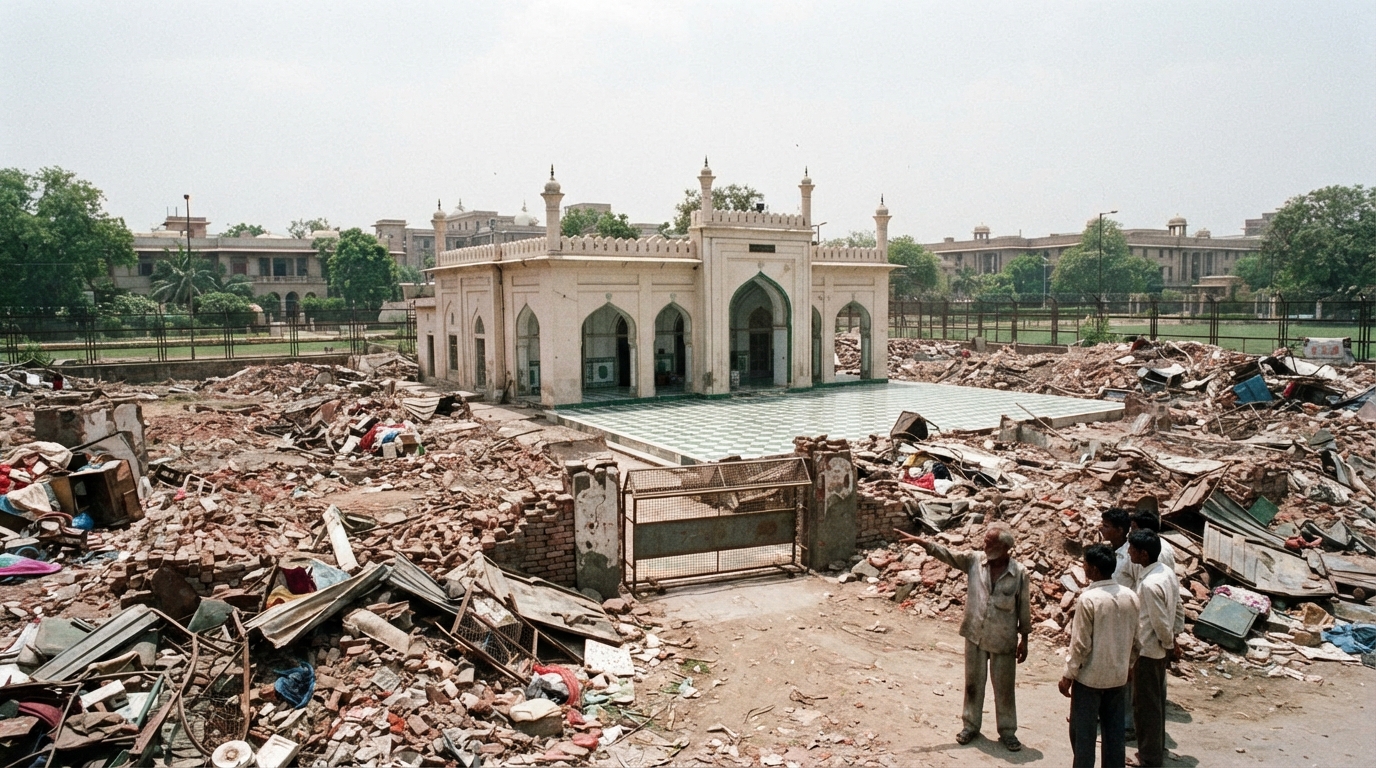
The Race Course mosque in Delhi is at the centre of a legal dispute
In central Delhi, not far from the Indian prime minister's residence, a small mosque stands amid heaps of rubble. Its pale walls and pointed arches are still standing, and its courtyard remains paved with green-and-white tiles.
Yet the people who once animated the place are no longer there.
Mohammad Wasim, 50, gestures across the debris to where his home used to be.
"My father was married there, and, decades later, so was my daughter," says Wasim, who works as a driver.
Wasim and his relatives were among hundreds of people living around the mosque in a jumble of modest houses squeezed between military compounds, elite clubs and large bungalows in Race Course, one of the Indian capital's richest and most tightly guarded areas. Many had been there for generations, employed as drivers, cleaners and gardeners in the affluent homes nearby.
On 7 October, officials tore down their homes across three settlements, saying they had been illegally built on government land. They also cited security worries because of the homes' closeness to military facilities. About 717 families were moved to Savda Ghevra, a colony almost 31 miles away on the edge of the city.
Residents had taken the evictions to the Delhi High Court, arguing that being shifted so far from their jobs, schools and communities would disrupt their lives. But in August, the court approved the relocation, accepting the government's security concerns and noting that alternative housing had been arranged.
Only the mosque and a nearby Hindu temple were left standing. But their water and electricity were cut off that day, and access to the compound has since been limited. Worshippers are usually turned away at the gates, though some are sometimes let in after pleading with guards.
The government says it owns the land where the mosque stands, but mosque officials say it was registered in 1977 as waqf property - land or buildings set aside under Islamic law for religious or charitable purposes - and is listed, external as a heritage structure. The Delhi Waqf Board says it is nearly 300 years old, though other estimates place it at 125-150 years.
The board has written to the authorities asking for the mosque's water and electricity to be restored and expressing concern about its future. Separately, a worshipper has petitioned the high court over limits on prayers and fears that the mosque may be demolished.
On 29 October, the government told the court it would take no action against the mosque for four weeks while it considered the board's objections. It opposed restoring access for prayers, citing safety concerns during demolition work, a stance disputed by the worshippers' lawyer. The court declined to step in and set another hearing for 16 December.
While the mosque's future is still unclear, for those who once lived around it, the question now is what can be saved of the lives they built there.
Wasim still comes back to the mosque to pray when he can, although guards sometimes turn him away. On a recent afternoon, he was among only four or five worshippers inside. A generator was rattling loudly outside, providing electricity after the power had been cut.
"Our hearts and entire lives are tied to this place," he says. "How can we let it go, when our childhood was spent playing here?"
Rekha, a widow, recalls the colony with sadness. She washed dishes in nearby homes, raised her family and performed seva (voluntary service) at the local temple.
To her, the word rehabilitation feels painfully insufficient: "How can a life built over decades be uprooted and planted somewhere else?" she asks.
Since the relocation, she has lost the work she relied on. Her 19-year-old son is struggling to find employment. She has been given a third-floor flat, but climbing stairs is painful because of a metal rod in her leg after an operation.
"I may have a house but my home was snatched away."
Critics say these stories are part of a longer pattern of displacement in Delhi, where working-class communities have repeatedly been pushed out.
"Relocation disconnects them from both jobs and networks, resulting in livelihood and income loss," urban researcher Mukta Naik told the BBC.
As families spread out in search of work, she says, the informal support systems they once depended on become harder to rebuild.
"This leaves families to fend for themselves," she says.
The Delhi government's housing agency, the local municipal council and the central government's land office did not respond to requests for comment.
Savda Ghevra was set up in 2006 on farmland near Delhi's border with Haryana state to house families displaced from elsewhere in the city.
The first residents found little more than empty plots, with no roads, running water or electricity. Over time, they built houses, opened shops and fought for basic services. By the early 2020s, an estimated 50,000 people lived there.
Now the families from Race Course have started the same slow process.
They have exchanged the leafy avenues of central Delhi for rows of almost identical concrete blocks, with open fields stretching beyond. Life continues, but much of what supported these families remains on the other side of the city.
Every day, Babloo leaves home at 5am to take his children by metro to their old school in central Delhi, changing trains three times on the way. He waits out the six hours until classes end at a tea stall outside his former neighbourhood. When he has work, his wife makes the trip.
Their new home is too far away, he says, to return between school runs. By the time the family gets back to Savda Ghevra, it is about 4pm.
Babloo once worked at a club in Race Course. He has now found work in Meerut, a town north-east of Delhi. Residents knew they might have to leave, he says, but they had hoped they would be moved somewhere close enough to keep their jobs and their children's schooling.
The government says suitable apartments were not available closer to Race Course. In court, it pointed to Savda Ghevra's schools, dispensaries and transport links as proof that the area could absorb the displaced families.
But those facilities offer little comfort to Naeem Khan, 63. His two grandsons have hearing and speech disabilities and need specialised care and schooling that he says are not available there.
The move has also split Naeem's family. One son and a divorced daughter share his small one-room apartment, while his two other sons had to move elsewhere because there was not enough space.
"We have been thrown 20 years backward," he says.
For women, the move has been especially harsh, cutting them off from their work
The distance has been particularly costly for women. Naik says childcare duties, transport expenses and safety worries make long commutes to work especially hard for them.
At Race Course, the wealth around the settlements created small but essential ways to earn money - washing dishes, tending gardens, collecting and selling discarded bottles.
Akhtari, an elderly widow, gathered mineral-water bottles for about 100 rupees (about $1.05; £0.80) a day and dried leftover rotis, or flatbreads, to sell as cattle feed.
Now even these small income sources have vanished.
"Everyone living here was evicted; everyone is poor, broken, and struggling themselves," Akhtari says. "Who will hire someone else for housework?"
At Race Course, when she had nothing, the mosque's imam or a neighbour might give her money for flour. Her neighbours looked in on her. In the new apartment, she has a roof over her head, but few people she can rely on.
She has started to worry about what will happen if she becomes ill.
"If I collapse and die inside, no one will even know," she says. " Hopefully someone will break down the door and find me."