

We do not need such an exchange
Kyrgyzstan has opposed accepting Afghans and Africans in exchange for jobs in Europe
**We don't need such an exchange**
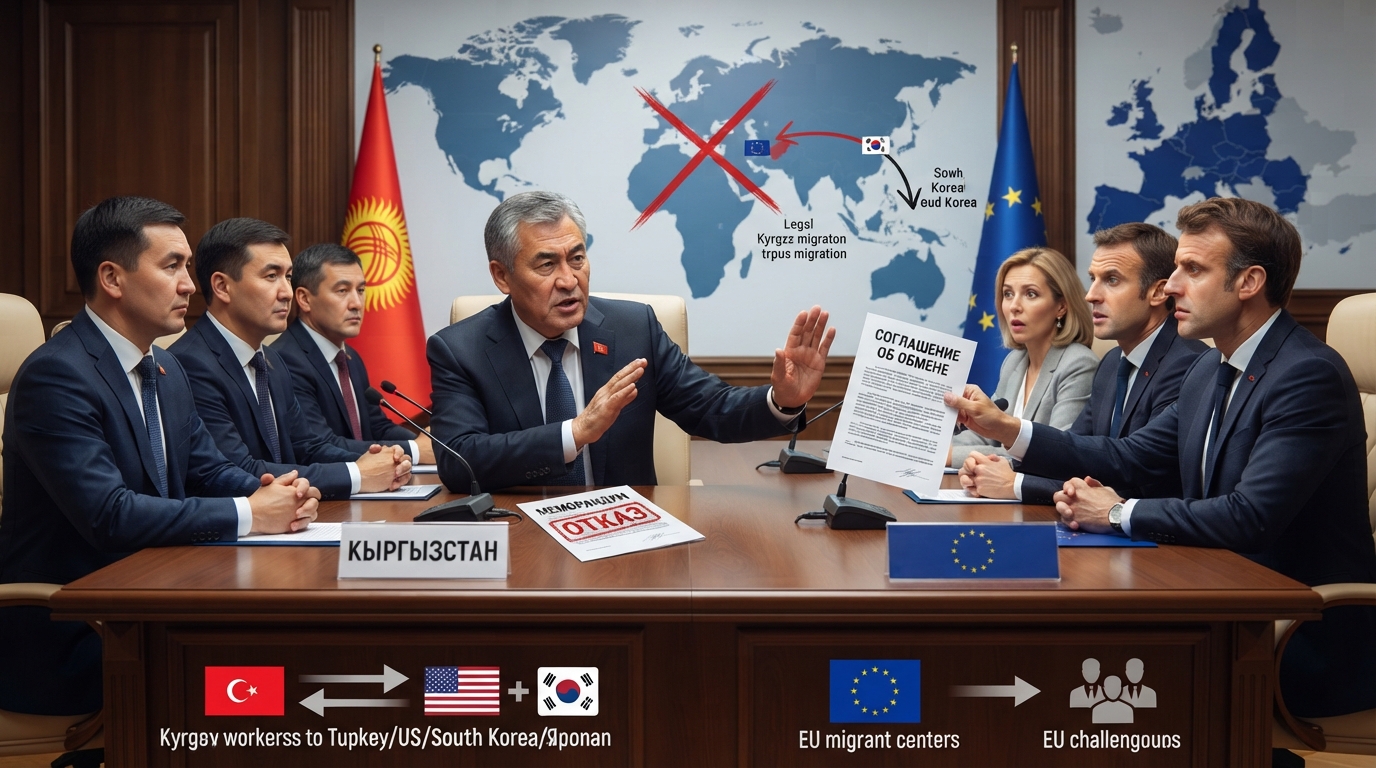
Kyrgyzstan has opposed a proposal from a number of European countries that were ready to accept skilled workers from the Central Asian republic in exchange for accepting migrants from Afghanistan and African states. Minister of Foreign Affairs Zheenbek Kulubaev stated this.
"Let our citizens go and work if there is such an opportunity. But we will not purposefully negotiate on these terms," Kulubaev emphasized on October 13 at a meeting of the Jogorku Kenesh (parliament of Kyrgyzstan) committee on international affairs, defense, security, and migration.
According to the head of the Foreign Ministry, labor migration destinations are gradually changing, with Kyrgyz citizens increasingly leaving for Turkey and the USA. At the same time, high demand for workers from Kyrgyzstan remains in South Korea and Japan. In particular, there is a need for staff to care for elderly people in hospitals there.
The minister recalled that Kyrgyzstan itself is in need of a workforce. For this reason, the authorities have reduced the organized direction of citizens for permanent work abroad, while sending people for seasonal work continues. "We want our migrants to have comfortable conditions," Kulubaev stressed.
Earlier, it was reported that EU countries were considering the possibility of creating so-called "return hubs" in third states for migrants whose asylum applications were rejected. Uzbekistan and Kazakhstan were mentioned among such countries. However, both nations officially denied this information. The Ministry of Foreign Affairs of Uzbekistan stated that reports of the possible creation of such hubs "do not correspond to reality," while Kazakhstan emphasized that only visa facilitation and the readmission of its own citizens are on the agenda of negotiations with the EU.
In May 2024, 15 EU countries sent a joint letter to the European Commission calling for the creation of mechanisms to remove migrants to third countries, including the possibility of intercepting them on the high seas and delivering them to a "safe place" outside the Union. Among the signatories were Austria, Bulgaria, Cyprus, the Czech Republic, Denmark, Finland, Estonia, Greece, Italy, Latvia, Lithuania, Malta, the Netherlands, Poland, and Romania.
In June 2026, as many as 19 European leaders demanded accelerating the external placement of deportation centers, citing Italy's agreement model with Albania. According to Eurostat, 135,460 people were returned from the EU to third countries in 2025 — 20.9% more than a year earlier.
Human rights organizations, including Amnesty International and Human Rights Watch, criticize plans to remove migrants to third countries. They point to risks of human rights violations, the lack of effective monitoring mechanisms, and the potential creation of "legal gray zones" where refugees will be deprived of access to independent courts and appeal procedures.