

'We came back from hell', say Ukrainians after years in Russia-occupied frontline city
One evacuated couple says they crossed minefields in Oleshky in a search for food.
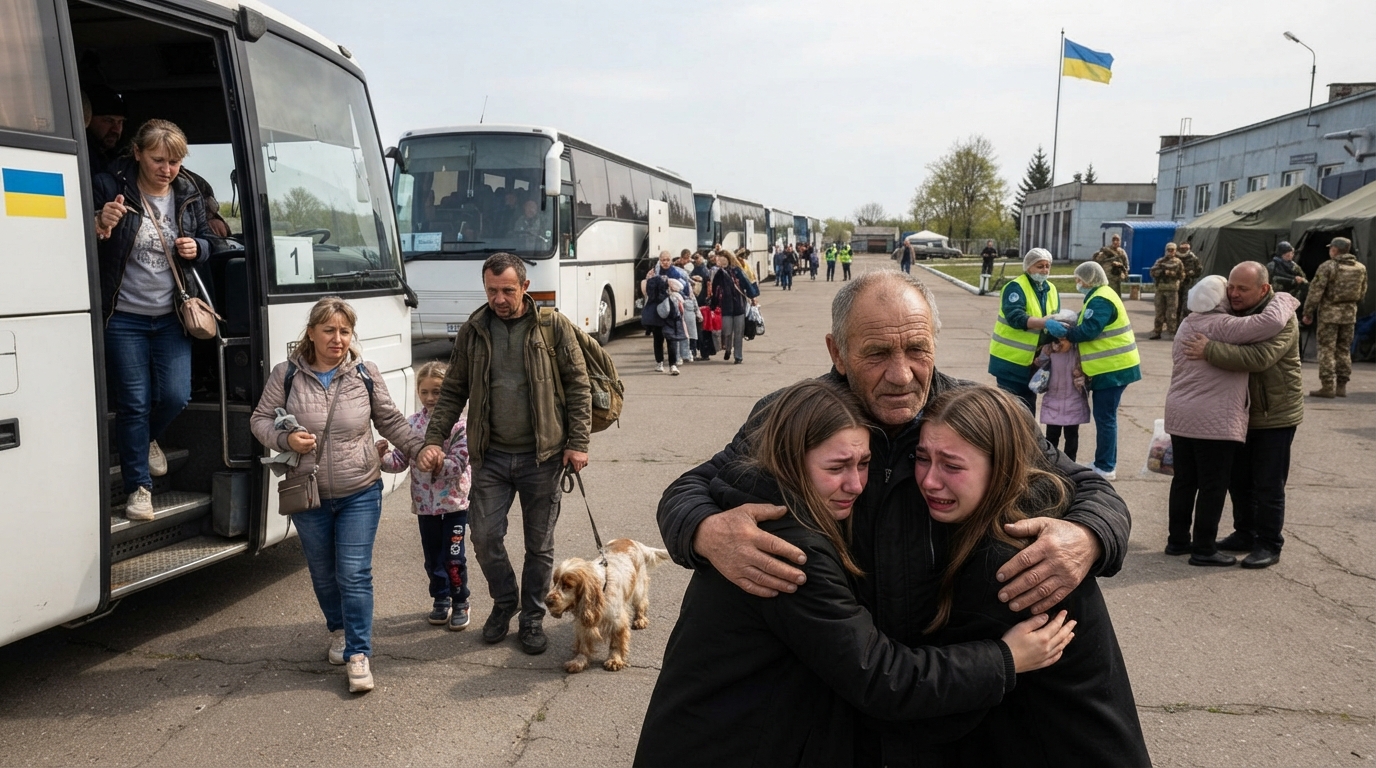
'We came back from hell', say Ukrainians after years in Russia-occupied frontline city
Viacheslav and his wife Olha had been living in Oleshky with their children.
Olha used one word to sum up life in the frontline city of Oleshky over the past few years: "Horror".
As she stepped off a coach in the Ukrainian region of Chernihiv with their immediate family and dog, her husband Viacheslav put it this way: "We came back from hell."
The couple were among hundreds of residents evacuated from the Russian-occupied city who crossed into northern Ukraine via Belarus on Saturday, with many being reunited with loved ones they had not seen for years.
Oleshky, captured by Russia in the first days of its full-scale invasion in February 2022, is cut off on one side by the Dnipro River and on the other by Russian forces.
Olha and Viacheslav had lived there with their son and daughter, both in their 30s. Even as the shelling around them grew heavier, they feared that trying to flee could be even more dangerous, with routes mined and exposed to drone attacks.
As food and other supplies ran low, the couple said they tried to find food by crossing minefields earlier this month. "People were stepping on mines, dying and being maimed, all just to survive," Olha told the BBC.
Those too frightened to go outside in the city had taken to cooking garden weeds to stay alive.
"We saw that the situation wasn't getting any better, so we realised we had to get out," Olha said.
That chance came earlier this week when a humanitarian ceasefire, brokered by US First Lady Melania Trump, came into force in the Kherson region, bringing the first few days of peace in the area for four years and enabling Oleshky residents to evacuate.
Up to 6,000 people, including 200 children, were thought to still be living in Oleshky and the surrounding areas, with 1,700 in the city itself.
Residents were given a four-hour window on Friday to leave, with a convoy of 25 buses arranged for up to 750 evacuees, as well as ambulances for those with limited mobility.
After travelling through Russian-occupied territory to southern Russia, then flying to Belarus, evacuees arrived by bus at a military facility in Chernihiv on Saturday.
On the tarmac, where evacuees were processed before continuing their journeys, some elderly residents were so weak they had to be carried on stretchers. Others were reunited in emotional scenes.
Mykhailo Palii says the situation in the city "kept getting worse and worse"
When Mykhailo Palii arrived, his daughters Dasha and Anya, who had feared they might never see him again, ran across the tarmac screaming and crying.
After an emotional embrace, Palii gave a glimpse of life in Oleshky, though he said he had kept many of the details from his family until then.
"A hole was blown into the bathroom," he said. "There were drone attacks and missile strikes. It happened, but I didn't tell them about it because I knew they would worry."
Volodymyr (L) and Tetiana (R) say they feared the journey out of Oleshky could have been disrupted
Tetiana and Volodymyr, who arrived in Chernihiv carrying a cat, said their entire home burned down three years ago, and they had since been living in a neighbour's abandoned house.
For them, leaving as soon as it was safe was an easy choice. "There's nothing for us to regret leaving. We don't have relatives there. Our children are married and don't live with us in the city," said Tetiana.
But those who escaped also worry about the people still there. "There are still a lot of people left there, living under those conditions," said Olha.
Now that the evacuees have left Oleshky, they face another challenge: deciding where to go next and how to rebuild their lives.
Palii said he would look for work so he could support his family: "There's no job I can't handle. Digging, hoeing, planting, building. I can even do demolition work."
Olha said she and her family have no relatives elsewhere in Ukraine, and will stay with acquaintances for an extended period while they get back on their feet.
She said: "If we managed to survive in hell, we'll survive here too."