

Was Neanderthal life violent? This wound suggests lethal fighting was more common
A 75,000-year-old Neanderthal spear wound may be evidence violence shaped human life far earlier than thought.
Was Neanderthal life violent? This wound suggests lethal fighting may have been more common
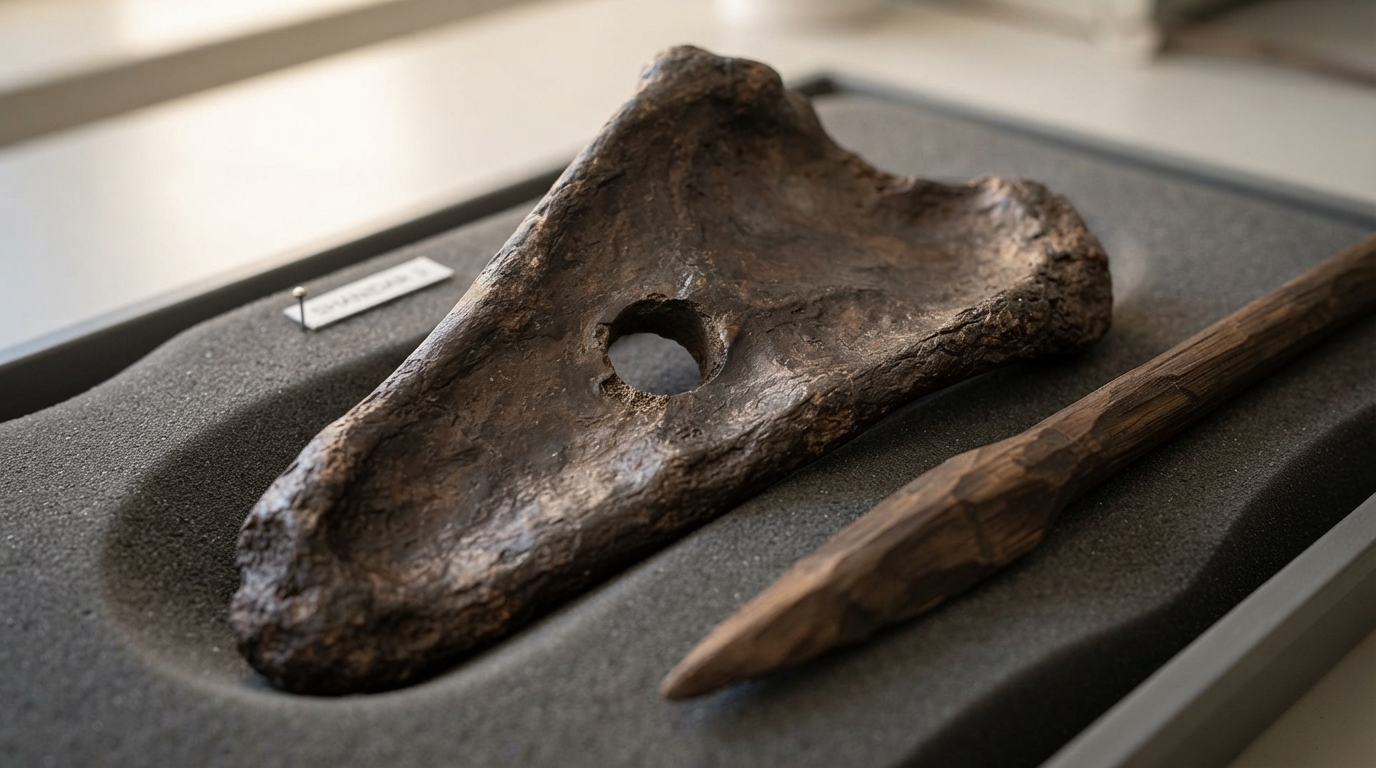
A wooden spear, scientists say, made the hole in this Neanderthal shoulder blade
Archaeologists say a Neanderthal who died 75,000 years ago may have been pierced through the chest by a sharpened wooden spear.
They say a 15mm hole discovered in a shoulder blade in a cave in Iraqi Kurdistan could be the earliest evidence of lethal violence involving such a weapon.
Based on the angle of the injury and other clues, the researchers think the spear entered the person’s chest and travelled through the body — probably injuring a lung and major blood vessels — before exiting through the left shoulder blade and leaving a near-perfect hole.
The study adds to growing evidence suggesting Neanderthal societies may have experienced more violence than was once believed.
Neanderthals were a separate human species that died out about 40,000 years ago. They lived across much of Europe and western and central Asia, and sometimes overlapped with Homo sapiens.
The injured Neanderthal’s remains were uncovered in a cave in Iraqi Kurdistan. Along with the left shoulder blade, the individual’s right hand, three ribs and some teeth were also recovered.
According to Dr Emma Pomeroy, the study’s lead author from Cambridge’s Department of Archaeology, the hole in the shoulder blade may be the earliest evidence of “lethal interpersonal violence” caused by a wooden spear.
“The fatal strike may have been an intended heart shot,” she told BBC News.
Archaeologists refer to the remains as Shanidar A, after the cave where they were found. At least 10 Neanderthals were found there during excavations in the 1950s.
Pomeroy said the wound is believed to be the first evidence of sharpened wooden spears being used in the prehistoric Middle East.
“It is not the kind of break that you would get naturally, because it is so circular,” she said. “Experiments with reconstructed wooden spears produce very similar round holes in bone.”
Still, she says interpersonal violence is far from certain. It could have been friendly fire, meaning a wound caused during a hunting accident.
But Prof Chris Stringer of the Natural History Museum in London, who was not involved in the study, told BBC News that an attack by a rival was the more likely explanation.
“The researchers leave it open whether this resulted from a hunting accident or interpersonal violence, but in my view the latter seems more likely, given the positioning and extent of the wound,” he said.
The discovery recalls an earlier find from the same cave in 1957. Those remains belonged to another Neanderthal who lived later, around 50,000 years ago. Their ribs showed evidence of a partly healed wound, which archaeologists think was probably caused by a stone-tipped spear.
We cannot know for certain whether these Neanderthals were injured by a companion during a hunt or killed by a rival. But they add to a small yet expanding body of evidence suggesting human-on-human violence may have been more common, and may stretch further back than current scientific consensus indicates.
“I unfortunately see the growing body of evidence as an indication that interpersonal violence goes deep into human prehistory,” Stringer told BBC News.
One important part of that evidence is a study published in 2022 of very early Neanderthal skulls from northern Spain at an archaeological site known as “the Pit of Bones”. It suggests deadly violence was occurring about 430,000 years ago.
Researchers identified 57 healed head injuries among 20 individuals. Nine individuals had skull fractures that could have been fatal. Six had similar puncture wounds at the back-left of the head. Because the injuries repeatedly appeared in nearly the same location, the researchers concluded that deliberate blows were more likely than accidental damage. One skull had two wounds that were probably caused by the same object.
The Pit of Bones evidence does not prove that everyone in that population was routinely violent, but it does offer strong evidence that repeated killing took place among these people hundreds of thousands of years ago.
For decades, many archaeologists tied the origins of organised warfare to farming, when people began living in permanent settlements and competing over land, livestock and food stores.
But evidence from earlier hunter-gatherers and even older human relatives has since shown that individual killings long pre-date farming.
The current scientific debate is about how widespread such violence was, and when isolated attacks turned into organised conflict and wars between groups.