

Ancient cave art discovery suggests first known humans in Ireland walked over from Wales
During the most recent Ice Age, researchers believe there was a "lost land bridge" between Wales and Ireland.
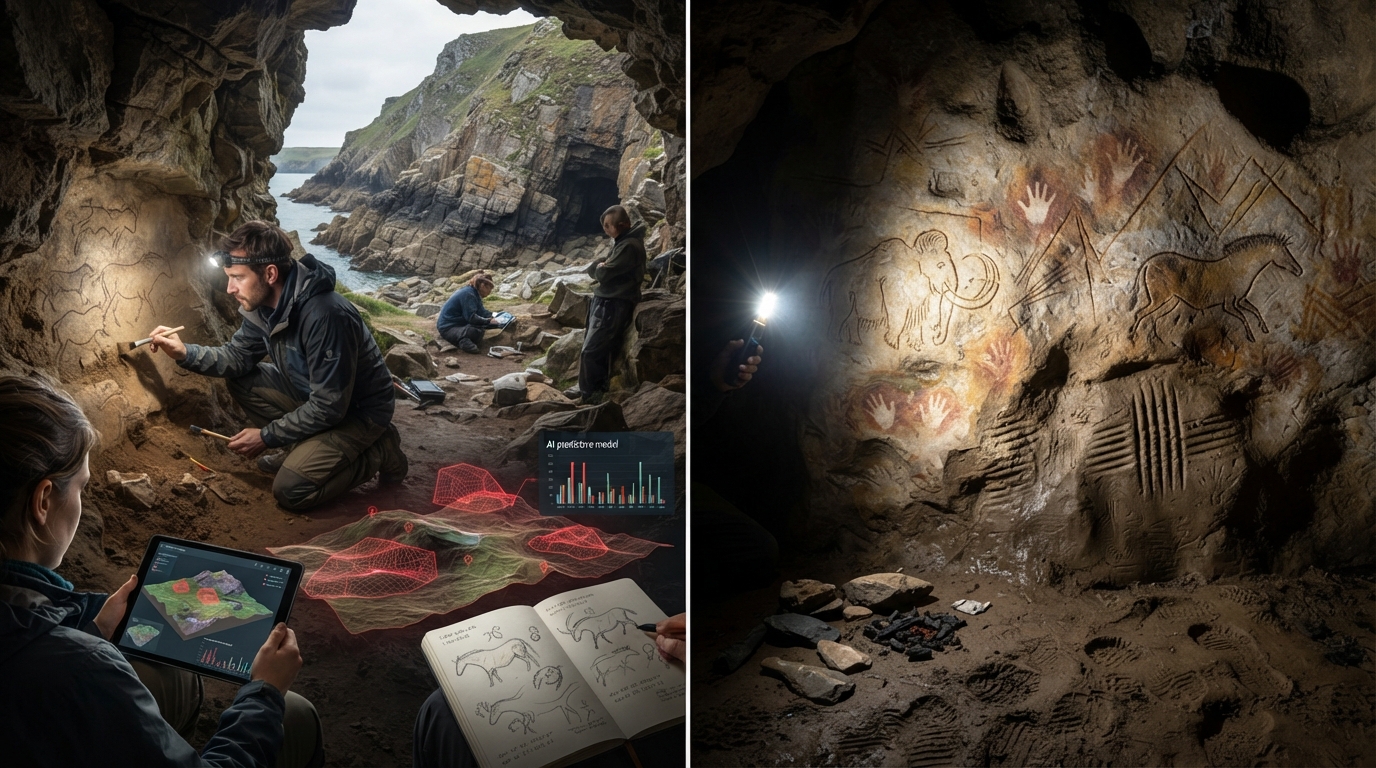
Ancient cave art find points to first known humans in Ireland having walked over from Wales
Researchers have helped uncover the earliest known evidence of human presence in Ireland
Researchers say the first known humans to arrive in Ireland thousands of years ago were most likely from Wales, after the “exciting” discovery of ancient cave art.
During the last Ice Age, when much of the British Isles lay under a huge continental glacier, falling sea levels exposed a “lost land bridge” linking modern-day Pembrokeshire with the south-east tip of Ireland, near Rosslare.
Rock specialist Dr George Nash of Liverpool University said the chances offered by this route would have been too attractive for hunter gatherers to pass up.
Working with an international team of experts, Nash has now identified eight cave sites in south-west Ireland containing rock art dating back at least 15,000 years, about 5,000 years earlier than the previous oldest evidence of humans in Ireland.
Nash, who led the Lost Land Bridge Project, said the route would have crossed a forested and grassland plateau about 46 miles (76 km) from coast to coast.
With summer temperatures typically -10°C to -20°C, Nash said the corridor would have supported wild horses, mammoth, bison, reindeer and other large herbivores feeding on hardy sedges, mosses and lichens growing in the fertile but near-frozen soil.
Nash said that throughout his career, based on what he had learned about human movement in that era, he had always believed it was unthinkable that people would not have taken advantage of the route.
That led him to bring together his multidisciplinary team of experts from University College Dublin and the University of Adelaide, as well as academics from Dubai, Wales and Portugal.
“Up until now the earliest evidence archaeologists had found - through accidental discovery - was from around 10,500 years ago, but everyone - not just me - knew that simply couldn't have been correct.
“We just weren't looking hard enough, and not in the right places. The principle we worked on was 'absence of proof isn't proof of absence'.”
He said progress in artificial intelligence (AI) had transformed the work.
“With the help of caving specialist Shane Diffily and digital mapping consultant Darren Lee, we were able to fill a computer algorithm with everything we knew about the characteristics of cave dwellings in south Wales and set it to work searching for similar sites in Ireland, without us trudging blindly around the countryside, hoping to bump into something which looked promising.”
The computer model produced 28 possible caves in south-west Ireland, which the team then examined.
Eight were found to contain cave art that they believe dates to at least 15,000 years ago and possibly much earlier, and about 5,000 years before the previous oldest evidence of humans in Ireland.
The team is currently unwilling to give a more exact location for the caves, fearing they could be vandalised or looted.
“We know that modern day south Wales was settled from around 35,000 to 40,000 years ago, by intrepid early modern humans from southern England, France and Spain, crossing the then dried-up land bridges of the English and Bristol Channels - seasonally settling in caves along the inhabitable strip of land stretching from Chepstow to St Davids,” said Nash.
“Over 20,000 years their art progressed from primitive line drawings which may have been early tally charts, to more figurative and representative depictions of the world around them, and what we've found in Ireland is yet another progression from that.”
The rock art uncovered by the Lost Land Bridge Project includes engravings on cave walls, paintings in ochre and charcoal, and line sketches pressed into clay and earth by fingertips.
Probably not meant to be permanent at the time, flutings made by three or four fingers gouged into soft layers of cave walls were likely early human children’s introduction to interpretive rock art
Nash believes the expanding population pushed humans ever farther west and north.
“There were around 100 human-inhabited caves on The Gower Peninsula for example, in a time when the technology didn't yet exist for human groups to create their own free-standing dwellings.
“The ambient temperature within these caves would have remained between 10°C and 15°C all year round, so with bearskin covers and fires at the entrance - which also helped to ward-off predators - it would have been quite a cosy place to live, especially compared with the -20°C outside.
“Competition for these caves would have been intense.
“As family networks grew, knowledge of how to survive by following animal migration routes improved and they must have become bolder.”
The Lost Land Bridge Project team believes there is strong potential for more discoveries in the future.
“The sites we've currently explored are in south-west Ireland, but it's illogical to presume that early humans just bypassed Wexford, Waterford and Cork, and ploughed on west,” said Nash.
“There must be more, and even earlier places which are just waiting for us to find them. This project is now pushing the boundaries of what we consider to be the final vestiges of a north-west European frontier. It's all very exciting.”