

"Vicious circle." Why don't new top clubs emerge?
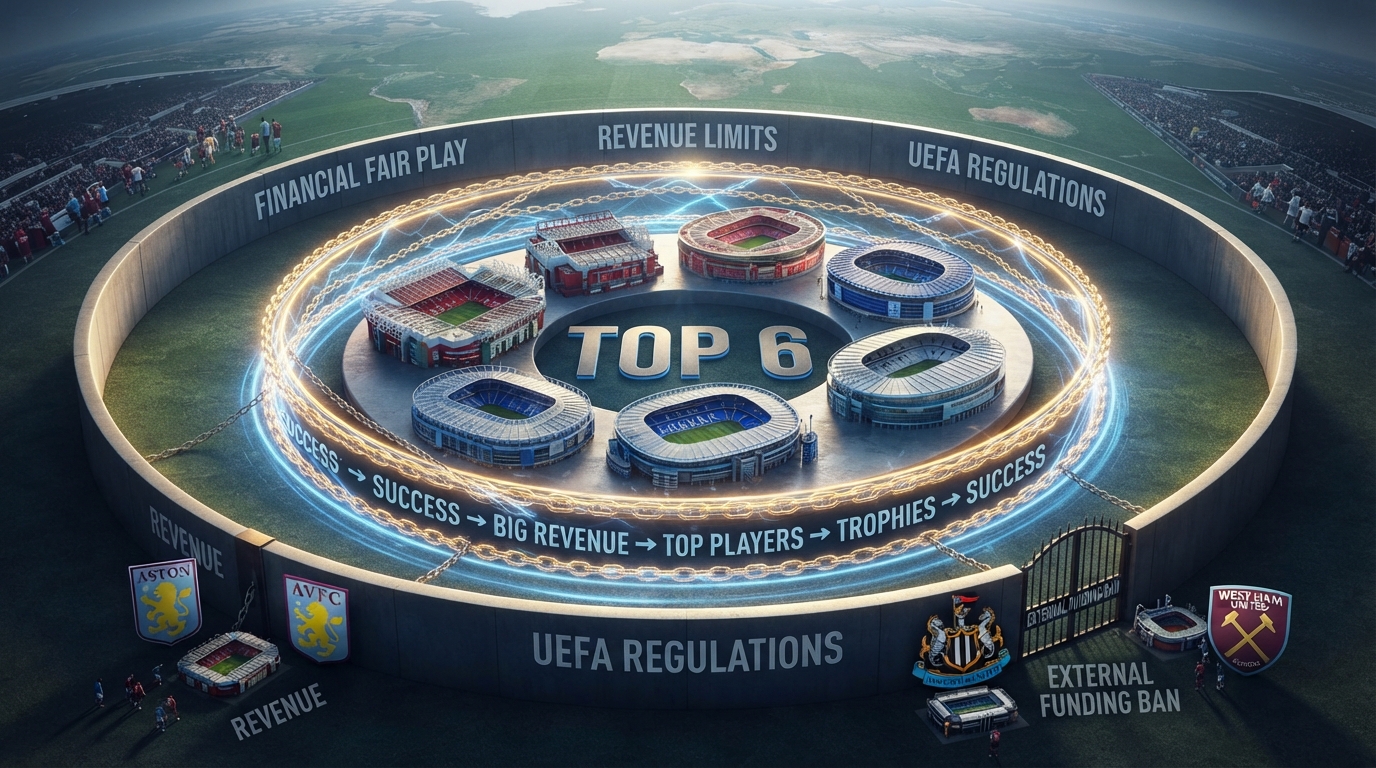
"Void Circle": Why are there no new top clubs?
In England, there is a traditional concept of "Top-6", which includes Manchester United, Liverpool, Arsenal, Chelsea, Manchester City and Tottenham. More than fifteen years ago, this list consisted of "Top-4". Later, Manchester City was bought by sheikhs and turned into a major club, and Tottenham also joined this circle. Interestingly, in the last seven years of the English championship, only once did these teams occupy the top six positions in the tournament table. In the remaining seasons, Leicester, Aston Villa, Newcastle and even West Ham managed to enter the top six. Nevertheless, the phrase "Top-6" is still used and is expected to remain so in the future.
For example, Aston Villa have finished the last three seasons in the Champions League zone, only missing out on goal difference in one. They have also won the Europa League. However, two of their key players - Morgan Rodgers to Chelsea and Youri Tielemans to Manchester United - have left. Luca Deeney is also in Paris, while Konsa could be snapped up by Arsenal. Villa may be a smaller club at the moment, but what about Newcastle? When Saudi investors bought the club a few years ago, they assured us that a new Manchester City project was emerging. We were even convinced that the project was being carried out more intelligently, as the squad gradually improved and the results improved. Here are the results since Eddie Howe arrived, that is, in the last five years:
[Photo: Opta]
Newcastle also performed well in the Champions League: they beat PSG, played well with Barcelona, and won the English League Cup. Last summer, they even tried to form an Ekitike-Isak pair in attack. They have not been without major transfers.
But look, this summer, Newcastle is also being "spoiled": Guimaraes went to Arsenal, Tonali to Tottenham, and Gordon to Barcelona. Eddie Howe is gone, now everything has to start from scratch. Why is this happening?
[Photo: Collage/"Daryo"]
When Abramovich bought Chelsea, the team was smaller than today's Newcastle or Villa. Manchester City was even smaller, and PSG did not have the influence in Europe that it does today. Why are projects that were successful at the beginning of the century not as successful today? What is wrong?
[Photo: Getty images]
We know that no one is making mistakes, it's just that in today's conditions it is almost impossible for a new top club to emerge, in my opinion. At the beginning of the century, Chelsea were as active as they are now, but every transfer they made was at the top level. They say that Manchester City sent Messi a blank check; although it is a bit of an exaggeration, many believed it, because the club's transfer policy was so aggressive. When investing in football became a prestigious business, such investors began to appear, and this began to worry the traditional top clubs that we know, including Bayern Munich, Real Madrid, Manchester United or Barcelona. These clubs, which, due to their good work in a certain crucial period, huge fan base and high football income, became hegemons in European football and took away everything from trophies to the best players every season, did not like new, radical investors. The forces were unequal: investors first used big money to win over the easiest thing - football stars - to their side, and then they began to compete on the football field, in the marketing market. Finally, a new generation of fans also paid attention - in every corner of the world you can often see young kids wearing the PSG or Manchester City jersey.
So, new rivals and additional competition began to worry the big clubs, who gradually took over UEFA. Naturally, constant balance and stability are also important for UEFA, and investors outside of football were destroying this stability. The same Chelsea project was also affected by crises such as Malaga and Portsmouth. So, expenses and income must be controlled.
The "Financial Fair Play" restrictions, which are often mentioned every summer in Europe, were gradually introduced from 2009 to 2013. The reason is that now, thanks to that foreign money, competition in football has increased, transfers and salaries have increased sharply, and clubs are forced to spend more than their income. By 2009, the total loss of the European top divisions had reached 1.6 billion euros. Continuing like this would put football at risk; if professional clubs competing with the Russian and Qatari rich continued to spend, the consequences would be even worse. It was considered better to clean football of foreign money and let it develop in a pure and natural way.
[Photo: Getty images]
That is, each club cannot spend more than the football revenue it generates. Abramovich cannot buy a player for Chelsea with the money he earns from his business. Chelsea can only earn money from broadcasting rights, marketing contracts, ticket sales and transfer sales, and only spend this money. Abramovich just needs to establish smart management. This control is also behind the 115 charges brought against Manchester City - allegedly the club overstated its income through fake contracts or understated expenses, brought in money from sponsors in various roundabout ways, etc. So, a new era has begun.
We know that, as always, there is another side to the coin. We say "football revenue", but its size is directly related to the fan base. The more fans a club has around the world, the higher the interest in it, the higher the club's chances of making money, right? The important thing is that in the 80s and 90s, the top clubs were already selected: the Italian, Spanish and English giants are known, of course, the whole world is their fan, shows interest in them. To get their share from here, the club needs to be very successful for several years, win several important trophies, and attract football stars. Chelsea became a very interesting team with Mourinho and attracted everyone's attention, Manchester City spent a lot of money on the squad and began to win trophies, Guardiola stabilized the team's victories, and PSG became a trophy machine under Enrique.
[Photo: Collage/"Daryo"]
Do you feel that a kind of vicious circle is emerging. A small club, for example, Newcastle, needs to compete for top positions and trophies for several years in order to reach the real top level. The way to compete for trophies is to fill the squad with strong players. And to attract strong players, you need to spend a lot of money. And to be able to spend a lot of money, the club needs to have a lot of football income. And for football income to be big, the club itself needs to be big. And for the club to be big... We go back to the beginning, the circle has closed. It is impossible to enter this closed circle. In the past, clubs would spend money from outside at the stage of "we need strong players to fight for top positions" and strengthen the squad, just like Chelsea or Manchester City. Now, if you can't spend that kind of money, of course you can't enter the circle.
[Photo: Premier league]
That is why, despite finishing 4th last season and qualifying for the Champions League, Aston Villa are forced to sell Morgan Rodgers to Chelsea. The reason is that Morgan Rodgers himself is a separate project: he also wants to grow as a player, win trophies. To keep him, Aston Villa needs to strengthen the squad, show Rodgers that they are ready to fight for the championship, for example. But the club does not have a lot of money to spend on new players, because there are no large marketing contracts or a huge fan base that generate income. Chelsea, on the other hand, could not even finish 10th last season, but they can give Rodgers that confidence, because regardless of which place Chelsea takes, they have a larger source of income than Villa. Villa will be forced to sell their leading players and replace them with others. It is difficult to achieve sustainable growth in this way, but even if it is maintained at a certain level, it will be considered a great success. At best, Aston Villa can fight for 4-5 places again, and therefore it will be considered a success.
[Photo: Chelsea]
You see, in the current conditions established in 2009, it is impossible for a new top club to emerge that would fight for all the trophies. Small clubs cannot suddenly earn huge football revenues. And it is impossible to bring in money from outside. What has happened has happened.