

UzTender: half of public procurement winners are new companies, while 161 companies secured 33 percent of contracts
The UzTender company describes the areas of opportunity available for new participants in Uzbekistan's public procurement, as well as methods to distinguish a fair tender from one tailored to a specific supplier within five minutes.
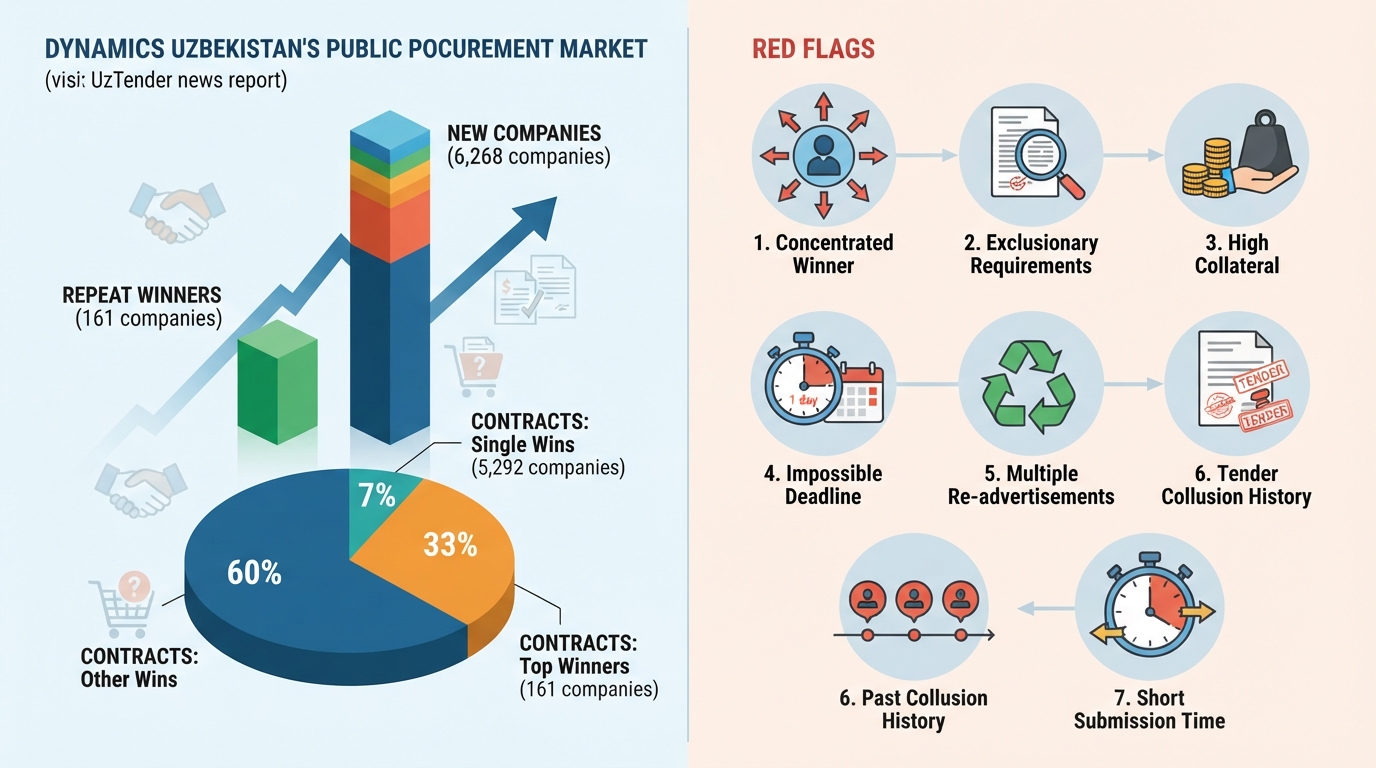
UzTender: half of public procurement winners are new companies, while 161 companies secured 33% of contracts
Over the last 12 months, Uzbekistan's public procurers concluded 75,123 contracts worth 60.6 trillion soums based on the results of tenders on xarid.uzex.uz, etender.uzex.uz, and other platforms. They were won by 11,947 companies, of which 6,268 (52%) had not won a single time in the previous two years. Half of the contracts are cheaper than 50 million soums: these are orders that even a small firm can easily compete for. UzTender looked into who is getting this money and how, and compiled seven red flags to recognize a lot "written for one's own" before submitting an application.
The median annual contract is 51 million soums. 50% of contracts are cheaper than 50 million soums, and 68% are cheaper than 200 million soums. Large construction projects occupy a significant place in the statistics, but by the number of orders, the market consists of small and medium supplies: stationery, fuel, repairs, design work, food, furniture.
Currently, 3,858 lots worth 2.3 trillion soums are open, two-thirds of which are up to 50 million soums. Nearly 570 new lots are published every working day.
There are also categories where orders are numerous and winners change from month to month: the market is not divided among two or three companies. In design and engineering services, 1,165 companies won 17,422 contracts in a year, with a median of 32 million soums. In electrical equipment, 378 companies won 2,112 contracts, with a median of 30 million soums. In such categories, a new company often wins its first contract.
Out of 11,947 winning companies, 6,268 had not won a single time in the previous 24 months: every second company has recently entered the procurement market.
There is also another side: 161 companies that won 50 or more times in a year secured 33% of all contracts. Companies that won 10 or more times account for 12% of the winners and 66% of the contracts. Meanwhile, 5,292 companies won only once, securing 7% of the contracts.
12% of companies receive two-thirds of contracts: share of companies and share of contracts by number of wins
Favoritism exists in procurement, and denying this is foolish. However, the bulk of the difference between 7% and 33% is explained not by favoritism, but by the process: companies with dozens of wins apply every week. They see the lot on the very day it is announced, their document package is ready, and they know the price corridor. Out of a thousand lots, they select three hundred, participate in one hundred, and win ten. This process is open to anyone who monitors the market daily.
A tender "written for one's own" is a procurement where only one pre-determined supplier can meet the conditions. The number of participants means nothing: both an honest lot and a rigged lot can have three participants. Other signs are more important, and all of them can be noticed before submitting an application.
The procurer awards the bulk of its contracts to a single supplier.
Example: Eyvalek Special Reinforced Concrete JSC concluded 583 contracts with 34 suppliers in a year. Of these, 323, or 55%, went to a single company, while three suppliers together secured 80%.
Concentration of a single procurer's suppliers: this is how it looks on the procurer's page
This is not always a violation: some procurers have a narrow specialization, and there are only two or three suppliers in the market. However, if 80% of contracts go to the same firm two years in a row, one must soberly assess the chances before spending a week on the application. In every eighth procurer out of 375 that conclude 20 or more contracts per year, one company receives more than half of the contracts, and in every sixteenth, it receives three-quarters or more.
In every eighth large procurer, one supplier receives more than half of the contracts
Requirements that do not describe the product, but rather exclude competitors.
A staff of dozens of specialists for a simple delivery, a specific brand without the words "or equivalent", a certificate that only one manufacturer in the country has.
The collateral for this category is much higher than usual.
When the median for the section is 1%, setting the bid security at 3% of the budget excludes not those who cannot handle the delivery, but those who do not have free funds.
Unfeasible delivery times.
Delivering equipment within one day after the contract can only be done by someone who knew about the lot in advance and has everything ready.
The lot is re-announced repeatedly until the desired company wins.
The bidding fails or another company wins, and the lot is re-announced with the same conditions. Often this is just a narrow market, but combined with the first sign, it is a clear signal.
In previous cycles, there was only one participant with this procurer.
If the same company comes year after year, no competition is to be expected there.
Less than three days to submit an application.
In 36% of lots in a year, less than three days were given to prepare an application, with a median of 4.2 days. Sometimes this is an urgent need. But a new document package cannot be assembled in two days, and the procurer knows this.
A single sign is not a verdict. But two together are a reason to bypass this lot. Concentration at the procurer, re-announcements, the ratio of collateral to the section median, disqualifying requirements, and submission deadlines are calculated automatically for each lot on UzTender, while checks for past cycles and delivery times will be added in the coming months.
The procurer announces the starting price, and the participants offer their price. A mistake of a new company is "to bid minus thirty to win for sure". Annual data on 35,000 procurements with a known starting price: in 14% of cases, the winner offered exactly the starting price, and in another 46% — 1-5% below it. The median discount is 5%, while discounts greater than 15% occur in only 7% of procurements.
There are also categories where bidding almost does not happen: in asset valuation, there were 1,371 procurements and 74 suppliers in a year, and every fourth procurement closed at exactly the starting price. The winner is not the one who bid minus thirty, but the one who submitted the application on time and met the requirements.
A practical guide is the range that includes the median and three-quarters of the winning price in similar procurements. On the lot card: the budget is 18 million soums, the median for 500 similar procurements is 15 million, the typical range is 10-25.3 million — meaning the price is at the market level and dumping is not necessary.
Market data on the lot: median and range of the winning price in similar procurements
Half of the lots remain open for less than five days. A company that logs onto the platform on Tuesday will not see half of the lots in its field: they are announced on Wednesday and closed on Friday. A winner with fifty contracts sees everything because they receive a notification as soon as it is announced. This is where the difference between 7% and 33% begins.
Open results of public tenders for the 12 months up to September 18, 2026: 75,987 contracts, of which the price is known for 75,123, with 11,947 winners and 4,226 procurers. The share of new companies is a lower-bound estimate: the history before September 2023 is not fully covered. The basis is the UzTender database: 489,000 tenders and 317,000 results from xarid.uzex.uz, etender.uzex.uz, tender-mc, and 31 other platforms.