

Uzbekistan's Startup Ecosystem: From 100 Fintech Projects to the First Unicorn – What's Happening in the Market
Uzbekistan is developing one of the most dynamic startup ecosystems in Central Asia, where the state is directly involved in venture capital financing and young teams compete for jobs at the Central Bank.
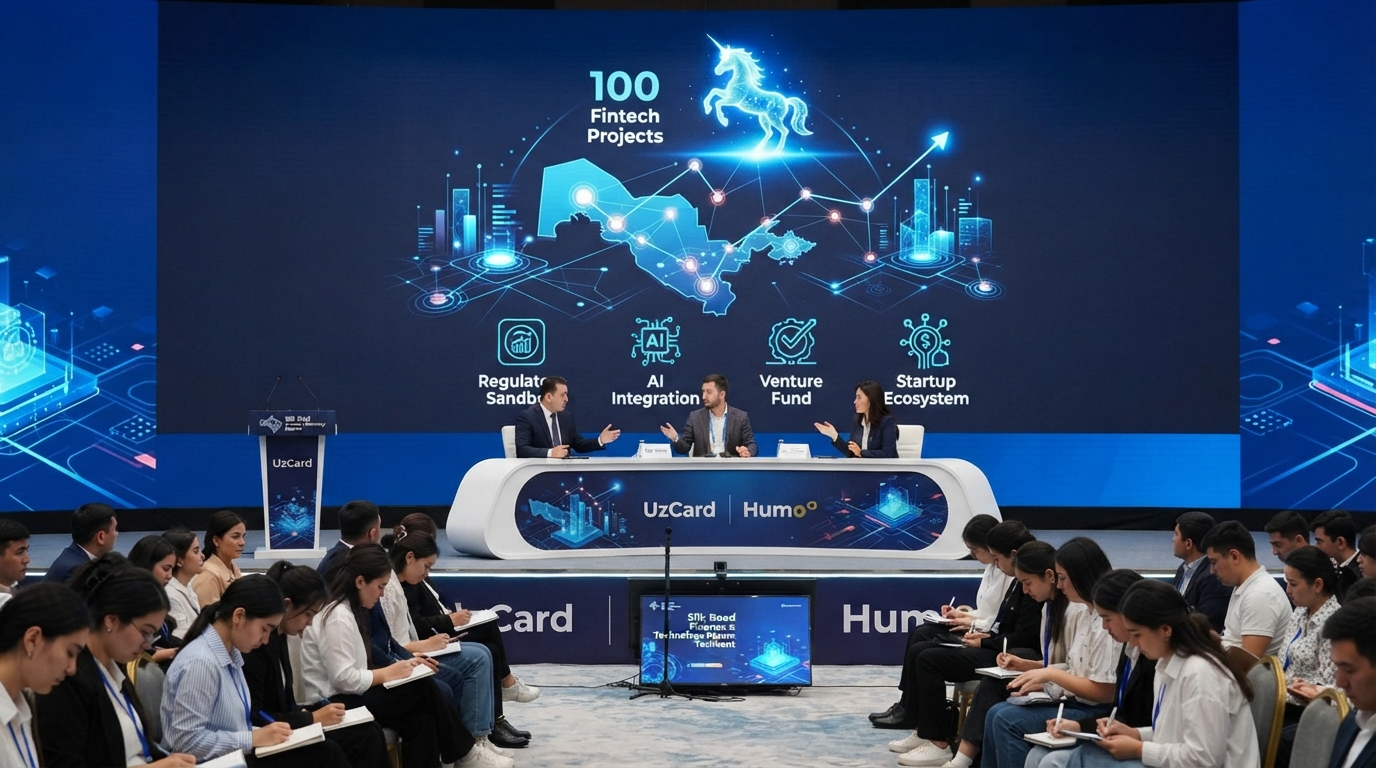
Uzbekistan's Startup Ecosystem: From 100 Fintech Projects to the First Unicorn – What's Happening in the Market
Uzbekistan is actively developing one of the most dynamic startup ecosystems in Central Asia, where the state directly participates in venture capital financing, and young teams compete for jobs at the Central Bank. This was evidenced by the speeches of government officials, institutional investors, and startup founders themselves at the Silk Road Finance & Technology Forum, held in Tashkent from August 24–26.
Market Figures
Bobur Khodjaev, Head of the Department of Financial Technologies, Digitalization, and Artificial Intelligence of the Presidential Administration, reported that there are approximately 100 fintech startups operating in the country, and the authorities intend to double this number by 2030. According to him, over $200 million in venture capital investments were attracted to Uzbek fintech startups last year, and the goal is to attract $1 billion to the sector by 2030.
**Fintech Ecosystem Around National Payment Systems**
Khojaev also noted that some innovations in the country are already being implemented around two national payment networks—UzCard and Humo—around which, he said, a broader fintech ecosystem is being built.
According to him, UzCard is focusing on artificial intelligence—in particular, AI scoring, anti-fraud systems, and consulting services—and is working closely with commercial banks in this area. Humo, in turn, is actively developing crypto assets: last year, the payment system issued tokens and is currently working on launching the country's first stablecoins.
"It's quite unusual for other countries to have two payment network systems," Khodjaev noted, adding that both companies are building fintech ecosystems around themselves, which are becoming a breeding ground for smaller startups.
**The First Unicorn and Three Startup Categories**
Nandan Mahanti, CEO of the Global Finance and Technology Network (GFTN), noted that the region has already seen the emergence of its first fintech unicorn, which has built its strategy on a fully digital model. He estimates that the Central Asian startup landscape is currently comprised of three categories of companies: technology providers helping regulated institutions accelerate digitalization; companies operating in the regulatory sandbox and seeking their own license; and global operators that have already achieved success in other markets and are entering the region.
According to Mahanti, three conditions are necessary for the successful development of a startup ecosystem: transparent corporate governance, which increases investor confidence; a developed digital public infrastructure on which startups can build products without major capital expenditures; and a cultural shift among young people from job seekers to job creators.
"In Asia, we've seen a significant shift from job seekers to job creators," he noted, adding that the presence of a state-developed payment and QR infrastructure in Uzbekistan lowers the barrier to entry for new startups.
Makhanti also drew attention to the Central Bank of Uzbekistan's decision to create its own venture fund, calling it an unprecedented step for the regulator.
"This is signal money. This demonstrates the central bank's intention to share the risk with a startup with a new idea," he stated.
**Central Bank Venture Fund**
Khojaev confirmed that the Central Bank has established a venture fund with $50 million in capital and is currently in talks to hire an external management company to administer it. Central Bank Chairman Timur Ishmetov, in turn, explained that the regulator's task is not to support every project, but to select fintech companies that can have a significant impact on the development of the financial market; direct management of the fund will be transferred to professional managers.
Earlier in the same speech, Khodjaev recalled that the National Fintech Strategy for 2026–2030 sets a goal of training 5,000 young specialists in fintech, and the Central Bank Innovation Hub will begin accepting its first cohort of residents in the fourth quarter of this year.
**Young Workforce and the Hunt for Talent**
Central Bank Chairman Timur Ishmetov explained how the regulator faced a shortage of IT specialists for a financial marketplace project and held a hackathon that brought together 40 teams—160 participants, mostly students. According to him, the winning team consisted of one banking risk manager and three students, and by the end of the event, approximately 80% of the participants had applied for jobs at the Central Bank.
"This was a huge revelation for me—we have so many talented young people," he noted.
Ishmetov said the regulator gained a similar experience by holding a monetary policy competition among universities: the participating students were already fluent in the models that Central Bank staff had needed support from the Swiss National Bank to master ten years earlier.
**A Startup Founder's Perspective**
Founder and entrepreneur Anastasia Yugova, who works at the intersection of fintech, agentic AI, and web3, noted during a panel discussion that the region doesn't experience a shortage of technology or capital per se—a technological product can be global from day one. Much more difficult, she says, is finding the path from a working prototype to launch in a specific regulated market: one needs to understand local payment mechanisms, partners, banking infrastructure, and compliance requirements, which vary greatly from country to country.
"Technology will inherently move faster than regulation, and it's impossible to completely close this gap... but precisely because we're developing ecosystems for startups, banks, and regulators, founders have more and more space to test new models together with regulators," she noted.