

Uzbekistan’s GDP grows 8.3% in January–September 2026
Uzbekistan’s gross domestic product (GDP) grew by 8.3% year-on-year in January–September 2026, reaching UZS 1,755.5 trillion at current prices, according to preliminary data released by the National Statistics Committee.
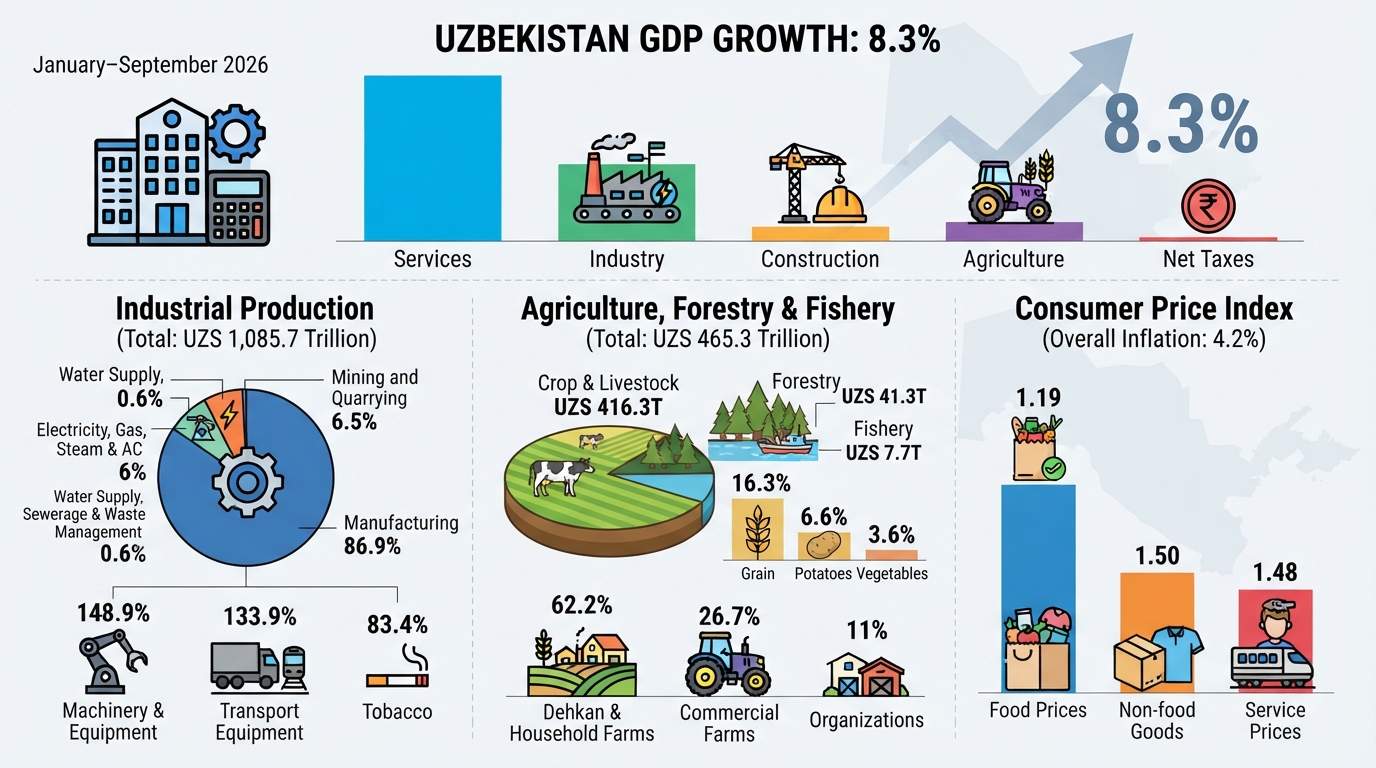
Uzbekistan’s GDP increased by 8.3% in January–September 2026.
The services sector was the biggest driver of economic growth, contributing 4.2 percentage points as output rose by 8.9%. Industry expanded by 8.1%, adding 2 percentage points, while construction grew by 12.5%, contributing 1 percentage point. Agriculture, forestry and fisheries increased by 4.6%, adding 0.7 percentage points, and net taxes on products rose by 8.4%, contributing a further 0.4 percentage points.
Industrial output totaled UZS 1,085.7 trillion in the first nine months, up 8.1% from the same period in 2025.
Manufacturing made up 86.9% of total industrial production, followed by mining and quarrying at 6.5%, electricity, gas, steam and air conditioning supply at 6%, and water supply, sewerage and waste management at 0.6%.
Manufacturing output climbed 8.6%, while electricity and gas supply and related activities rose by 10.1%. Mining and quarrying grew by 3.1%, and water supply, sewerage and waste management increased by 1.6%.
Within manufacturing, production of machinery and equipment not elsewhere classified rose to 148.9% of its level a year earlier. Output of other transport equipment reached 133.9%, while other manufactured goods increased to 132.3% of the previous year's level. Tobacco production, however, dropped to 83.4% of its January–September 2025 level.
Agricultural, forestry and fishery output and services amounted to UZS 465.3 trillion, up 4.6% year on year. Crop and livestock production, hunting and related services made up UZS 416.3 trillion, forestry UZS 41.3 trillion, and fisheries UZS 7.7 trillion.
Vegetable output increased by 3.6%, grain production by 16.3%, potatoes by 6.6% and melons and gourds by 4.5%.
Dehkan and household farms accounted for 62.2% of agricultural output, commercial farms for 26.7%, and organizations engaged in agricultural activities for 11%.
Consumer prices rose by 4.2% from January to September 2026. Food prices went up by an average of 2.9%, contributing 1.19 percentage points to overall inflation. Non-food goods became 4.6% more expensive, adding 1.50 percentage points, while service prices increased by 5.6%, contributing 1.48 percentage points.